A staff duress system that tells you exactly where — affordable to deploy or replace.
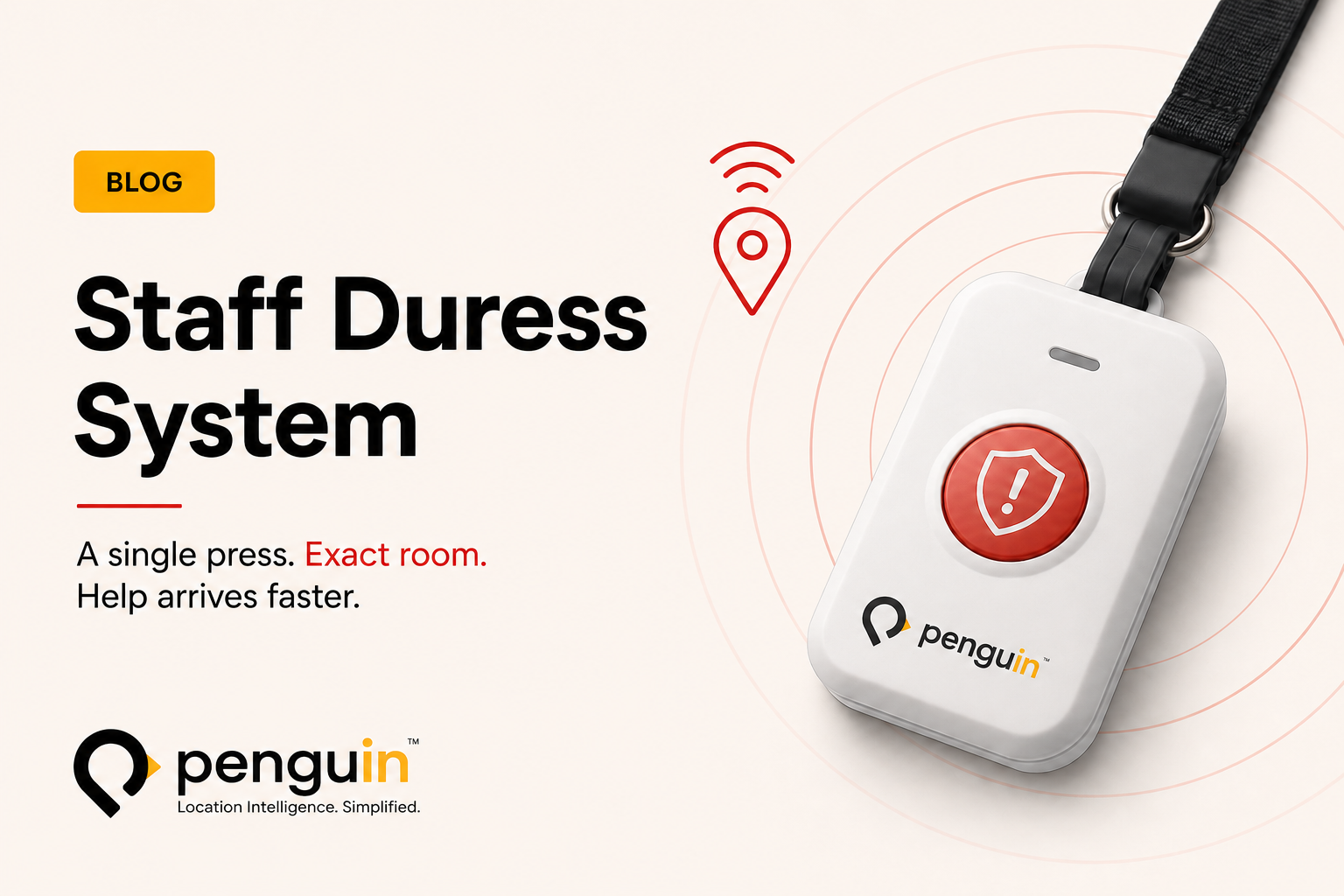
A staff duress badge is a wearable panic button for your team — and when a nurse or staff member calls for help, an alert alone isn’t enough — responders need to know which room, instantly. Penguin Location Services delivers room- and sub-meter accuracy with AI and BLE 5.1, so a single press turns into a precise location and a fast, coordinated response. And because it runs on AI and standard hardware instead of infrared in every room, it does this at a fraction of the cost of legacy duress systems. Here’s what a modern staff duress system does, what to look for, and when it’s time to replace an older one.
A duress button that only sends an alert tells responders something is wrong. A location-aware system tells them exactly where — turning “somewhere on the floor” into “room 412,” when seconds count.
How a modern staff duress system works
Three steps, with no thinking required from the person who needs help.
STEP 01
Press
A staff member presses their wearable badge — a discreet panic button that’s always on them, with no phone or app required.
STEP 02
Locate
The system fixes the exact room in real time and raises the alert on every responder’s device and dashboard.
STEP 03
Respond
Responders move straight to the location, and the event is logged automatically for review and reporting.
What to look for in a hospital staff duress system
If you’re evaluating options, these are the capabilities that separate a real safety system from a basic panic button.
Room-level location — responders get the exact room, not just a floor or wing.
One-press wearable badge — discreet, hands-free, always on the person.
Real-time response routing — the alert and location reach every responder instantly.
Integration — works with your nurse call, access control and security systems.
Automatic reporting — timestamped incident logs, response-time trends and location heat maps for review and compliance.
Rechargeable, non-proprietary badges — bought once and reused, with no locked-in tags or specialized batteries to keep buying.
One platform — the same system can add wander prevention, infant protection, asset tracking and wayfinding when you’re ready.
Signs it’s time to replace your current duress system
The biggest reason hospitals keep an aging duress system is the assumed cost of replacing it. Penguin changes that math: because it runs on AI and standard hardware instead of infrared in every room, replacing a legacy system typically costs a fraction of what you’d expect — and far less to run year over year. That makes acting on these common gaps easy to justify.
Replacing costs less than you think
A modern Penguin system typically runs a fraction of a legacy platform — up to ~60% lower total cost of ownership — with off-the-shelf rechargeable badges and no per-room infrared to buy or maintain. Often the reason to switch, not the reason to wait.
It only sends an alert
Responders know something happened, but not the exact room — costing the seconds that matter most.
No response-time data
You can’t show how fast your team responds or whether the program is improving — which reviewers increasingly expect.
Dead zones & costly upkeep
Coverage gaps erode staff trust, while proprietary tags and specialized batteries mean ongoing purchases and fleet-wide replacement work.
Meet PenSafe, by Penguin Location Services
PenSafe is Penguin’s staff safety and duress platform, built on BLE 5.1 and AI-powered location. It resolves the exact room a staff member is in — achieving sub-meter accuracy roughly 95% of the time and about 99% room-level accuracy where room-level certainty is required — without infrared or ultrasound hardware in every room. Badges are off-the-shelf and rechargeable, so you can source them from any supplier and reuse them. And because it’s one platform, the same infrastructure can grow into wander prevention, infant protection, asset tracking and wayfinding.
PenSafe’s analytics portal captures every event automatically — timestamped incident logs, location heat maps, and response-time trends — the kind of documentation safety and accreditation teams need, produced as a byproduct of the system doing its job.
Room-level staff duress, made affordable. Penguin delivers it for a fraction of the cost of legacy duress systems — up to ~60% lower total cost — because AI replaces the per-room infrared hardware and badges are off-the-shelf and rechargeable.
Based on customer-reported evaluations and Penguin deployment pricing. Total cost of ownership varies by facility, scope and integrations.
Why Penguin staff duress is more affordable
Affordability isn’t a discount — it’s the architecture. Three design choices put hospital-grade duress within reach of more facilities.
01
AI instead of infrared
Room-level accuracy comes from AI and BLE 5.1 — no infrared emitter to buy, mount and maintain in every room, and a faster, less disruptive install.
02
Off-the-shelf badges
Badges are standard and rechargeable — buy them from any supplier and reuse them. No proprietary tags or specialized batteries to keep purchasing.
03
One platform, shared cost
The same infrastructure also powers wander prevention, infant protection, asset tracking and wayfinding — so the cost is spread across many uses, not one.
Have questions about staff duress?
Whether you’re just exploring or comparing options, we’re happy to walk you through how it works and answer anything — no sales pitch.
Ask a question, request a walkthrough, or just see if it’s a fit.
Staff duress systems: common questions
What is a staff duress system?
A staff duress system lets a healthcare worker call for help quickly and discreetly — usually with a button on a wearable badge. A modern, location-aware system goes further: it identifies the exact room where the alert came from and routes responders there in real time, rather than just signaling that something happened somewhere.
How does a hospital staff duress system work?
A staff member presses the button on their badge; the system determines their exact location in real time and raises the alert on responders’ devices and dashboards; responders go straight to the room; and the event is logged automatically. With Penguin, location is resolved using AI and BLE 5.1 — no infrared or ultrasound emitters in every room.
What should a hospital staff duress system include?
Look for room-level location accuracy, a discreet one-press wearable badge, real-time response routing, integration with your nurse call and security systems, automatic reporting (incident logs, response-time trends and heat maps), and rechargeable, non-proprietary badges so you’re not locked into one vendor’s tags and batteries.
Why does room-level accuracy matter for staff duress?
In an emergency, responders need to know exactly where to go. A system that reports only a floor or wing forces them to search, wasting the seconds that matter most. Room-level accuracy sends help directly to the right room — which is why it’s a safety requirement, not an optional upgrade.
How do I know it’s time to replace our current duress system?
Common signs include: it only sends an alert without a precise location; it can’t produce response-time data or reports; it has coverage dead zones or frequent false alerts that erode staff trust; or it’s costly to maintain because of proprietary tags and specialized batteries. Any of these is a reason to re-evaluate.
Can a staff duress system integrate with our existing systems?
Yes. A modern platform like PenSafe integrates with nurse call systems, access control and security operations, so the alert-to-response workflow is captured in one place — and the same infrastructure can later support wander prevention, infant protection, asset tracking and wayfinding.
Is a staff duress badge the same as a panic button?
Essentially, yes — a staff duress badge is a wearable panic button designed for healthcare staff. The difference with a modern system is what happens after the press: instead of just sounding an alert, it pinpoints the exact room and routes responders there in real time, and logs the event automatically.
How much does a staff duress system cost?
It varies by facility size, the number of badges and the integrations you need. Penguin Location Services is designed to be a fraction of the cost of legacy duress systems — up to roughly 60% lower total cost of ownership — because it uses AI and standard hardware instead of infrared in every room, plus off-the-shelf rechargeable badges. The best way to get a real number is a quick estimate for your facility.
The RTLS accuracy hospitals need — powered by AI, at less than half the cost.
If you’re weighing a CenTrak quote, you already know the trade-offs of infrared-based RTLS: paying to put hardware in every room, non-standard batteries to replace across the fleet, and a disruptive install. Penguin Location Services delivers room- and sub-meter accuracy with AI and BLE 5.1 — far less to buy, install and maintain, deployed worldwide. Here’s the honest side-by-side.
Penguin Location Services delivers hospital-grade RTLS for less than half the total cost of legacy infrared systems — hardware and software combined.
Based on customer-reported evaluations and Penguin deployment pricing. Reflects total cost of ownership across hardware and software; individual results vary by facility, scope and configuration.
Penguin Location Services vs CenTrak, compared
Two capable healthcare RTLS platforms. The real divergence is the technology approach — and everything it drives downstream in hardware, software, batteries and total cost.
Dimension
Penguin Location Services BLE 5.1 + AI location intelligence
CenTrak Multi-mode Clinical-Grade RTLS™
Core locating technology
Proprietary BLE 5.1 engine. AI/ML resolves location from the full pattern of signals across multiple antennas (spatial diversity) — accurate in multipath, without relying on explicit angle-of-arrival.
Multi-mode infrared hybrid. Second-Generation Infrared (Gen2IR™) plus Low-Frequency RF, UHF Active RFID, Wi-Fi and BLE.
How room-level is achieved
AI on standard BLE. Room- and sub-meter accuracy computed in software — no infrared or ultrasound emitters required.
Infrared in every room. An infrared emitter is placed in each room, since IR light doesn’t pass through walls.
Accuracy
Sub-meter ~95% · room-level ~99%. Sub-meter the majority of the time, with ~99% room-level accuracy where room-level certainty is required.
Room- & bed-level. Certainty-based room- and bed-level location via infrared.
Badges & tags
Rechargeable · ~3× lower cost. Off-the-shelf, rechargeable badges you can buy from any supplier — roughly a third the cost of proprietary tags.
Proprietary badges. Purpose-built battery-powered badges, purchased from the vendor.
Batteries
Recharge & reuse. Rechargeable badges, bought once and reused — no consumable batteries to purchase.
Specialized batteries. Non-standard lithium cells (not off-the-shelf) — a recurring purchase and fleet-wide replacement task; CenTrak offers it as a managed service.
Infrastructure
Penguin locator dev kit. Penguin’s own locator hardware replaces gateways at about a third of the cost (~3× cheaper). Wiring is comparable — the device cost is where you save.
Gateways + in-room devices. Wired gateways and in-room repeaters, plus battery-operated in-room beacons (Monitors, Virtual Walls™).
Software & licensing
Modern AI SaaS. A single AI-driven platform licensed at a fraction of a legacy RTLS platform — a major part of the total-cost gap.
Accessible by design. Less than half the total cost across hardware and software — built to remove cost as the #1 barrier to RTLS adoption.
Proprietary ecosystem. Tags, badges, hardware and software purchased from the vendor.
Penguin details from penguinin.com. CenTrak details from CenTrak’s published materials at centrak.com, current as of 2026. CenTrak®, Gen2IR™, Virtual Walls™ and Clinical-Grade RTLS™ are trademarks of CenTrak, Inc. Provided for informational purposes; verify current specifications with each vendor.
One platform, every use case
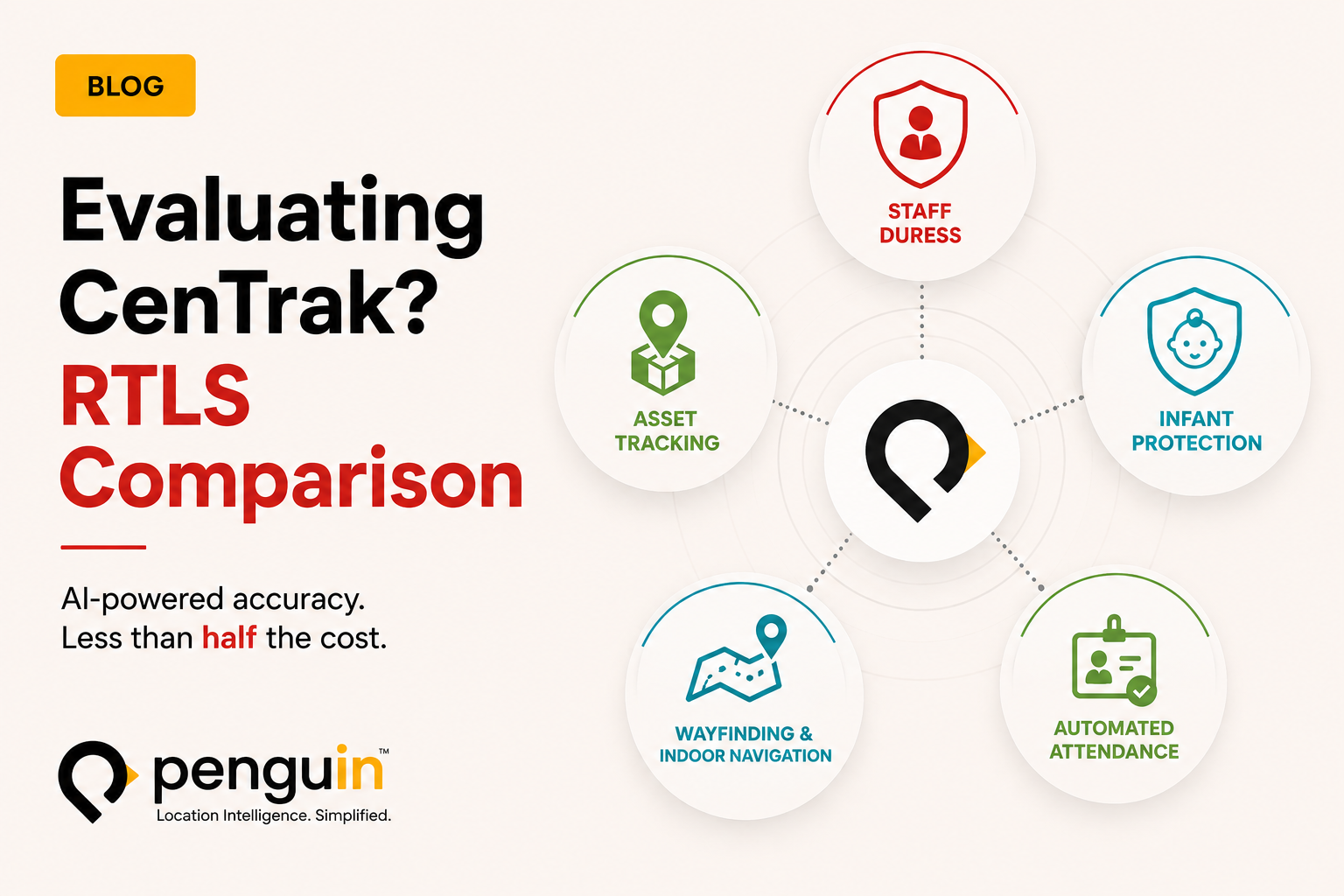
The same AI-driven Penguin infrastructure powers a full range of hospital location services — so you can start with one and add the rest without new hardware.
Staff duress
Instant, room-level alerts when a team member presses their badge.
Asset tracking
Find pumps, wheelchairs and equipment in seconds, not hours.
Infant protection
Tamper-aware monitoring and exit control for mother-baby units.
Wayfinding & indoor navigation
Turn-by-turn navigation that gets patients and visitors to the right door.
Automated attendance
Accurate, touch-free staff and patient presence records.
Wander prevention
Protect at-risk patients and residents at every exit.
The trade-offs of infrared RTLS — and how Penguin answers them
These aren’t knocks on CenTrak; they’re the built-in trade-offs of an infrared architecture. Here’s what evaluators raise most — and how Penguin Location Services’ AI-driven approach removes each one.
01
The quote is the shock
Infrared hardware in every room, plus proprietary software.
Penguin comes in at less than half the total cost — hardware and software combined — because AI replaces the per-room infrastructure, the software is a fraction of a legacy license, and Penguin takes no margin on hardware.
02
Locked to one vendor
Proprietary tags and non-standard batteries to keep buying.
Penguin badges are off-the-shelf and rechargeable — buy them from any supplier, recharge and reuse. No proprietary tags tied to one vendor, no specialized batteries, no fleet-wide replacement program to fund and staff.
03
Hardware in every room
Infrared needs an emitter per room, and a disruptive install.
Penguin gets room- and sub-meter accuracy from AI and BLE 5.1 — nothing to mount in every room, and a faster, less disruptive path to going live.
What accessible RTLS looks like — an example
Illustrative first-year total cost for a typical 200-bed hospital tracking 1,000 assets with 500 badges. Not a CenTrak quote — real pricing depends on your building and scope.
Legacy infrared RTLS (typical)
~$210,000
Penguin Location Services
~$77,000
≈ 63% lower first-year cost
Illustrative model using typical per-unit costs (in-room devices/gateways, tags, badges and first-year software/maintenance). Ask for an exact estimate for your facility below.
Get your free RTLS estimate
Tell us about your facility and we’ll send a tailored estimate — plus help with your RFP or a replacement-cost analysis against your current CenTrak quote. No obligation.
Penguin Location Services vs CenTrak: common questions
Is there a lower-cost alternative to CenTrak for hospital RTLS?
Yes. Penguin Location Services is an AI-driven RTLS built on BLE 5.1 that delivers room- and sub-meter accuracy at less than half the total cost of legacy infrared systems like CenTrak — across hardware and software combined — because it replaces per-room infrared infrastructure with AI and takes no margin on hardware.
How is Penguin’s technology different from CenTrak’s?
CenTrak reaches room level using Second-Generation Infrared (Gen2IR) with an emitter in each room, as part of a multi-mode hybrid (infrared, RF, UHF RFID, Wi-Fi, BLE). Penguin uses BLE 5.1 with proprietary AI/ML algorithms that resolve location from the full pattern of signals across multiple antennas — achieving room- and sub-meter accuracy without infrared or ultrasound.
Can I buy Penguin badges from any vendor?
Yes. Penguin badges are off-the-shelf and rechargeable, so you can source them from any supplier at roughly a third the cost of proprietary tags — with no vendor lock-in, no specialized batteries to keep buying, and no fleet-wide battery-replacement program.
Does Penguin require infrared hardware in every room like CenTrak?
No. Because Penguin achieves room- and sub-meter accuracy in software with AI and BLE 5.1, there is no infrared emitter to buy, mount and maintain in every room — which means lower cost and a faster, less disruptive installation.
How do CenTrak badges compare to Penguin’s?
CenTrak uses proprietary, battery-powered badges purchased from the vendor, with specialized (non-standard) replaceable batteries. Penguin Location Services uses off-the-shelf rechargeable badges you can buy from any supplier at roughly a third the cost — with no vendor lock-in and no consumable batteries to keep replacing.
Does Penguin cost less than CenTrak RTLS?
In customer-reported evaluations, Penguin Location Services has come in at less than half the total cost of legacy infrared RTLS across hardware and software combined — because AI replaces per-room infrared infrastructure, the software is a fraction of a legacy license, and Penguin takes no margin on hardware.
What use cases does Penguin’s RTLS support?
Penguin runs staff duress, asset tracking, infant protection, wander prevention, wayfinding and indoor navigation, and automated attendance — all on one AI-driven BLE 5.1 platform. Because they share the same infrastructure, you can start with one use case and add others without new hardware.
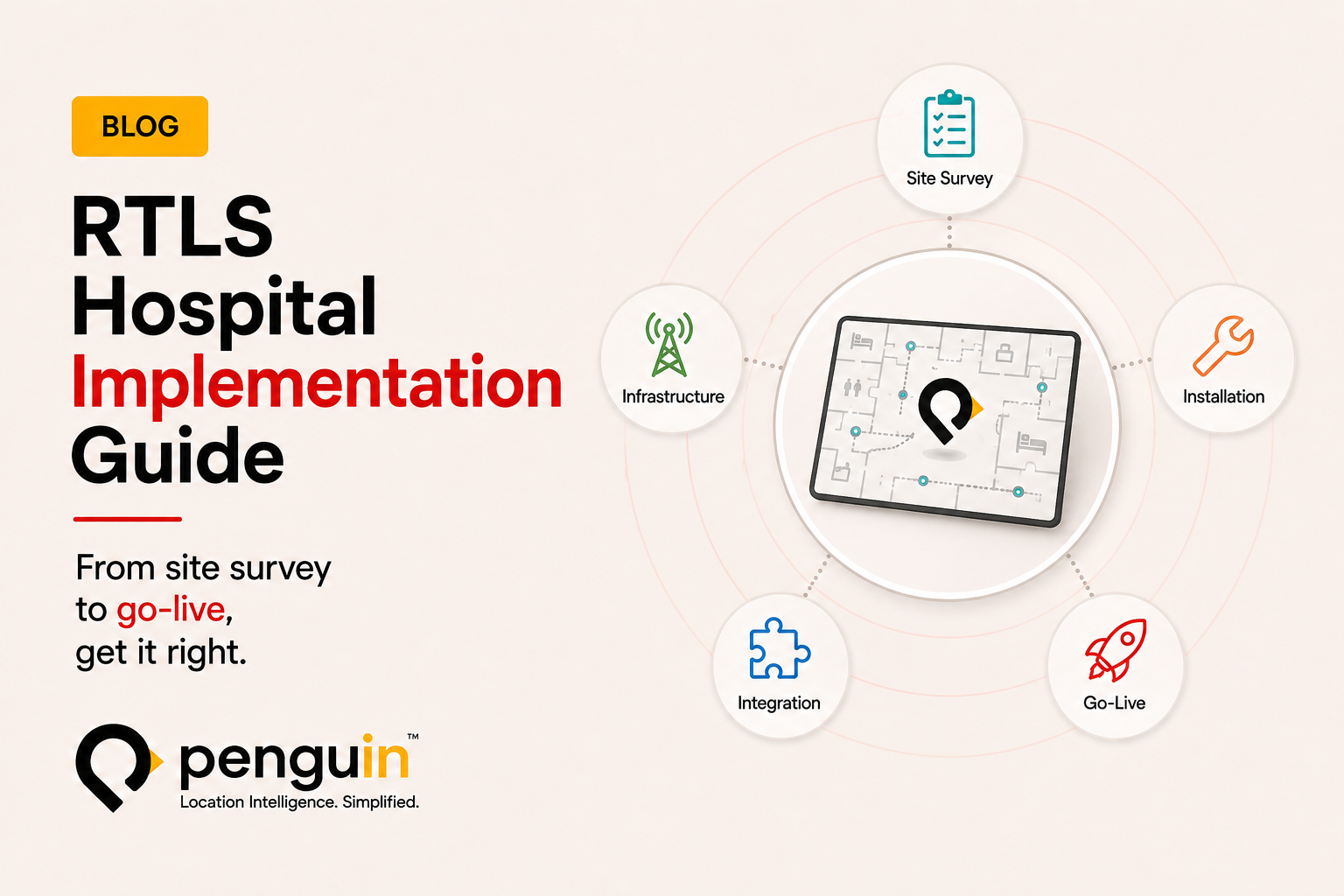
A hospital RTLS deployment follows five phases: site survey, infrastructure validation, gateway installation and tag deployment, system integration, and go-live. The full sequence takes 8 to 24 weeks depending on facility size and existing infrastructure. That range is not a vendor estimate, it is what real IT directors encounter once they are accountable for the project plan.
The problem is not the technology. The problem is that no one tells you, before you sign the contract, who owns what. Hospital IT thinks the vendor handles infrastructure. The vendor thinks hospital IT has already opened the firewall ports. Clinical engineering assumes someone else completed the device inventory. Meanwhile, the go-live date slips by six weeks and the CFO wants answers.
This guide covers what each of the five phases actually requires, which tasks belong to hospital IT versus clinical engineering versus the vendor, what your infrastructure must look like before a single gateway goes on the wall, how CMMS integration works at a workflow level, and what the documented ROI numbers from the field look like. Use it to build your project plan, or to pressure-test the one your vendor already gave you.
Key Takeaways
Full hospital RTLS deployment takes 8 to 24 weeks depending on facility size and infrastructure readiness.
Hospitals with BLE-enabled Wi-Fi 6 already in place can reduce deployment time by 40 to 60 percent.
A major health system in North Carolina documented $10 million in annual savings from RTLS asset tracking, as reported by HIT Consultant.
Nurses spend up to 60 minutes per shift searching for equipment, according to HIMSS.
A responsibility matrix, not just a vendor timeline, is the single most important document an IT director can request before signing.
CMMS integration is where the long-term ROI lives: equipment leaves a room, a work order triggers automatically.
What Does an RTLS Hospital Implementation Actually Involve?
Real-time location systems (RTLS) in hospitals use hardware tags attached to equipment or worn by staff, gateways mounted on ceilings or walls to receive tag signals, and a software layer that translates those signals into location data displayed on a live map. The practical result: a nurse can see exactly where the nearest available IV pump is without leaving the floor.
Every implementation, regardless of vendor or facility size, moves through the same five phases. The phases are sequential, skipping or compressing any one of them is the primary reason hospital RTLS projects run late or fail to achieve expected accuracy at go-live.
According to HIMSS, inefficient medical equipment management costs US hospitals $14 billion annually. Nurses spend up to 60 minutes per shift searching for lost equipment. The operational problem is real. The technology works. The implementation execution is where hospitals leave money on the table.
Only 20% of healthcare facilities have deployed RTLS to date, according to Penguin’s AI and Location Intelligence whitepaper. The gap between the known ROI and actual adoption comes down to one word: complexity. A structured deployment framework closes that gap.
Why So Many RTLS Deployments Run Late, and How to Avoid It
The most common cause of delayed RTLS go-lives is infrastructure assumption. Vendors quote aggressive timelines, sometimes as short as two weeks, that are only achievable when a specific infrastructure condition is already met: BLE-enabled Wi-Fi 6 access points, live and configured, across the entire facility. When that infrastructure is not in place, the two-week estimate becomes a twelve-week scramble.
The second most common cause is role ambiguity. In a typical hospital RTLS project, three internal teams and one vendor are involved: hospital IT, clinical engineering, biomed, and the RTLS vendor. Without a written responsibility matrix assigned before kickoff, tasks fall through the gaps between teams.
The single document that determines whether an RTLS deployment finishes on time is not the vendor’s implementation guide. It is the responsibility matrix, the one that names exactly which team owns each task in each phase.
For deeper context on how hospital asset tracking with BLE compares to earlier infrastructure approaches, and why the infrastructure gap exists, that background informs every timeline discussion you will have with a vendor.
A hospital with Wi-Fi 6 and BLE radio already enabled across its facility can reduce deployment time by 40 to 60 percent compared to a facility starting from a legacy Wi-Fi 4 or 5 baseline. That is not a marketing claim. It is a direct consequence of skipping Phase 1 remediation work.
Phase 1, Site Survey and Infrastructure Assessment
What happens: The vendor conducts a physical walkthrough of every space in scope. Hospital IT confirms network readiness. Clinical engineering completes the device inventory. Duration: 1–3 weeks for a 200-bed facility; 3–5 weeks for a 500-bed facility or multi-building campus.
Infrastructure Prerequisites Checklist
Every item on this list must be confirmed before Phase 2 begins. If it is not confirmed, document the gap and schedule remediation as a Phase 1 deliverable.
BLE 5.1-compatible access points: This means 802.11ax (Wi-Fi 6) access points with the BLE radio enabled in firmware. Wi-Fi 6 hardware that has BLE disabled at the firmware level does not count. Confirm with your network vendor before the site survey date.
VLAN configuration for IoT devices: RTLS tags and gateways communicate on the network. They need a dedicated IoT VLAN, isolated from clinical systems, with appropriate QoS settings. Your IT team owns this, not the vendor.
Gateway power source: Most modern BLE gateways run on PoE (Power over Ethernet). Confirm that ceiling drops in the target areas support PoE. Where they do not, AC power with a secondary adapter is an option, but it adds installation time and cost.
Server or cloud instance provisioning: The RTLS software layer needs a home. Cloud deployment is faster. On-premises requires a server provisioned, racked, and connected to the network before gateway installation begins.
Firewall rules: Tag-to-gateway and gateway-to-server communication requires specific ports open. The vendor provides the port list. Hospital IT opens and validates the rules. This task is frequently missed until a gateway goes live and no data appears on the dashboard.
Device inventory: Clinical engineering completes a full audit of which equipment categories receive tags, IV pumps, infusion stations, wheelchairs, stretchers, portable monitors, and how many units exist per category. Incomplete inventories cause tag quantity errors that delay procurement and push go-live by weeks.
Explore Penguin’s hospital asset tracking solutions for a complete picture of what asset categories benefit most from RTLS tagging at each accuracy tier.
Behavioral Health Units: Modified Phase 1 Requirements
Behavioral health units require a different site survey protocol. Gateway density must be higher, typically 1 gateway per 400–600 square feet rather than the standard 800–1,000 square feet, because sub-room accuracy within a single ward is a life-safety requirement for staff duress scenarios. The Phase 1 survey must map seclusion rooms, elopement risk corridors, and staff-only access points separately. Staff training requirements in Phase 4 also differ for behavioral health teams.
Phase 2, Gateway Installation and Tag Deployment
What happens: The vendor designs gateway placement based on the Phase 1 site survey. Facilities installs gateways. Tags are programmed and assigned to assets. Duration: 2–4 weeks for a 200-bed facility; 4–8 weeks at scale.
Gateway Density: What the Numbers Mean
Gateway density directly determines location accuracy. Zone-level accuracy, knowing which room an asset is in, requires roughly one gateway per 800 to 1,000 square feet in standard hospital construction. Sub-room accuracy, needed for workflow automation and staff duress, requires higher density: one gateway per 400 to 600 square feet.
Thick concrete walls, masonry construction, and seclusion room shielding all reduce effective gateway range. The site survey heat map from Phase 1 should identify these areas and flag them for increased density. Skipping this step is the most common cause of accuracy complaints after go-live.
Tag programming happens in parallel with gateway installation. Each tag is assigned an asset ID that maps to a record in your CMMS or EHR. This mapping must be validated before go-live, an asset tagged with the wrong ID produces location data that is worse than useless in an emergency.
Phase 3, EHR, CMMS, and Nurse Call Integration
What happens: The RTLS software connects to the hospital’s existing clinical and operational systems. Duration: 2–4 weeks, often running in parallel with late-stage Phase 2 work. This phase has the highest failure risk of any phase, and the highest long-term value when done correctly.
EHR Integration
EHR integration links location data to patient records and clinical workflows. HL7 is the messaging standard that governs this connection. Your EHR vendor’s integration team must provide API access credentials and sandbox environment access before the RTLS vendor can begin configuration. Hospital IT owns the process of obtaining these credentials, the vendor cannot request them on your behalf.
The practical output of EHR integration is asset availability displayed in clinical context. A nurse checking the EHR for a patient’s IV pump order can see, in the same interface, whether the pump assigned to that patient is in the room or was pulled for another patient two floors up.
CMMS Integration: Where the Long-Term ROI Lives
CMMS integration is the most underrated component of a hospital RTLS deployment, and the most skipped. Here is what it actually does in practice.
When a tagged IV pump leaves the ICU and enters a soiled utility room, the RTLS system logs that event. If that pump has been in circulation for 90 days since its last PM (preventive maintenance), the RTLS event triggers a work order in the CMMS automatically. The biomed engineer does not search for the pump. The CMMS already knows where it is and has pre-assigned the work order to the next available tech.
When the pump moves from the soiled utility room to the biomed shop, the RTLS logs that transition. When it returns to the clean equipment room, a second event updates the CMMS record. The entire maintenance lifecycle, from trigger to return, is documented without a single manual entry.
This is why 50% of IV pumps sitting idle most of the day in a typical hospital, according to Penguin’s AI and Location Intelligence whitepaper, is both a problem and an opportunity. The idle pump is not being maintained because no one knows it needs it. CMMS integration closes that loop.
For a detailed breakdown of how RTLS event data connects to CMMS workflows and biomed dashboards, the guide on how RTLS integrates with hospital CMMS platforms covers the technical and operational specifics in full.
CMMS API integration works across most enterprise CMMS platforms via standard REST API calls. The RTLS vendor configures the event rules, which location transitions trigger which work order types. Clinical engineering defines the maintenance rules, which equipment categories, which PM intervals, which priority levels. Both teams must be in the same room for this configuration session.
Nurse Call Integration
Nurse call integration routes RTLS-generated alerts, staff duress events, equipment boundary violations, wander-prevention triggers, through the existing nurse call infrastructure. This avoids adding a parallel notification system and uses the communication channels nurses already trust. The vendor connects to the nurse call API. Hospital IT validates that the alert routing rules match the facility’s emergency response protocols.
Phase 4, Staff Training and Go-Live
What happens: The vendor delivers role-specific training. The system enters a parallel-run period. Go-live is declared when accuracy benchmarks and alert workflows are validated. Duration: 1–3 weeks.
Training should never be a single all-staff session. Different roles need different content. Nurses need to know how to read the asset map and interpret location alerts. Biomed engineers need to understand the CMMS integration dashboard and how to validate work order triggers. Security teams need to know how to respond to duress alerts, including how to read room-level location data under time pressure.
The parallel-run period, typically one to two weeks, runs the RTLS system live while staff continue using existing tracking methods. This surfaces accuracy gaps before the old methods are retired. Any zone with accuracy below the agreed benchmark triggers a gateway density review before the old method is turned off.
Go-live is not the end of the project. Battery management, tag replacement cycles, and NIST certification cycles for location accuracy all begin at go-live. The service tier SLA your vendor offers determines how these ongoing requirements are handled, and the cost difference between SLA tiers frequently exceeds the hardware cost difference between vendors.
Who Owns What? The IT, Clinical Engineering, and Vendor Responsibility Matrix
Print this. Put it in the project kickoff deck. Assign a named owner to every row before the contract is signed.
Hospital IT Owns
Network readiness validation, confirming BLE 5.1-capable access points are live and BLE radio is enabled in firmware across all zones in scope.
IoT VLAN configuration, creating and configuring the isolated network segment for RTLS gateways and tags, including QoS rules.
Firewall rule implementation, opening the specific ports required for tag-to-gateway-to-server communication, as specified by the vendor’s network requirements document.
Server or cloud instance provisioning, standing up the environment where the RTLS software layer runs before gateway installation begins.
EHR API access credentials, obtaining sandbox and production API access from the EHR vendor’s integration team and providing them to the RTLS vendor at the Phase 3 kickoff.
Ongoing network monitoring, post go-live, IT monitors gateway connectivity and flags any access point firmware updates that could affect BLE radio function.
Clinical Engineering Owns
Device inventory audit, a complete, categorized count of every asset category receiving a tag, with current CMMS asset IDs for each unit. This is the document that determines tag quantities for procurement.
CMMS maintenance rule configuration, defining which equipment categories trigger which PM work orders at which intervals, and what priority level each work order carries in the CMMS queue.
Biomed integration requirements sign-off, clinical engineering signs off on the CMMS integration configuration before go-live, confirming that automated work order triggers match actual maintenance protocols.
Tag-to-asset mapping validation, confirming that each physical tag is correctly matched to the right CMMS asset record before go-live. A single mismatch here creates downstream maintenance documentation errors.
Post-go-live battery management, tracking tag battery life and scheduling replacement cycles. For facilities using rechargeable tags, clinical engineering manages the charging schedule.
Vendor Owns
Site survey and heat map production, walking every space in scope, mapping RF signal propagation, identifying density gaps caused by wall construction, and producing a gateway placement design document.
Gateway placement design, specifying the exact location, mounting height, and orientation of each gateway, with density adjusted for accuracy tier requirements in each zone.
Tag programming and configuration, programming each tag with the appropriate beacon interval, asset ID, and alert rule parameters before distribution to clinical engineering for physical assignment.
Software configuration, setting up the RTLS platform, map layers, alert rules, dashboard views, and user roles before go-live.
Training delivery, delivering role-specific training for nurses, biomed engineers, security staff, and administrators, with separate sessions for each role.
Go-live support, staffing the deployment with a technical resource on-site for the duration of the parallel-run period, resolving accuracy gaps before the legacy tracking method is retired.
SLA-covered post-go-live support, covering battery management alerts, firmware updates, accuracy recertification cycles, and integration troubleshooting under the agreed service tier.
How Penguin’s PenTrack Platform Simplifies Hospital RTLS Deployment
Penguin’s PenTrack asset tracking platform is built on BLE 5.1 hardware with an AI/ML location algorithm at its core. The algorithm, based on the MUSIC (Multiple Signal Classification) approach, analyzes signals across all antenna elements simultaneously rather than relying on a single angle estimate. In plain English: instead of asking “what angle did this signal arrive from?”, the algorithm asks “what does the complete picture of signals across all antennas tell us about where this tag is?” The result is room-level and sub-room accuracy on standard, off-the-shelf BLE 5.1 hardware.
This matters most in the environments where accuracy is hardest to achieve: thick-walled ICUs, shielded procedure rooms, and behavioral health units with seclusion room construction. The MUSIC algorithm resolves location in high-multipath environments, where signals bounce off walls, floors, and ceilings, without requiring proprietary supplemental hardware.
PenTrack operates across a location accuracy continuum. Presence detection gives floor-level and building-level awareness. Asset tracking delivers zone and room-level accuracy. Workflow-level tracking achieves sub-room precision, bed-level, bay-level, for clinical workflow automation. Hospitals can start at any tier and expand accuracy by adding low-cost BLE beacons and locators without replacing the core infrastructure.
The Penguin deployment model maps directly to the five-phase framework above. Site survey and gateway placement design are Penguin deliverables. The hospital IT team handles network readiness and firewall configuration with Penguin’s infrastructure requirements document as the guide. Integration connects to EHR, CMMS, nurse call, and access control systems through standard APIs and HL7.
For safety-critical applications, staff duress, wander prevention, infant protection, PenTrack works alongside PenSafe, Penguin’s safety-oriented product line, using the same BLE 5.1 infrastructure investment across both asset tracking and staff safety use cases.
What Does RTLS Implementation Cost, and When Does It Pay Off?
A 200-bed hospital deploying RTLS on a modern BLE 5.1 infrastructure can expect total project costs in the range of $300,000 to $500,000. That figure includes hardware (gateways, tags, any PoE infrastructure upgrades), software licensing, integration work, and go-live support. Facilities upgrading from legacy proprietary RTLS systems, which required infrared or ultrasound supplemental hardware, frequently find that the BLE 5.1 replacement costs significantly less than the original system, despite delivering higher accuracy.
The ROI case is documented. A major health system in North Carolina documented $10 million in annual savings from RTLS asset tracking, as reported by HIT Consultant. That figure reflects reduced equipment purchases from better asset utilization, eliminated travel nurse hours spent searching for equipment, and reduced equipment rental costs.
Clinician hunt time, the minutes nurses spend searching for equipment instead of caring for patients, drops by 30% with AI and RTLS, according to Penguin’s AI and Location Intelligence whitepaper. For a 200-bed hospital, that translates to hundreds of nursing hours recovered per month.
The 50% IV pump idle rate in a typical hospital is the clearest signal of where the financial return comes from. Idle pumps are not generating value. They are sitting in a hallway, untracked, while the purchasing department orders more because clinicians report a shortage. RTLS reveals that the shortage is a location problem, not an inventory problem. Facilities that deploy RTLS consistently achieve a 15 to 20% reduction in IV pump inventory through better utilization, according to Penguin’s AI and Location Intelligence whitepaper.
For a complete breakdown of documented ROI figures from healthcare RTLS deployments, the analysis of documented ROI from healthcare asset tracking provides category-by-category financial modeling.
Payback timelines vary by facility size and use case mix. Asset tracking alone, without integration or advanced workflow features, typically achieves payback in 18 to 36 months. Full deployment with CMMS integration and workflow automation compresses that timeline, because the automated work order reduction saves biomed labor hours from day one of go-live.
What Hospital IT Directors Should Evaluate Before Signing a Contract
Use these questions in every vendor conversation. If a vendor cannot answer all of them with specifics, that is a signal worth acting on before the contract is signed.
Does the vendor’s go-live timeline assume BLE-enabled Wi-Fi 6 is already in place? Ask this directly. An aggressive timeline that assumes infrastructure you do not yet have is not a competitive advantage, it is a scope gap that becomes your problem at week three.
What is the vendor’s written responsibility matrix? If the vendor does not have a documented responsibility matrix, specifying which tasks belong to hospital IT, clinical engineering, and the vendor in each phase, request one before signing. A vendor that cannot produce this document has not deployed enough times to have learned from failure.
What gateway density does the proposal specify, and how does it vary by accuracy tier? A proposal that uses a single gateway density figure for the entire facility is not site-specific. The behavioral health unit and the main supply corridor have different accuracy requirements. Gateway density should reflect those differences.
How does the CMMS integration work at the event-trigger level? Ask the vendor to describe exactly which location events trigger which CMMS work order types. If they describe it generically (“it integrates with your CMMS”), they have not done a deep integration before. A vendor with CMMS integration experience can describe the event taxonomy in specific terms.
What does the post-go-live service tier cover, and what is excluded? Battery management alerts, tag replacement, firmware updates, and accuracy recertification are ongoing operational requirements. Confirm whether each is included in the base SLA or billable separately.
What is the path from a pilot to full deployment? A pilot covering one department or one floor is a legitimate starting point. Confirm that the pilot infrastructure, gateways, network configuration, software instance, can be extended to the full facility without replacing components. Pilots that require a forklift upgrade to scale are pilots designed to create a second sales cycle, not a path to enterprise deployment.
Explore Penguin’s healthcare RTLS solutions for a full view of how PenTrack, PenSafe, and PenNav address the complete spectrum of hospital location intelligence use cases.
The Real Question Is Not Whether, It Is How
For hospital IT directors evaluating RTLS in 2026, the financial case is settled. The $14 billion in annual waste documented by HIMSS, the $10 million documented savings at a major North Carolina health system, and the 30% reduction in clinician hunt time are not projections. They are outcomes from facilities that completed the implementation. The question is no longer whether to deploy RTLS. It is how to deploy it in a way that reaches go-live on schedule and delivers the accuracy benchmarks the ROI model assumes.
The answer to that question is a responsibility matrix, an infrastructure prerequisites checklist, and a vendor who can describe their CMMS integration at the event-trigger level, not just in a brochure, but in a pre-contract technical review. Facilities that do that work before signing reach go-live faster than facilities that leave it to the kickoff meeting.
The five-phase framework above is the starting point. The responsibility matrix is the tool. The infrastructure checklist is the gate. Any vendor that cannot walk you through all three before the contract is signed has not earned the contract.
Frequently Asked Questions
The following questions represent the most common queries from hospital IT directors, clinical engineers, and procurement teams evaluating RTLS implementation for the first time or replacing a legacy system.
Q: How long does it take to implement an RTLS system in a hospital?
A full hospital RTLS deployment takes 8 to 24 weeks from kickoff to go-live. A single-department pilot runs 8 to 12 weeks. A full facility deployment at a 200-bed hospital runs 12 to 16 weeks when existing BLE-enabled Wi-Fi 6 infrastructure is in place. The same 200-bed hospital without BLE-capable access points runs 16 to 24 weeks, because infrastructure upgrades run in parallel with site survey work. Multi-building campus deployments at 500 beds or more follow a phased schedule, building by building, and the full rollout can extend to 30 weeks or longer depending on construction access and integration complexity.
Q: What Wi-Fi or network infrastructure does a hospital need before deploying RTLS?
At minimum, the facility needs 802.11ax (Wi-Fi 6) access points with the BLE radio enabled in firmware across all zones in scope. A dedicated IoT VLAN for RTLS gateways and tags must be configured and isolated from clinical systems. PoE ceiling drops are required at gateway mounting locations, or AC power with adapters where PoE is unavailable. Firewall rules must permit tag-to-gateway and gateway-to-server traffic on the ports the vendor specifies. A server or cloud instance must be provisioned for the RTLS software layer. All of these items must be validated in Phase 1 before gateway installation begins, not discovered during it.
Q: Who is responsible for RTLS installation, the hospital IT team or the vendor?
Both, with defined boundaries. The vendor owns gateway placement design, tag programming, software configuration, training delivery, and go-live support. Hospital IT owns network readiness, IoT VLAN configuration, firewall rules, server provisioning, and EHR API access credentials. Clinical engineering owns the device inventory audit, CMMS maintenance rule configuration, tag-to-asset mapping validation, and post-go-live battery management. Facilities that assign named owners to each of these tasks before kickoff consistently reach go-live faster than facilities that leave ownership implicit.
Q: How many BLE gateways does a hospital need per floor for RTLS to work?
Gateway density depends on the accuracy tier required and the construction characteristics of each space. Zone and room-level accuracy, sufficient for most asset tracking use cases, requires approximately one gateway per 800 to 1,000 square feet in standard drywall or light masonry construction. Sub-room accuracy for workflow automation or staff duress requires one gateway per 400 to 600 square feet. Behavioral health units, ICUs with thick concrete walls, and shielded procedure rooms all require higher density because construction attenuates BLE signal propagation. The Phase 1 site survey heat map produces the specific gateway count and placement design, a single-number-per-floor estimate in a vendor proposal is a red flag, not a planning document.
Q: Can hospital RTLS integrate with Epic or Cerner EHR systems?
Yes. RTLS platforms integrate with EHR systems through HL7 messaging standards and, in modern deployments, through REST API connections. The EHR vendor’s integration team must provide API access credentials and sandbox environment access before the RTLS vendor can begin configuration. The specific workflows enabled by the integration, asset availability displayed in the EHR, patient location visible in clinical documentation, depend on what the EHR’s API exposes and what the facility’s clinical informatics team approves. Hospital IT is responsible for obtaining API access and managing the integration environment. The RTLS vendor configures the connection on their end.
Q: What is the difference between an RTLS pilot and a full hospital deployment?
A pilot covers a single department, floor, or use case, typically one to three months in duration, and is designed to validate accuracy, workflow integration, and staff adoption before committing to a full facility deployment. A full hospital deployment covers all zones in scope, all asset categories receiving tags, and all integration touchpoints. The critical evaluation criterion when choosing a pilot is scalability: the gateways, network configuration, and software instance used in the pilot should extend to the full facility without replacement. A pilot that requires new hardware or a different software tier to scale is not a pilot, it is a proof of concept that creates a second procurement cycle.
Q: How does RTLS connect to a hospital CMMS for equipment maintenance scheduling?
RTLS connects to a CMMS through the CMMS’s API layer. The RTLS platform is configured with event rules that define which location transitions, equipment entering a soiled utility room, returning to the biomed shop, exceeding a PM interval threshold, generate work orders in the CMMS automatically. Clinical engineering defines the maintenance rules: which equipment categories, which PM intervals, which priority levels. The vendor configures the event triggers. Once live, biomed engineers see maintenance-due alerts in the CMMS dashboard without physically searching for equipment first, because the RTLS already knows where the asset is and has pre-populated the work order location field.
Q: What happens to RTLS accuracy in areas with thick concrete walls or high RF interference?
Thick concrete walls, masonry construction, and environments with high RF interference, including seclusion rooms with shielded construction and procedure rooms with metal-shielded walls, attenuate BLE signal propagation and increase multipath effects: signals bouncing off surfaces arrive at the gateway from multiple directions simultaneously, making simple signal strength estimates unreliable. The solution is a combination of higher gateway density in those areas and an AI algorithm that analyzes the full picture of signals across all antennas simultaneously rather than relying on any single signal path. This multi-antenna analysis approach resolves location even where individual signal paths are unreliable, which is precisely why behavioral health units and ICUs require a modified site survey protocol in Phase 1.
Penguin Location Services delivers AI-powered location intelligence for hospitals across North America and the Middle East. Our PenTrack asset tracking platform uses BLE 5.1 and the MUSIC algorithm to achieve room-level and sub-room accuracy on standard off-the-shelf hardware, with a structured five-phase deployment model and a written responsibility matrix built into every engagement. To discuss a site assessment or pilot scope for your facility, visit penguinin.com/pentrack or explore our full range of healthcare RTLS solutions.
A hospital staff duress system costs between $300,000 and $500,000 for a modern BLE 5.1 deployment at a 200-bed facility, or more than $2,000,000 if you are still buying legacy proprietary infrastructure. That gap is not a rounding error. It is the difference between a capital project your board approves and one that dies in committee. The risk that justifies the investment is real: nursing staff face duress at nearly four times the rate of any other profession, according to Penguin Location Services. The financial case to act has never been stronger, or easier to make.
The problem is that most hospital administrators walk into a vendor conversation without a financial model. They get a proposal with a total number, no line-item breakdown, and no honest comparison to what the alternative actually costs over seven years. The $300K vs. $2M gap exists, but nobody in the industry has published the data behind it. Badge battery economics alone can swing your total cost of ownership by hundreds of thousands of dollars over a deployment lifecycle. That story has never been the headline of a serious buyer’s guide.
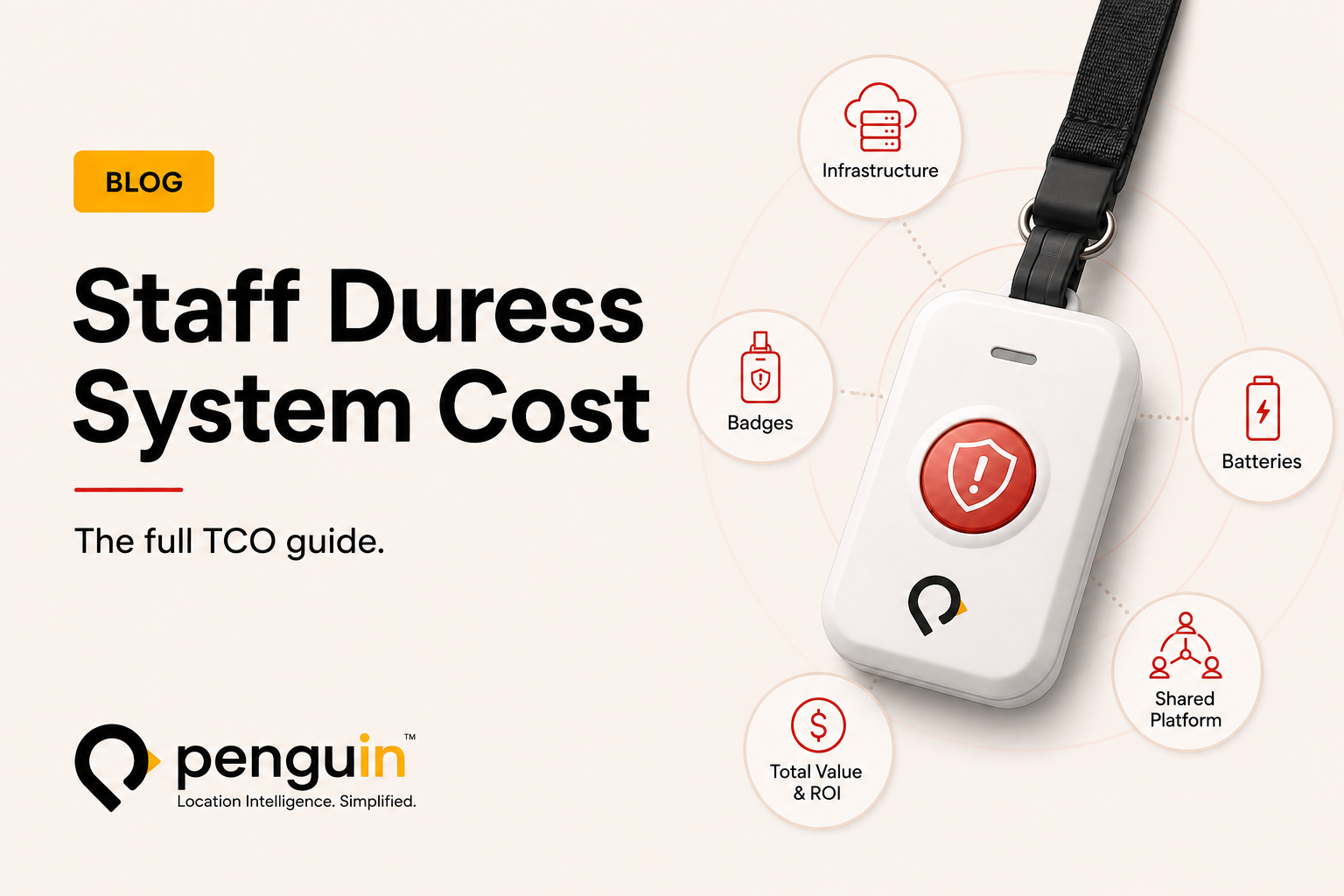
This guide changes that. It breaks down every cost driver in a hospital staff duress system, infrastructure, tags, software, maintenance, and battery economics. It compares legacy proprietary systems to modern BLE 5.1 deployments with actual numbers. It shows you how to build a board-ready ROI model. And it explains how a shared RTLS platform converts a single-use safety line item into an operational investment that pays for itself across multiple use cases.
What Does a Hospital Staff Duress System Actually Cost?
The short answer: it depends on which generation of technology you are buying. The long answer is why this guide exists.
A legacy proprietary staff duress system at a 200-bed hospital typically runs $1,500,000 to $2,500,000 for full deployment. That number includes proprietary locators hardwired into ceilings, proprietary tags that cost $300–$800 each, a closed software platform with annual license fees, and an ongoing battery replacement program that never ends. Most proposals do not show you this math across seven years. They show you year one.
A modern BLE 5.1 staff duress system at the same 200-bed hospital runs $300,000 to $500,000. Standard off-the-shelf hardware. No proprietary networks. Rechargeable badges that eliminate the disposable battery cost entirely. Software that integrates with the systems you already own.
The delta is not incremental. It is transformational.
According to the Kaiser Family Foundation, hospital operating margins rebounded to an average of 5.2%, but 39% of hospitals still reported negative margins. For those CFOs, a $2M safety system is a non-starter. A $400K system with a defensible ROI model is a fundable project.
The question is not whether your nurses need a duress system. The question is whether your financial model can survive the vendor you are about to call.
Why Legacy Staff Duress Systems Cost So Much More Than You Think
Legacy systems were built on a closed-infrastructure model. The vendor sells you proprietary locators that only work with their proprietary tags, running on a proprietary network that only their software can read. Every component locks you in. Every upgrade requires their approval. Every hardware failure requires their technician.
The cost consequences compound over time.
Infrastructure Lock-In
Proprietary locators require hardwired installation, conduit, cabling, junction boxes, and electrician labor for every unit across every floor. A 200-bed hospital might require 400–600 locator units at $400–$800 per unit, before installation labor. That is $200,000–$500,000 in infrastructure before you have tagged a single nurse.
When the vendor releases a new generation of hardware, you cannot upgrade selectively. The proprietary protocol means the old locators and new tags are incompatible. You buy the infrastructure again.
Tag Unit Cost
Legacy staff duress badges cost $300–$800 per unit. A 200-bed hospital typically needs one badge per clinical FTE on shift, plus spares, that is commonly 250–400 badges in active circulation. At $500 average per badge, the tag fleet alone costs $125,000–$200,000. And those badges use disposable batteries.
That last fact matters more than most proposals acknowledge. We cover it in detail in the battery economics section below.
Software and Annual Fees
Proprietary platforms charge annual license fees of $50,000–$150,000 for a mid-sized hospital deployment. Maintenance contracts typically add 15–20% of the hardware cost per year. Neither fee disappears after year one. Over seven years, the software and maintenance line alone can exceed the original hardware investment.
“The total cost of ownership for a legacy duress system at a 200-bed hospital frequently exceeds $2 million over seven years, yet the year-one proposal rarely shows more than $800,000.”
How Modern BLE 5.1 Staff Duress Systems Drive Cost Down
The cost revolution in staff duress systems traces directly to one technology shift: BLE 5.1, combined with AI-powered location algorithms that extract room-level accuracy from standard, mass-produced hardware.
BLE 5.1 hardware is manufactured at commodity scale. Over 646 million BLE-enabled devices are in active use across hospitals, clinics, and medical offices, according to Penguin’s 2024 RTLS whitepaper. That volume drives unit costs to a fraction of what proprietary locators cost. You are not buying a specialty product, you are buying from a global supply chain that already serves the consumer electronics industry.
For readers who want a deeper explanation of how the technology works before engaging with the cost data, our guide on how RTLS staff duress works in hospitals covers the full mechanism, BLE gateways, wearable tags, the MUSIC algorithm, and room-level location resolution.
No Proprietary Network Required
Modern BLE 5.1 systems deploy on existing enterprise infrastructure. No hardwired proprietary locators. No dedicated wireless network. Existing Wi-Fi access points and standard BLE gateways handle signal collection, and the AI layer does the heavy lifting on location resolution. Installation labor drops dramatically when you are not pulling cable to 500 ceiling-mounted proprietary units.
Room-Level Accuracy Without Legacy Infrastructure
The critical accuracy requirement for staff duress is room-level, not sub-meter coordinates, and not floor-level zones. When a nurse triggers a silent duress alert, security cannot afford ambiguity. A sub-meter coordinate that sits on a shared wall boundary between two adjacent rooms sends responders to one of two possible rooms. Responding to the wrong room costs seconds that matter.
Modern BLE 5.1 systems with AI pattern detection resolve the exact room with certainty, even at wall boundaries. That is the life-safety requirement. Legacy proprietary systems required supplemental infrared or ultrasound hardware to achieve this, adding infrastructure cost and maintenance overhead. BLE 5.1 achieves it with the same standard hardware used for everything else on the platform.
What Are the Real Cost Drivers? A Line-by-Line Breakdown
Every staff duress proposal contains the same five cost categories. The difference between a $400K project and a $2M project lives in how each category is priced, and what the vendor does not put on the line item at all.
1. Infrastructure (Locators / Gateways)
Legacy: $200,000–$500,000 for hardwired proprietary locators, installed.
Modern BLE 5.1: $50,000–$120,000 for standard BLE gateways, largely leveraging existing Wi-Fi cabling.
2. Wearable Tags / Badges
Legacy: $300–$800 per badge. Fleet of 250–400 badges: $75,000–$320,000.
Modern rechargeable: A fraction of legacy badge cost. Rechargeable design eliminates battery replacement cost across the full fleet lifecycle.
3. Software Platform
Legacy: $50,000–$150,000/year in license fees. Proprietary platform with limited integration.
Modern: Integrated platform with EHR, nurse call, and access control. Annual fees structured per-use-case or per-bed, with transparent pricing.
4. Installation and Commissioning
Legacy: $100,000–$250,000 in electrician and integration labor for hardwired proprietary infrastructure.
Modern BLE 5.1: $30,000–$80,000. Standard mounting, no conduit runs, faster commissioning timeline.
5. Ongoing Maintenance
Legacy: 15–20% of hardware cost per year. Proprietary parts. Vendor-only servicing.
Modern: Standard hardware maintained by in-house biomedical or IT teams. Vendor maintenance contracts are optional, not mandatory.
Behavioral health units represent a distinct deployment scenario worth noting here. Higher badge density requirements, tamper-resistant enclosures, and extended alert escalation paths add cost, but the BLE 5.1 infrastructure model still delivers meaningful savings versus proprietary alternatives. Our dedicated guide on staff safety in behavioral health facilities covers the specific design requirements and cost implications for those environments.
The line item most CFOs miss is not on the proposal. It is the battery replacement program that runs for the entire life of the system, every badge, every ward, every quarter, forever.
The Hidden Cost Nobody Puts in the Proposal: Badge Battery Economics
This is the cost argument that changes the conversation, and almost no vendor surfaces it voluntarily.
Legacy staff duress badges use disposable batteries. A typical badge battery lasts 60–90 days under active use. A 200-bed hospital with 300 active badges replaces batteries 1,200–1,500 times per year. At $3–$5 per battery replacement (parts plus labor), that is $3,600–$7,500 per year. Over seven years: $25,000–$52,500 in battery replacement costs alone.
That math understates the real burden. Battery replacement is not just a parts cost, it is a labor cost. Someone tracks which badges are low. Someone collects them, replaces the batteries, and redistributes them. In a busy clinical environment, that process fails. Dead badges go unnoticed. A nurse triggers a duress alert with a badge that has been dead for three days.
A dead badge in a duress situation is not a maintenance failure. It is a patient safety failure and a liability event.
The Rechargeable Badge Model
Modern rechargeable staff duress badges eliminate this entirely. Badges charge at the end of each shift, the same way a mobile phone charges. No disposable batteries. No battery replacement program. No tracking which badge is due for a change. No dead badge on shift.
The unit cost of a rechargeable badge is a fraction of a legacy disposable-battery badge. Combined with zero ongoing battery replacement overhead, rechargeable badge savings over seven years frequently exceed the hardware cost difference between a legacy and modern system. That is not a marketing claim, it is arithmetic the CFO can verify with the vendor’s own SKU pricing.
Ask every vendor you evaluate: what is the battery replacement cost for your badge fleet over seven years? If they cannot answer that question on the spot, you are looking at an unquantified ongoing cost that will appear in your operational budget every year for the life of the system.
How to Build the ROI Case for Board Approval
A board-ready ROI model for a staff duress system has four components: cost avoidance, liability reduction, retention impact, and regulatory compliance value. Each can be quantified with numbers already in your possession.
Cost Avoidance: Nurse Retention
Nursing turnover costs $40,000–$60,000 per nurse in recruitment, onboarding, and lost productivity. The risk of duress incidents in nursing is nearly four times that of any other profession, according to Penguin Location Services. Nurses who experience unresolved safety incidents leave at higher rates. A measurable improvement in incident response time and staff confidence directly reduces that turnover cost. If a staff duress system retains five nurses who would otherwise leave, the avoided cost is $200,000–$300,000, in year one alone.
For a broader picture of the financial case for workforce safety investment, our workforce safety solutions page covers the retention ROI model in full.
Liability Reduction
Unresolved workplace violence incidents generate legal exposure. A documented, defensible duress response system, with timestamped location data showing exactly where staff were when an alert was triggered and how quickly security responded, is evidence in any legal proceeding. It is also evidence for OSHA compliance. The cost of one unresolved liability event routinely exceeds the cost of the entire duress system.
Insurance Premium Impact
Some hospital liability insurers offer premium reductions for documented workplace violence prevention investments. The reduction percentage varies by insurer and state, but it is a direct, recurring cash benefit that belongs in your TCO model.
Regulatory Compliance Value
OSHA’s workplace violence prevention guidance and Joint Commission Environment of Care standards both create compliance obligations that a documented duress system satisfies. The cost of a corrective action plan or citation is not zero, and it is not budgeted. Include it as a risk-adjusted cost avoidance item.
The board does not need to believe in staff safety to approve this project. They need to believe the math. Build the model with retention cost, liability exposure, and regulatory risk, and the $400K investment becomes the cheaper option on every line.
How PenSafe Delivers Staff Duress on a Shared RTLS Platform
The most important cost argument for a modern staff duress system is one that rarely appears in the vendor’s proposal: shared infrastructure.
The PenSafe staff duress platform runs on the same BLE 5.1 infrastructure as Penguin’s asset tracking, patient elopement prevention, infant protection, and hand hygiene compliance solutions. The gateways, the network, the location engine, all shared. Deploy staff duress today, and when the board approves asset tracking next year, you are not buying new infrastructure. You are adding a use case to infrastructure you already own.
That shared infrastructure model fundamentally changes the per-use-case cost calculation. A dedicated, single-purpose staff duress system costs $300,000–$500,000 for a 200-bed hospital. A multi-use RTLS platform that includes staff duress, asset tracking, and workflow automation can deliver three or four funded use cases on infrastructure that costs the same $300,000–$500,000. The per-use-case cost drops to $100,000–$170,000. That is a capital project that funds itself across departments.
What PenSafe Delivers at the Clinical Level
When a nurse wearing a PenSafe badge feels threatened, she presses the badge. The alert triggers silently and immediately, no voice call, no visible action that escalates the situation. The centralized platform shows the exact room where the alert originated in real time. Security receives the location-specific alert and responds directly to the right room. Escalation paths are configurable: charge nurse, security team, management, in whatever sequence your clinical operations require.
PenSafe uses BLE 5.1 and the MUSIC algorithm’s AI pattern detection to resolve room-level location with certainty, even at wall boundaries where sub-meter coordinates alone would be ambiguous. For staff duress, room-level accuracy is a life-safety requirement, not a feature preference.
The largest hospital group in the Middle East has deployed PenSafe for staff duress across its network, alongside infant protection, hand hygiene compliance monitoring, and wander prevention, all running on the same shared BLE 5.1 infrastructure.
What the Regulatory Landscape Adds to Your Cost Calculation
Regulatory pressure on hospital workplace violence is not static. It is accelerating, and that acceleration has a direct cost implication for hospitals that delay investment.
OSHA has maintained General Duty Clause obligations for workplace violence prevention since 1970. Its 2015 healthcare-specific guidelines and subsequent enforcement activity make clear that hospitals without documented prevention programs face citation risk. Cal/OSHA enacted mandatory workplace violence prevention regulations for California hospitals in 2018. Federal OSHA proposed a formal healthcare workplace violence rule that would create enforceable standards nationwide. Each escalation increases the compliance cost of inaction.
The Joint Commission Environment of Care standard EC.02.01.01 requires hospitals to manage risks associated with the care environment, which accreditation surveyors have increasingly interpreted to include staff safety from workplace violence. A hospital that cannot demonstrate a functioning duress response system during a survey faces findings that require corrective action plans, documentation, and follow-up reviews. That process is not free.
For a complete mapping of OSHA’s workplace violence prevention obligations and how a staff duress system satisfies each requirement, our article on OSHA workplace violence prevention standards for hospitals covers the regulatory framework in full.
The strategic context for hospital administrators is this: the cost of regulatory non-compliance is not fixed. It compounds as regulations tighten. A hospital that invests in a documented, functional duress system today acquires an asset with increasing regulatory value over time. A hospital that delays funds a growing liability.
For administrators evaluating the full scope of their RTLS investment across staff safety, asset tracking, and patient flow, the Penguin healthcare RTLS platform overview maps each regulatory obligation to a specific platform capability.
56% of nurses report emotional exhaustion and burnout symptoms, according to the American Nurses Association. A workforce that does not feel safe does not stay. The regulatory cost of inaction and the retention cost of inaction are the same problem.
What CFOs and Administrators Should Ask Before Signing Any Contract
These are the seven questions that separate a well-structured procurement from an expensive regret.
What is the seven-year total cost of ownership, including badge battery replacement?
If the vendor cannot provide this number, ask them to model it. A proposal that shows only year-one hardware cost is not a TCO, it is a down payment disclosure. Get the full seven-year model in writing before signing.
Are the badges rechargeable or disposable-battery?
Rechargeable badges eliminate a perpetual operational overhead. Disposable-battery badges create a permanent maintenance program and a failure mode (dead badge on shift) that has safety consequences. This question alone filters out a generation of legacy products.
Is the infrastructure proprietary or standard BLE 5.1?
Proprietary infrastructure locks you into a single vendor for every future upgrade. Standard BLE 5.1 infrastructure supports competitive hardware sourcing, lower replacement costs, and multi-use-case deployment without additional infrastructure investment.
What accuracy does the system deliver, and how is room-level resolved at wall boundaries?
Zone-level accuracy is insufficient for staff duress. Ask specifically how the system resolves a location when the badge coordinate falls on a shared wall between two adjacent rooms. A credible answer names the algorithm and explains the AI layer. A non-answer reveals that the system cannot do it.
Does the platform support additional use cases on the same infrastructure?
A single-use staff duress system is a single-use cost. A shared RTLS platform amortizes the infrastructure cost across asset tracking, patient elopement, hand hygiene compliance, and other funded use cases. The per-use-case cost of a shared platform is dramatically lower than building separate point solutions.
What are the annual software license and maintenance contract terms?
Get the year-three and year-five renewal pricing in writing at signing. Vendors that offer favorable year-one pricing and reserve the right to increase license fees at renewal are selling you a subscription, not a capital asset. Understand what you are buying.
What integration does the platform support, and at what cost?
A duress system that does not integrate with your nurse call system, access control, and security command center is a standalone silo. Integration with EHR, HL7, and nurse call platforms is standard on modern systems. Ask for the integration list and the cost of each integration project.
The Financial Decision in Front of You
For hospital CFOs evaluating staff duress system options in 2026, the technology question is settled. BLE 5.1 delivers room-level accuracy without proprietary infrastructure, at $300,000–$500,000 versus $2,000,000+ for legacy systems at a 200-bed hospital. Rechargeable badges eliminate an ongoing operational cost that compounds invisibly for the life of the deployment. Shared RTLS infrastructure converts a single-use safety line item into a multi-use platform investment.
The remaining question is not whether to invest. It is which system to choose, and whether the vendor you are evaluating has been honest about the seven-year cost of what they are selling you.
The system that costs least in year one is rarely the system that costs least by year seven. The vendor who answers the battery question, the proprietary infrastructure question, and the seven-year TCO question without hesitation is the vendor who has built a product they can defend financially. That is the vendor worth your board presentation.
Frequently Asked Questions
The following questions represent the most common queries from hospital CFOs, administrators, and procurement teams evaluating staff duress system investments and pricing.
Q: How much does a hospital staff duress system cost in 2026?
A modern BLE 5.1 staff duress system costs $300,000–$500,000 for a 200-bed hospital, including infrastructure, badges, software, and installation. Legacy proprietary systems at the same scale run $1,500,000–$2,500,000. The difference comes from infrastructure model (standard vs. proprietary), badge unit cost ($300–$800 legacy vs. a fraction for modern rechargeable), and annual software licensing. Over seven years, the TCO gap between legacy and modern systems frequently exceeds $1,000,000 at a 200-bed hospital when badge battery replacement and maintenance escalation are included.
Q: What is the difference between a legacy staff duress system and a modern RTLS-based system?
Legacy systems use proprietary locators hardwired into ceilings, proprietary tags with disposable batteries, and closed software platforms with limited integration. Modern RTLS-based systems use standard BLE 5.1 hardware, rechargeable badges, and open platforms that integrate with EHR, nurse call, and access control systems. The accuracy difference matters clinically: legacy systems required supplemental infrared or ultrasound hardware to achieve room-level accuracy. Modern BLE 5.1 systems with AI pattern detection achieve room-level location resolution on standard hardware, without the supplemental infrastructure cost.
Q: How many staff duress badges does a 200-bed hospital need?
A 200-bed hospital typically needs 250–400 active badges, sized to cover one badge per clinical FTE per shift plus a spare inventory buffer of 10–15%. High-acuity units, emergency departments, and behavioral health floors require higher badge density. The badge fleet size directly drives both the hardware cost and, for disposable-battery systems, the ongoing battery replacement program. Sizing the fleet accurately before procurement prevents both under-coverage (staff without badges on shift) and over-procurement (idle inventory that still requires maintenance).
Q: Do rechargeable staff duress badges really save money compared to disposable ones?
Yes, the math is straightforward. A 300-badge fleet using disposable batteries at a 60–90 day replacement cycle requires 1,200–1,500 battery replacements per year. At $3–$5 per replacement in parts and labor, that is $3,600–$7,500 annually, or $25,000–$52,500 over seven years, before accounting for the operational overhead of tracking which badges are low. Rechargeable badges eliminate this entirely: badges charge at shift end, battery status is monitored automatically, and the replacement program does not exist. The unit cost of a rechargeable badge is also a fraction of a legacy disposable-battery badge, meaning the savings compound from day one.
Q: Can a staff duress system run on our existing hospital Wi-Fi network?
Modern BLE 5.1 staff duress systems are designed to leverage existing enterprise network infrastructure, which substantially reduces installation cost compared to legacy proprietary networks. However, BLE 5.1 gateways are typically distinct from Wi-Fi access points, they collect BLE signals from wearable badges and transmit data over the existing wired or wireless network. The key question for your IT team is gateway placement density: room-level accuracy requires adequate gateway coverage per square foot. A site survey will confirm whether your existing infrastructure can support the required coverage or whether supplemental gateways are needed.
Q: Does a staff duress system satisfy Joint Commission and OSHA workplace violence requirements?
A documented, functional staff duress system contributes directly to Joint Commission Environment of Care standard EC.02.01.01 compliance and supports OSHA’s General Duty Clause obligation to provide a workplace free from recognized hazards. The critical word is “documented”, the system must generate timestamped location data showing alert origin, response time, and escalation path. That audit trail is what satisfies surveyors and OSHA inspectors. A duress button that triggers a call to the security desk without location data is not the same as a location-specific, escalation-mapped, audit-logged duress system. Ask vendors specifically what compliance documentation the system generates automatically.
Q: What is the total cost of ownership for a hospital staff duress system over 5–7 years?
For a modern BLE 5.1 system at a 200-bed hospital, the seven-year TCO typically runs $500,000–$750,000, including initial deployment, annual software fees, maintenance, and badge replacement for units that are lost or damaged. For a legacy proprietary system at the same scale, the seven-year TCO commonly exceeds $2,000,000 when hardware refresh cycles, proprietary maintenance contracts, battery replacement programs, and annual license escalation are included. The single largest driver of TCO difference is the infrastructure model: standard BLE 5.1 hardware can be maintained and upgraded competitively, while proprietary infrastructure is serviced exclusively by the original vendor at their pricing.
Q: How does a multi-use RTLS platform reduce the per-use-case cost of staff duress?
When a staff duress system runs on a shared BLE 5.1 infrastructure platform, the gateway network, location engine, and software layer are shared across every use case, staff duress, asset tracking, patient elopement prevention, hand hygiene compliance monitoring, and others. A dedicated single-purpose duress system at $400,000 delivers one funded outcome. The same $400,000 infrastructure investment on a shared RTLS platform can deliver three or four funded use cases, each drawing on the same hardware. The effective per-use-case cost drops to $100,000–$170,000. For hospital CFOs managing capital against negative margins, that amortization argument is often what converts a deferred project into an approved one.
Penguin Location Services delivers hospital staff duress on a shared BLE 5.1 RTLS platform designed for modern healthcare budgets. Our PenSafe staff duress platform provides room-level location accuracy, rechargeable wearable badges, configurable escalation paths, and full integration with nurse call, access control, and EHR systems, at a fraction of legacy system cost. To discuss how PenSafe supports your staff safety program and board-ready financial model, visit penguinin.com/pensafe or explore our full workforce safety solutions.
Workplace violence is the most underreported safety hazard in American healthcare, and OSHA is done waiting for hospitals to act voluntarily. Under the General Duty Clause (Section 5(a)(1) of the OSH Act), every US hospital already has a legal obligation to eliminate recognized workplace violence hazards through documented, feasible engineering controls. No specific healthcare violence standard is required for OSHA to cite and penalize your facility. The General Duty Clause is enough. And in 2026, with Cal/OSHA’s new workplace violence standard taking effect in December, Virginia’s amended reporting rules already live, and federal enforcement actions accelerating, the exposure for hospitals that have not deployed documented engineering controls is at its highest point in decades.
The gap is not awareness, every hospital administrator knows violence against nurses is a real and growing problem. The gap is translation: what exactly does OSHA require, what evidence does it use to build a citation, and what specific technology satisfies the legal standard for “feasible means of abatement”? Most legal summaries stop at describing the problem. None of them hand a hospital administrator an operational checklist.
This article does exactly that. It maps all four General Duty Clause citation elements to specific hospital action items, explains how RTLS-based staff duress systems satisfy the fourth element as a documented engineering control, addresses the deregulatory noise creating false comfort in 2026, and provides a practical evaluation framework for choosing the right solution.
Key Takeaways
OSHA’s General Duty Clause already applies to hospital workplace violence, no separate federal standard is required for enforcement.
A citation requires four elements: recognized hazard, employer knowledge, serious harm, and feasible means of abatement not implemented.
Nursing carries nearly 4 times the duress risk of any other profession, according to industry data, this is OSHA’s “recognized hazard” evidence.
Cal/OSHA’s dedicated workplace violence prevention standard takes effect December 2026, setting a precedent other states are actively tracking.
An RTLS-based staff duress system, one that delivers room-level accuracy and documented alert trails, is the specific engineering control that satisfies the fourth citation element.
Proposed federal deregulation for inherently risky professions does not eliminate General Duty Clause exposure. Hospitals that wait are accumulating risk, not avoiding it.
What Does OSHA Actually Require Hospitals to Do About Workplace Violence in 2026?
OSHA does not have a standalone healthcare workplace violence regulation at the federal level, at least not yet. What it does have is the General Duty Clause, and that clause is sufficient for enforcement. Under Section 5(a)(1) of the Occupational Safety and Health Act, every US employer must provide a workplace “free from recognized hazards that are causing or are likely to cause death or serious physical harm.” Workplace violence in hospitals meets every element of that definition, and OSHA has said so explicitly in its guidelines and enforcement actions.
In practice, what OSHA requires hospitals to do is threefold:
First, develop and maintain a written Workplace Violence Prevention Plan (WVPP) that identifies hazards specific to the facility, documents staff training, and describes the engineering and administrative controls in place.
Second, implement the controls described in that plan, and those controls must be real, documented, and operational. A plan that lists controls but cannot demonstrate deployment is not a defense; it is additional evidence of employer knowledge of an unaddressed hazard.
Third, demonstrate that the controls chosen represent feasible means of abatement, meaning they are technically possible, economically reasonable, and capable of materially reducing the hazard. This is the element most hospital administrators misunderstand. Feasibility is not aspirational. It is an evidentiary standard OSHA uses in enforcement proceedings.
The General Duty Clause does not require a perfect workplace. It requires documented action on recognized hazards. A hospital with a written plan, deployed technology, and recorded alert history is in a fundamentally different legal position than a hospital with a plan and no controls.
How Widespread Is the Problem, and Why Is OSHA Treating It as a Recognized Hazard?
The legal concept of a “recognized hazard” under the General Duty Clause has two sources: industry recognition and employer knowledge. Workplace violence against healthcare workers clears both bars without ambiguity.
The risk of staff duress in nursing is nearly four times that of any other profession, according to industry data. That single statistic is the kind of evidence OSHA uses to establish that the hazard is universally recognized across the healthcare industry, not just known to a particular employer.
The burnout data reinforces the exposure picture. According to the American Nurses Association, 56% of nurses report emotional exhaustion and burnout symptoms. According to industry data, more than 60% of nurses report symptoms of emotional fatigue, job dissatisfaction, and depersonalization. These are not abstract workforce metrics. They describe a clinical workforce operating under sustained pressure, which is directly correlated with increased vulnerability during patient interactions.
Isolation compounds the risk. According to HIMSS, nurses spend up to 60 minutes per shift searching for lost equipment. That time is spent alone, in supply rooms, in corridors, away from the nurse station, exactly the conditions that make duress incidents more likely and response more delayed.
In a 196-nurse study (industry data) at a North American hospital, 52 were classified low-risk for burnout, 110 moderate-risk, and 38 high-risk. The high-risk cohort represents staff who are most likely to be in crisis, least likely to ask for help, and most exposed to the physical and emotional conditions that precede a workplace violence incident.
Less than 30% of nurses feel adequately supported by hospital management in managing work-related stress, according to industry data. That gap between the scale of the hazard and the perceived organizational response is precisely what OSHA’s recognized hazard standard captures.
How Does OSHA’s General Duty Clause Apply to Hospital Workplace Violence?
The General Duty Clause is a catch-all provision. Congress designed it to address hazards that are real and serious but not yet covered by a specific OSHA standard. Workplace violence in healthcare is its textbook application.
OSHA has issued guidance documents, most notably its 2015 Guidelines for Preventing Workplace Violence for Healthcare and Social Service Workers, that establish the agency’s position: workplace violence in healthcare is a recognized hazard, hospitals are expected to address it through a hierarchy of controls, and the absence of documented engineering controls is an enforceable deficiency under the General Duty Clause.
“Employers are required to provide their employees with a place of employment that is free from recognized hazards that are causing or are likely to cause death or serious physical harm to the employees.”
, OSH Act Section 5(a)(1), the General Duty Clause
OSHA’s enforcement approach focuses on the documented record. An inspector reviewing a citation will look for: evidence that the hospital knew about violence incidents (OSHA 300 logs, incident reports, police reports), evidence that the hospital assessed its risk (written hazard assessments), and evidence that it implemented, not just planned, controls proportionate to the assessed risk.
The deregulatory discussion in 2025 and 2026 has created some confusion. A proposed rulemaking in the Federal Register (2025) suggested limiting General Duty Clause applicability to professions with inherently dangerous conditions, the argument being that hospitals should not be cited for violence incidents that are intrinsic to caring for agitated patients. That proposal has not been finalized. Even if finalized in some form, it would not eliminate employer obligations: it would shift the burden of proof, requiring hospitals to demonstrate that their controls were proportionate to an unavoidable residual risk. The practical compliance response is identical in both scenarios: document the hazard, deploy engineering controls, maintain the records.
Hospitals that wait for regulatory certainty are making the costlier bet.
What Are the Four Citation Elements, and What Does Each One Require Your Hospital to Do?
To cite an employer under the General Duty Clause, OSHA must prove all four of the following elements. Understanding each element tells you exactly what your hospital needs to do, and document, to reduce citation risk. Explore Penguin’s workforce safety solutions for healthcare facilities alongside this checklist to see how each element maps to technology controls.
Element 1, The employer failed to keep the workplace free from a hazard.
OSHA must show that a hazard existed and that the employer did not eliminate or materially reduce it. For hospitals, this means OSHA will point to your OSHA 300 injury log, your incident reports, your employee complaints, and any police reports from the facility. What your hospital must do: Conduct a formal written hazard assessment of all units, document findings, and show that controls are calibrated to the findings. A hazard assessment that identifies the ED and psychiatric units as high-risk but deploys no additional controls in those units fails this element.
Element 2, The hazard was recognized.
OSHA can establish recognition either through industry-wide evidence (trade associations, published guidance, peer literature) or through employer-specific evidence (past incidents, complaints, prior OSHA notices). In healthcare, industry recognition is beyond dispute, OSHA’s own 2015 guidelines establish it. What your hospital must do: Acknowledge the hazard explicitly in your WVPP. A plan that describes “potential risks” vaguely is weaker than one that states “assault and battery of clinical staff by patients and visitors is a recognized hazard in acute care settings, as documented by OSHA and our facility incident history.” Explicit acknowledgment does not create liability, it demonstrates compliance with the recognition prong.
Element 3, The hazard was causing or likely to cause death or serious physical harm.
Assaults that result in contusions, lacerations, fractures, or psychological trauma qualify. OSHA does not require a fatality, serious physical harm is sufficient. The data is sufficient to meet this element in any US hospital: a profession carrying nearly 4 times the duress risk of the national average, with 56% of practitioners reporting emotional exhaustion per the American Nurses Association. What your hospital must do: Record all violent incidents in your OSHA 300 log accurately. Underreporting, which is endemic in healthcare, is itself a liability: it can be characterized as evidence of inadequate hazard recognition at audit, and it creates a gap between what your plan says and what your logs show.
Element 4, A feasible means of abatement existed that the employer failed to implement.
This is the element that separates hospitals with genuine compliance posture from those with paperwork. OSHA must show that a technically and economically feasible control existed and was not deployed. The engineering controls OSHA cites most consistently for healthcare workplace violence include: physical barriers, controlled access systems, alarm systems, and, most relevant to 2026, real-time staff location and duress alerting. What your hospital must do: Deploy at least one documented engineering control proportionate to your assessed risk level in each high-risk unit. The control must be operational, not planned. It must have a documented implementation date, a maintenance record, and a usage log showing it has been used or tested. A staff duress system with no alert history raises more questions than it answers.
Element 4 is where citations are won or lost. OSHA does not need to prove your hospital was negligent. It needs to prove a feasible control existed and was not deployed. In 2026, RTLS-based staff duress systems are that control, documented, commercially available, and deployed in hospitals of comparable size and risk profile.
How Does an RTLS-Based Staff Duress System Satisfy the ‘Feasible Abatement’ Requirement?
The term “feasible means of abatement” has two components under OSHA’s enforcement framework: technical feasibility and economic feasibility. An RTLS-based staff duress system satisfies both, and it satisfies them with documentation that legacy panic buttons cannot match.
Technical Feasibility: Why Room-Level Accuracy Matters for OSHA
A traditional panic button tells security that an alert was triggered somewhere in the building. A legacy wired duress system might narrow that to a floor or zone. Neither produces the specific, actionable location evidence that OSHA’s engineering control standard requires, or that security needs in a real incident.
An RTLS-based staff duress system uses BLE 5.1 wearable badges paired with a location engine to deliver room-level accuracy in real time. When a nurse triggers a silent duress alert, security receives the nurse’s exact room, not a floor, not a wing, not a coordinate that straddles a shared wall between two adjacent spaces. Room-level accuracy is a life-safety requirement for duress, not an operational preference. Responding to the wrong room costs seconds that cannot be recovered.
For OSHA purposes, the technical feasibility argument is documented by commercial availability. RTLS-based duress platforms are deployed in hospitals of comparable size and clinical complexity across North America. That commercial deployment record is exactly the evidence OSHA uses to establish that a control is technically feasible for an employer of your type, and that a hospital which has not deployed it cannot claim the control was unavailable.
To understand how RTLS-based staff duress systems work in hospital settings, including gateway placement, badge configuration, and alert routing, the technical architecture is straightforward: BLE 5.1 wearable badges transmit continuously to BLE gateways mounted on ceilings or walls throughout the facility. The location engine processes those signals using AI/ML algorithms, analyzing the totality of signals across all antenna elements, not just angle-of-arrival estimates, to resolve the badge’s exact room with certainty. When the nurse presses the badge, the alert routes instantly to the security platform with a real-time location pin.
Economic Feasibility: What “Proportionate Cost” Means in Practice
Economic feasibility under the General Duty Clause does not mean lowest-priced. It means the cost of the control is not so disproportionate to the employer’s resources that implementation would be unreasonable. For hospitals with annual operating budgets in the tens or hundreds of millions, a staff duress deployment costing $300,000–$500,000 for a 200-bed facility clears that bar without ambiguity.
Modern BLE 5.1-based duress platforms are substantially less expensive than the proprietary infrastructure-based systems that preceded them. BLE 5.1 hardware is produced at commodity scale. No proprietary wireless networks are required. No dedicated hardwired locator runs are needed. Existing enterprise infrastructure supports the deployment. The cost argument that once made RTLS economically unfeasible for mid-size hospitals no longer holds.
The PenSafe staff duress platform from Penguin Location Services uses standard BLE 5.1 wearable badges paired with Penguin’s AI/ML location engine to deliver room-level accuracy with minimal infrastructure. The platform integrates with existing nurse call systems, access control, and security monitoring platforms, producing the documented alert trail that OSHA’s feasible abatement standard requires. Configurable escalation paths route alerts to charge nurses, security teams, and management simultaneously, so the response chain is as documented as the control itself.
What Do the 2026 State Laws Add to the Federal Baseline, and Does Cal/OSHA Change Everything?
The federal General Duty Clause sets the floor. State laws in 2026 are raising it, and California is raising it furthest.
California (Cal/OSHA): California’s dedicated Cal/OSHA workplace violence prevention standard for healthcare takes effect in December 2026. It requires hospitals to maintain a written WVPP, conduct annual workplace violence hazard assessments, provide unit-level training, and implement engineering controls documented in the plan. For California hospitals, this is no longer a General Duty Clause risk calculation, it is a specific standard with specific audit criteria. For hospitals in other states, California’s standard is the clearest preview of where federal rulemaking is heading.
Virginia: Virginia amended its workplace violence reporting requirements for healthcare facilities in 2025, adding real-time incident documentation obligations that increase the paper trail available to OSHA inspectors. A Virginia hospital that is not documenting incidents accurately is now simultaneously exposed to state penalty and producing deficient records that weaken its federal General Duty Clause defense.
Washington and Missouri: Both states have enacted or significantly strengthened healthcare workplace violence prevention laws, adding training requirements and hazard assessment mandates on top of the federal baseline. Utah has moved in the same direction. The state patchwork is not converging on uniformity, it is converging on escalating requirements.
The question hospital administrators outside California sometimes ask is whether their state’s relative inaction provides cover. It does not. OSHA’s federal General Duty Clause enforcement operates independently of state law. A Texas or Florida hospital with no state-specific violence prevention mandate is still subject to federal enforcement on exactly the same four-element standard as a California hospital. The only difference is that the California hospital also faces a specific state standard with its own penalties.
The North American trend is consistent. For Canadian hospitals navigating parallel obligations under provincial law, our analysis of Bill 168 workplace violence requirements for Ontario hospitals shows how legislative frameworks differ in structure but converge on the same operational outcome: documented hazard assessment, written prevention plan, and deployed engineering controls. US and Canadian administrators facing these obligations are asking the same questions.
Penguin’s healthcare RTLS solutions are deployed across hospital networks in North America and the Middle East, environments that span multiple regulatory frameworks and have tested the platform against real-world compliance audit requirements.
What Should Hospital Administrators Evaluate When Choosing a Workplace Violence Prevention Technology?
Not all staff duress systems produce equivalent OSHA compliance documentation. The evaluation criteria below map directly to what OSHA inspectors and legal counsel will look for when auditing your engineering controls. For broader context on how the category has changed, our article on how staff duress technology has evolved beyond legacy panic buttons covers the spectrum from hardwired pull stations to modern RTLS-based platforms.
Does the system produce room-level location accuracy, not just a floor or zone?
This is the non-negotiable criterion. A duress system that tells security “third floor, north wing” is not the same as one that routes responders to “Room 314.” For OSHA purposes, room-level accuracy is what distinguishes a documented engineering control from a ceremonial one. Zone-level accuracy may suffice for asset tracking; for staff duress, it introduces response delays that are both operationally dangerous and legally problematic. Ask vendors for accuracy validation data, not marketing claims.
Does the platform produce a documented alert trail that survives an OSHA audit?
An alert log, timestamped, room-specific, linked to the responding staff member, is the documentation your legal counsel needs if OSHA opens an inspection. Systems that alert in real time but do not maintain a retrievable historical record of every alert, location, response time, and outcome are incomplete as compliance controls. Before selecting a platform, ask the vendor to show you the incident report output. If it cannot export a compliance-grade record, it will not serve your OSHA defense.
Does the system integrate with your existing nurse call and security infrastructure?
A duress platform that operates as an island, separate from your nurse call system, your access control, and your security monitoring station, creates response gaps that undermine its value as an engineering control. Integration means that a triggered duress alert simultaneously notifies the charge nurse, routes to the security desk, and can trigger door lock or access control responses in high-risk units. The integration capability is also a deployment cost factor: a system that requires a parallel infrastructure build is more expensive than one that layers on top of your existing network.
Is the wearable badge form factor designed for clinical wear patterns?
A staff duress badge that nurses find cumbersome, forget to charge, or leave in their locker is not a deployed engineering control, it is a liability. Badge form factor, battery life, charging workflow, and clip or lanyard compatibility all affect real-world adoption. Ask vendors for adoption rate data from comparable deployments. A platform with 95% theoretical coverage and 60% actual daily wear is not providing the protection your WVPP describes.
The OSHA audit question is not whether you purchased a duress system. It is whether staff were wearing it, whether it was operational, and whether the alert history reflects actual use. Deployment records matter as much as the technology itself.
Closing Thought
The General Duty Clause has required US hospitals to address workplace violence since 1970. What has changed in 2026 is the enforcement environment, the state legislative landscape, and the commercial availability of the specific engineering controls OSHA’s fourth citation element requires. A hospital that cannot demonstrate a deployed, documented, room-accurate staff duress system is carrying an exposure it can reduce, and in a regulatory environment where Cal/OSHA’s standard takes effect in December and federal enforcement actions are accelerating, the cost of that exposure is rising every quarter.
For hospital administrators evaluating their options, the question is no longer whether to deploy a staff duress system. It is how to choose the right one, one that delivers room-level accuracy for real-time response, produces a compliance-grade alert trail for OSHA documentation, integrates with existing infrastructure, and achieves genuine staff adoption rather than ceremonial deployment.
The proposed federal deregulation changes nothing operationally. Hospitals that act now reduce their exposure under current law. They build the documentation record that protects them regardless of how rulemaking resolves. And they protect the nurses who are carrying four times the duress risk of any other profession in the American workforce.
Frequently Asked Questions
The following questions represent the most common queries from US hospital administrators, safety officers, legal counsel, and clinical engineering teams evaluating OSHA workplace violence compliance requirements in 2026.
Q: Does OSHA have a specific workplace violence standard for hospitals, or does it use the General Duty Clause?
OSHA does not have a finalized federal standard specifically governing workplace violence in hospitals as of 2026. Enforcement relies on the General Duty Clause (Section 5(a)(1) of the OSH Act), supported by OSHA’s 2015 Guidelines for Preventing Workplace Violence for Healthcare and Social Service Workers. That guidance document, while not a binding standard, establishes the agency’s enforcement expectations and is used by inspectors to evaluate whether a hospital’s controls are proportionate to its assessed risk. A dedicated federal standard has been under development for years, but rulemaking timelines remain uncertain. The General Duty Clause is sufficient for citation and penalty in the interim.
Q: What is the “feasible means of abatement” requirement under OSHA’s General Duty Clause?
Feasible means of abatement is the fourth element OSHA must establish in a General Duty Clause citation. It requires OSHA to show that a control existed, technically possible and economically reasonable for an employer of the cited hospital’s type and size, that would materially reduce or eliminate the hazard, and that the employer failed to implement it. For workplace violence in hospitals, OSHA has consistently identified engineering controls including alarm systems, controlled access, physical barriers, and real-time staff location and alerting as feasible abatement measures. The commercial availability of RTLS-based staff duress systems at current price points makes the economic feasibility argument difficult for hospitals to contest.
Q: What happens if a hospital gets cited under OSHA’s General Duty Clause for workplace violence?
A General Duty Clause citation for workplace violence is classified as a serious violation, carrying a penalty of up to $16,131 per violation as of current OSHA penalty tables (adjusted annually for inflation). Willful or repeated violations carry penalties up to $161,323 per instance. Beyond the direct financial penalty, a citation creates a documented enforcement record, which is discoverable in civil litigation brought by injured staff. Hospitals that have received a prior citation and have not implemented the abatement measures specified in the citation agreement face elevated repeat-violation exposure. The litigation risk from an injured employee who can point to an unaddressed OSHA citation substantially exceeds the penalty itself.
Q: Does the proposed OSHA deregulation for inherently risky professions mean hospitals can wait before acting?
No. The proposed Federal Register rulemaking (2025) that would limit General Duty Clause applicability to professions with inherently dangerous conditions has not been finalized. Even if it were finalized, it would shift the burden of proof rather than eliminate the obligation, hospitals would need to demonstrate that their controls were proportionate to an unavoidable residual risk, which requires the same documentation as current compliance: written hazard assessment, deployed controls, maintenance records, and alert history. Waiting for regulatory certainty produces a hospital that has accumulated a larger incident history with less documentation than a hospital that acted. The compliance response is the same in both scenarios; the risk calculus favors acting now.
Q: How does California’s new Cal/OSHA workplace violence standard affect hospitals in other states?
California’s dedicated workplace violence prevention standard for healthcare takes effect in December 2026 and establishes specific requirements: written WVPP, annual hazard assessments, unit-level training, and documented engineering controls. For California hospitals, this is a binding standard with specific audit criteria, separate from and in addition to the federal General Duty Clause. For hospitals in other states, Cal/OSHA’s standard is the clearest signal of where federal rulemaking is heading and where other progressive state legislatures are looking for models. The practical effect is that a hospital in any state that builds its WVPP and engineering controls to meet California’s standard will be well-positioned regardless of how federal or state rulemaking evolves in its own jurisdiction.
Q: What documentation does a hospital need to demonstrate compliance with OSHA workplace violence requirements?
At minimum, OSHA inspectors reviewing a General Duty Clause workplace violence matter will look for: a written Workplace Violence Prevention Plan (WVPP) current within the last 12 months; a unit-level hazard assessment with documented findings and control mappings; OSHA 300 and 301 logs with accurate violent incident recording; staff training records; engineering control deployment records including implementation dates, maintenance logs, and system test records; and, for duress systems specifically, an alert history showing the system has been operational and used. A gap in any of these categories is evidence of an unaddressed recognition or abatement failure. The documentation does not need to be perfect, it needs to be honest, current, and proportionate to the assessed risk level.
Q: How is an RTLS-based staff duress system different from a standard panic button for OSHA compliance purposes?
The critical difference is location specificity and documentation. A standard panic button confirms that an alert was triggered; it does not reliably identify where the staff member is at the time of the alert. An RTLS-based system delivers room-level location in real time, routing responders to the specific room where the nurse is, not to a floor or zone. For OSHA compliance, this distinction matters because “feasible means of abatement” is evaluated against the hazard’s severity and the control’s capacity to materially reduce it. A system that cannot reliably locate the distressed employee to a specific room is harder to characterize as effective abatement in a serious incident. The RTLS platform also produces a timestamped, location-specific alert log that serves as the compliance documentation record a panic button system typically cannot generate.
Q: What workplace violence prevention plan does OSHA require hospitals to maintain in 2026?
Under the General Duty Clause, OSHA does not prescribe a specific WVPP format, but its 2015 guidelines describe five core program elements that inspectors use as an evaluation framework: management commitment and employee involvement; worksite analysis (unit-level hazard assessment); hazard prevention and control (hierarchy of engineering, administrative, and behavioral controls); safety and health training; and recordkeeping and program evaluation. California’s December 2026 standard goes further, requiring specific plan components, annual review cycles, and employee participation procedures. Hospitals building or updating their WVPP in 2026 should use California’s standard as the template regardless of their state, since it represents the most fully developed regulatory articulation of what a defensible plan looks like.
Penguin Location Services provides RTLS-based staff safety solutions for hospitals and healthcare networks across North America and the Middle East. Our PenSafe staff duress platform delivers room-level accuracy, configurable escalation paths, and compliance-grade alert documentation, the specific engineering control that satisfies OSHA’s feasible abatement standard. To discuss how PenSafe supports your workplace violence prevention plan, visit penguinin.com/pensafe or explore our workforce safety solutions for healthcare facilities.
Psychiatric nurses are attacked at work at nearly four times the rate of any other profession, yet the duress systems installed to protect them routinely fail the moment they are needed most. The button gets pressed. The alert goes nowhere. Security responds to the wrong floor. Or the system simply times out because the signal died inside a shielded seclusion room.
The problem is not that hospitals are ignoring staff safety. Most behavioral health units have some form of duress system installed. The problem is that nearly every standalone duress system on the market was designed for a general hospital ward, open Wi-Fi coverage, standard drywall construction, minimal RF interference, and then deployed inside a behavioral health unit that has none of those conditions. The result is a system that looks compliant on paper and fails operationally every time a real incident occurs.
This guide covers what makes behavioral health units structurally different from general wards, the four infrastructure constraints that break standard duress systems, a fifth constraint that almost no vendor mentions, how an RTLS-native behavioral health staff duress system actually works, and what safety directors and CNOs should evaluate before they spend another dollar on a parallel standalone system.
Key Takeaways
Nursing staff face a risk of workplace violence nearly 4 times higher than any other profession, according to industry data, and inpatient psychiatric settings carry the highest concentration of that risk.
Behavioral health units have four physical infrastructure constraints, RF shielding, dead zones, device restrictions, and architectural isolation, that standard Wi-Fi and Bluetooth 4.0 duress systems cannot reliably overcome.
A fifth constraint, the total cost of operating a standalone duress network in parallel with existing RTLS infrastructure, is never disclosed in standalone vendor proposals.
An RTLS-native platform running BLE 5.1 delivers room-level duress accuracy on the same network used for asset tracking and patient safety, eliminating the parallel system cost entirely.
The Joint Commission and OSHA both impose documented obligations on hospitals to prevent and respond to workplace violence, and a duress system that fails in a shielded room does not satisfy either standard.
What Makes Behavioral Health Units Different, and Why Standard Duress Systems Are Not Designed for Them
A general medical-surgical ward and an inpatient psychiatric unit share the same building. They do not share the same operating environment.
Behavioral health units are purpose-built to restrict, contain, and de-escalate. The architecture reflects that mission: reinforced walls that block radio frequency (RF) signals, seclusion rooms lined with materials that absorb or scatter wireless transmission, locked units where personal electronic devices are prohibited, and physical layouts designed to limit patient movement, not optimize Wi-Fi coverage. Every one of those design decisions degrades the performance of a standard hospital duress system.
Standard hospital duress systems are built on two assumptions: that the RF environment is predictable and that staff carry or wear devices compatible with the facility network. Both assumptions collapse inside a behavioral health unit. The result is a system that registers as deployed, passes the initial site survey, and then produces dead zones, missed alerts, and ambiguous location data precisely when a violent incident occurs and accuracy matters most.
The Design Principles That Break Standard Duress Technology
Three architectural principles define behavioral health unit design, and each one directly conflicts with the technical requirements of standard Wi-Fi or BLE 4.0 duress systems.
RF containment is the first. Seclusion rooms and high-acuity observation rooms use concrete block, steel framing, or dedicated shielding materials. These materials do not just attenuate signals, they can eliminate them. A staff member inside a seclusion room pressing a duress badge may generate zero detectable signal at any gateway outside that room if the system relies on RSSI (Received Signal Strength Indicator) thresholds.
Device restriction is the second. Most inpatient psychiatric units prohibit patients from bringing personal electronic devices onto the unit. Many extend this policy to staff smartphones during active shifts. A duress system that depends on a staff member’s personal phone as the alert transmitter fails the moment that phone stays at the nursing station.
Network isolation is the third. Many psychiatric units operate on segregated network segments by design, to prevent patient access to facility infrastructure. A duress system that routes alerts through the general hospital Wi-Fi network may find that its traffic path is blocked, throttled, or unreachable from inside the behavioral health unit’s isolated segment.
How Serious Is the Violence Problem in Inpatient Psychiatric Settings?
The scale of violence against psychiatric nursing staff is not a policy abstraction. It is a documented clinical reality that ends careers and drives the nursing workforce shortage.
According to industry data, nursing staff face a risk of workplace violence nearly four times higher than any other profession. Within healthcare, inpatient psychiatric and behavioral health settings carry a disproportionate share of that risk. Staff in these units face daily exposure to patients in acute psychiatric crisis, patients who may be experiencing command hallucinations, severe agitation, or substance withdrawal, and who may have no awareness that they are causing harm.
The downstream consequences extend well beyond individual incidents. According to industry data, more than 60% of nurses report symptoms of emotional fatigue, job dissatisfaction, and depersonalization. Less than 30% feel adequately supported by hospital management in managing work-related stress. Over 100,000 nurses leave the profession annually. Behavioral health nurses, the subset exposed to the highest violence risk, are overrepresented in every one of those exit numbers.
“A duress system that fails inside a seclusion room is not a technology problem. It is an institutional signal to the nurse inside that room that the facility does not consider her location worth knowing.”
In a 196-nurse study (industry data) at a North American hospital, only 52 were classified as low-risk for burnout. One hundred and ten were moderate-risk. Thirty-eight were high-risk. A duress system that nurses do not trust, because they have watched it fail, does not reduce burnout risk. It amplifies it. Every nurse who knows her badge will not transmit from inside the seclusion room goes into that room carrying additional psychological load that compounds over every shift.
The Four Infrastructure Constraints That Break Standard Duress Systems in BH Units
These are not edge cases. Every behavioral health unit deployment encounters at least two of these constraints. Most encounter all four. For a deeper look at how RTLS-based staff duress works across hospital departments, the how RTLS-based staff duress works across hospital departments guide covers the full deployment context.
Constraint 1: RF-Shielded Seclusion Rooms
Seclusion rooms are the highest-risk physical environment in any behavioral health unit. They are also where standard duress systems are most likely to fail. Concrete block walls, steel door frames, and acoustic treatment materials all attenuate BLE and Wi-Fi signals. A BLE 4.0 system relying on RSSI thresholds to determine location loses signal coherence inside these rooms. The gateway outside the door may detect a faint ping, enough to register the badge as present on the unit, but not enough to resolve which room the staff member is in. Security responds to the wing, not the room, and loses critical seconds at the door.
BLE 5.1 with multi-antenna signal analysis resolves this differently. Rather than relying on signal strength from a single gateway, the algorithm analyzes phase and timing relationships across multiple antenna elements simultaneously. The result: even in a heavily attenuated environment, the system can resolve a precise location from the geometry of the signal rather than its strength alone.
Constraint 2: Wi-Fi Dead Zones and Network Segmentation
Wi-Fi-dependent duress systems depend on a facility’s existing wireless infrastructure. Behavioral health units frequently sit in older building wings, basement floors, or purpose-built additions that were not designed with Wi-Fi coverage density in mind. Dead zones are common. Yet even where coverage exists, network segmentation, isolating the behavioral health unit’s traffic from the general hospital network for patient safety and HIPAA reasons, can break the alert routing path entirely. The badge transmits. The gateway receives. The alert never reaches the security console because the network segment it needs to traverse is blocked.
Constraint 3: Device Restriction Policies
Many standalone duress vendors offer smartphone-based alert triggering as a primary or backup channel. Inside a behavioral health unit, that approach fails immediately. Staff smartphones are either prohibited on the unit floor or must remain at the nursing station. A duress system whose mobile app is the primary alert mechanism is a system that does not function in the environment it was sold for. The only reliable alert trigger in a behavioral health unit is a dedicated wearable badge, one that requires no smartphone, no personal device, and no cellular connection to transmit.
Constraint 4: Architectural Isolation and Non-Standard Layouts
Behavioral health unit floor plans do not look like general ward floor plans. Long corridors with right-angle blind turns, small rooms clustered around a central nursing station, observation bays with line-of-sight restrictions, these layouts create multipath RF environments where signals reflect off walls and arrive at gateways from unexpected angles. Standard RSSI-based systems interpret these reflections as location ambiguity. A staff member in a room at the end of a blind corridor may register as being in two adjacent rooms simultaneously. For asset tracking, that ambiguity is a minor inconvenience. For staff duress, it routes security to the wrong door.
4x
Higher violence risk for nurses vs. any other profession
60%+
Nurses reporting emotional fatigue and depersonalization
<30%
Nurses who feel adequately supported by management
The Fifth Constraint Nobody Talks About, Total Cost of a Standalone Duress System
Every constraint above is technical. This one is financial, and it is the one standalone duress vendors never include in a proposal.
A standalone behavioral health staff duress system requires its own dedicated hardware infrastructure: gateways, locators, a separate server or cloud instance, a separate maintenance contract, a separate integration layer to reach the security console, and a separate badge charging and distribution workflow. That infrastructure runs in parallel with whatever RTLS infrastructure the hospital already uses or plans to use for asset tracking and patient safety. Every dollar spent on the standalone duress network is a dollar that produces exactly one outcome: duress alerts. The same dollar invested in an RTLS-native platform produces duress alerts, asset location, equipment utilization data, patient elopement protection, and workflow analytics, on a single network, under a single maintenance contract, from a single vendor.
The total cost of ownership divergence compounds over time. As the article on how staff duress technology has evolved from pagers to real-time location documents, hospitals that deployed first-generation standalone systems in the early 2010s are now facing a dual replacement cycle: aging duress hardware and aging asset tracking hardware, from two different vendors, on two contracts, requiring two separate upgrade projects. An RTLS-native deployment eliminates that duplication from day one.
This is not a hypothetical efficiency argument. A major health system in North Carolina documented $10 million in annual savings from RTLS asset tracking alone, as reported by HIT Consultant. Those savings came from a single RTLS use case. A platform that delivers that ROI on asset tracking while simultaneously running the behavioral health duress function on the same infrastructure does not add cost, it amortizes it across multiple lines of value.
“The question is not whether a standalone duress system is expensive. The question is whether you are willing to pay for the same infrastructure twice.”
How Does an RTLS-Native Staff Duress System Actually Work in a Psychiatric Unit?
The mechanism is specific, and understanding it clarifies why BLE 5.1 outperforms both Wi-Fi and legacy BLE 4.0 in the behavioral health environment.
The Badge
Each staff member wears a dedicated BLE 5.1 wearable badge. The badge requires no smartphone, no personal device, and no facility Wi-Fi connection. It communicates directly with BLE 5.1 gateways mounted throughout the unit. When the staff member presses the duress button, or when a configurable no-motion alert triggers automatically, the badge transmits an emergency signal to every gateway within range simultaneously.
The Location Engine
The RTLS location engine receives signals from multiple gateways at once. Rather than relying on which gateway has the strongest signal, the RSSI approach that fails in attenuated environments, the MUSIC (Multiple Signal Classification) algorithm analyzes phase and timing relationships across all antenna elements of all receiving gateways simultaneously. This matters in behavioral health units because attenuated signals arrive at multiple gateways at different strengths and phase offsets. The algorithm resolves those discrepancies into a precise coordinate set rather than defaulting to the nearest gateway’s zone assignment.
Room-Level Resolution: The Critical Distinction
Sub-meter coordinate accuracy and room-level accuracy are two different things, and in a psychiatric unit, room-level is the one that saves lives. A sub-meter coordinate placed on a shared wall between two adjacent seclusion rooms tells security exactly where the nurse is in physical space. It does not tell security which side of the wall to enter. Room-level AI resolution, the machine learning layer that maps coordinate sets to defined room polygons, answers that question with certainty. Security receives an alert that reads “Seclusion Room 4” and responds to that door, not the corridor outside it.
That distinction is not available in a standalone duress system with zone-level accuracy. It requires the ML layer that only an RTLS-native platform carries.
How PenSafe Addresses All Five Behavioral Health Constraints on a Single Platform
The PenSafe staff duress platform was built on the same BLE 5.1 + MUSIC algorithm infrastructure that Penguin deploys for asset tracking and patient safety. That architecture, one network, multiple safety applications, is what makes it structurally different from every standalone duress vendor in this category.
Constraint
Standalone Duress Vendor
PenSafe (RTLS-Native)
RF-shielded seclusion rooms
RSSI degradation causes missed alerts
MUSIC algorithm resolves location from phase geometry, not signal strength alone
Wi-Fi dead zones and network segmentation
Alert routing breaks at segment boundary
BLE 5.1 gateways operate independently of facility Wi-Fi network
Device restriction policies
Smartphone-dependent alert triggers left at nursing station
Dedicated wearable badge, no personal device required
Architectural isolation and multipath layouts
Multipath reflections produce ambiguous room assignment
ML room-resolution layer maps coordinates to exact room polygon
Total cost of parallel infrastructure
Separate hardware, contract, maintenance, integration
Single platform, duress runs on the same network as asset tracking and patient safety
Beyond the technical architecture, PenSafe delivers configurable escalation paths. When a nurse presses her badge, the alert routes simultaneously to the charge nurse console, the security team mobile device, and the unit manager, with the exact room displayed on every screen. Escalation timing is configurable: if security does not acknowledge within 60 seconds, the alert auto-escalates to the next tier. No manual relay. No radio chain that breaks when a security officer is off the floor.
For behavioral health units that also need wander prevention, tracking patients with elopement risk within designated safe zones, PenSafe runs both functions on the same gateway network. The incremental cost of adding wander prevention to an existing PenSafe duress deployment is a software configuration, not a second hardware installation. Explore the full range of workforce safety solutions for healthcare that Penguin delivers on this platform.
What Regulatory and Accreditation Standards Apply to BH Staff Safety Right Now?
Three regulatory frameworks impose specific obligations on hospitals operating inpatient behavioral health units, and each one has sharpened its enforcement posture since 2022.
The Joint Commission, Workplace Violence Prevention Standard
The Joint Commission requires accredited hospitals to implement a workplace violence prevention program that includes documented prevention strategies, incident reporting, and post-incident response. For behavioral health units specifically, the standard requires evidence that the physical environment supports staff safety, including the ability to summon help quickly. A duress system that cannot reliably transmit from inside a seclusion room is not evidence of a functioning rapid-response capability. It is evidence of a gap.
OSHA, Healthcare Workplace Violence Guidelines
OSHA’s workplace violence enforcement guidelines specifically identify inpatient psychiatric settings as high-risk environments and require employers to implement engineering controls, administrative controls, and response systems. OSHA’s General Duty Clause (Section 5(a)(1)) obligates employers to provide a workplace free from recognized hazards, and healthcare workplace violence is explicitly a recognized hazard. A documented history of duress system failures in a behavioral health unit creates direct General Duty Clause exposure.
State-Level Legislation
Across North America, state and provincial governments are enacting mandatory workplace violence prevention legislation that goes beyond Joint Commission and OSHA guidance. Ontario’s Bill 168 requirements, covered in detail in Penguin’s guide to workplace violence legislation hospitals must comply with, impose specific documentation and response obligations that a system with behavioral health dead zones cannot satisfy. California, New York, and several other states have enacted comparable requirements. The trend is consistent: regulators are moving from guidance to enforcement, and the evidentiary bar for a functioning duress capability is rising.
For safety directors building a compliance case, the documentation trail matters. An RTLS-native platform that logs every alert, every acknowledgment timestamp, every response time, and every location coordinate produces the audit evidence that regulators now require. A standalone system that triggers a radio call and closes the loop manually produces nothing.
Explore Penguin’s full healthcare RTLS solutions library for additional compliance context across Joint Commission, OSHA, and state-level frameworks.
What Should Safety Directors Evaluate Before Choosing a Behavioral Health Duress System?
The following six dimensions are the right framework for evaluating any behavioral health staff duress system. The first five come directly from standard duress vendor evaluation practice. The sixth is the one that changes every scoring outcome.
Network Independence
Ask the vendor: Does the system require facility Wi-Fi to transmit duress alerts, or does it operate on an independent BLE gateway network? Any system that routes alerts through the general hospital Wi-Fi infrastructure inherits all of that infrastructure’s coverage gaps, segmentation policies, and network maintenance windows. An independent BLE 5.1 gateway network is the only architecture that can guarantee coverage inside a segmented, shielded behavioral health unit.
Deployment Burden
Ask the vendor: How many gateways does the system require to achieve room-level coverage in a behavioral health unit with shielded seclusion rooms? Ask for a gateway density specification for your specific floor plan, not a general hospital average. Standalone systems frequently underbid gateway counts during the sales process, then require expensive additions to achieve the coverage they promised during the site survey.
Accuracy: Zone, Room, or Sub-Room
Ask the vendor: What is the specific accuracy tier this system delivers inside a shielded seclusion room, not in an open ward? Zone-level is insufficient for behavioral health duress. Room-level is the minimum. Sub-room is preferable in multi-bed observation bays where a staff member’s position within the room determines the fastest intervention path.
Outcome Documentation
Ask the vendor: What data does the system produce that satisfies Joint Commission and OSHA audit requirements? Ask specifically for alert logs, response time data, location accuracy validation reports, and escalation path records. A system that does not produce structured audit data does not reduce regulatory exposure, it delays the conversation about whether the system worked.
Staff Adoption
Ask the vendor: What does the badge wearing compliance rate look like at deployments in behavioral health settings 90 days post-go-live? Staff who have seen a duress system fail do not trust a new one immediately. Badge weight, comfort for a full 12-hour shift, and single-button simplicity directly determine whether staff wear the badge or leave it at the station.
Platform Unification, The Sixth Dimension
Ask the vendor: Does this system run on the same infrastructure you are using or planning to use for asset tracking, patient elopement, and hand hygiene compliance? If the answer is no, document the total cost of the parallel infrastructure, hardware, installation, integration, maintenance, and replacement cycle, and add it to the five-year TCO. In almost every behavioral health unit we have evaluated, that parallel cost exceeds the hardware cost difference between a standalone system and an RTLS-native platform by year three.
Closing Thought
The behavioral health staff duress problem is not a technology gap. It is a deployment context gap. Every major duress vendor has a product that works in the environment it was designed for. None of them was designed for a shielded seclusion room on a segmented network inside a locked psychiatric unit where staff cannot carry personal devices.
For safety directors and CNOs evaluating their options after a Joint Commission finding or a documented system failure, the question is no longer whether to upgrade the duress capability. It is whether to buy a better version of the same architecture that already failed, or to deploy the platform that addresses all five constraints, documents every response on a structured audit log, and runs the duress function on the same network that already tracks equipment and patients across the entire facility.
The nurse inside the seclusion room pressed the button. The system should know exactly where she is. That is not a stretch goal. It is the minimum the standard demands, and the minimum the people who work in those rooms deserve.
Frequently Asked Questions
The following questions represent the most common queries from safety directors, CNOs, and facilities managers evaluating staff duress systems for inpatient psychiatric and behavioral health units.
Q: Why do WiFi-based duress systems fail in psychiatric units?
Wi-Fi-based duress systems rely on the facility’s existing wireless network to route alert traffic from badge to security console. Psychiatric units frequently have Wi-Fi dead zones in shielded seclusion rooms, and many operate on network segments that are isolated from the general hospital infrastructure for patient safety and HIPAA compliance. When the alert traffic path hits a dead zone or a segment boundary, the alert does not reach its destination, regardless of whether the badge transmitted successfully. BLE 5.1 gateway networks operate independently of facility Wi-Fi, routing alerts through a dedicated infrastructure that is not subject to the same coverage gaps or segmentation policies.
Q: What is the best staff duress system for behavioral health units in 2026?
The best behavioral health staff duress system in 2026 is one that delivers room-level accuracy inside shielded seclusion rooms, operates on an infrastructure independent of facility Wi-Fi, uses dedicated wearable badges that require no personal device, and produces structured audit logs for Joint Commission and OSHA documentation. RTLS-native platforms running BLE 5.1 with ML-based room resolution meet all four criteria. Standalone duress vendors that rely on Wi-Fi routing, RSSI-based positioning, or smartphone-supplemented triggering meet none of them reliably in a behavioral health environment.
Q: Can staff wear duress badges on a psychiatric floor where personal devices are restricted?
Yes, a dedicated BLE wearable duress badge is not a personal device. It carries no data, has no camera, and cannot connect to external networks. Most behavioral health units that restrict patient and staff smartphone access explicitly permit dedicated safety wearables because they present no patient privacy or contraband risk. The badge worn on a lanyard or clipped to a uniform is operationally equivalent to a standard hospital ID badge, and most facilities can incorporate it into existing badge and uniform policies without amendment.
Q: How does a staff duress system meet Joint Commission workplace violence standards for inpatient behavioral health?
The Joint Commission requires hospitals to demonstrate a functioning rapid-response capability as part of their workplace violence prevention program. For inpatient behavioral health, that means a documented ability to summon help quickly from any location on the unit, including shielded high-acuity rooms. A system that logs alert timestamps, response times, acknowledging responder identity, and exact alert location for every incident provides the audit trail that satisfies this requirement. A system that triggers a radio call and closes the loop manually produces no structured documentation and leaves the accreditation record incomplete.
Q: What is the difference between a standalone duress alarm and an RTLS-native staff duress platform?
A standalone duress alarm is a single-purpose system: badge pressed, alert transmitted, security notified. It runs on its own hardware infrastructure, its own software platform, and its own maintenance contract. An RTLS-native staff duress platform runs the duress function on the same BLE 5.1 gateway network that also tracks medical equipment, monitors patient elopement risk, and supports workflow analytics. The hardware investment is shared across all of those use cases, which eliminates the parallel infrastructure cost of the standalone approach and typically delivers a lower five-year total cost of ownership even when the upfront hardware cost is comparable.
Q: How accurate does a staff duress system need to be in a psychiatric unit, zone-level or room-level?
Room-level is the minimum for a psychiatric unit. Zone-level accuracy, knowing that a staff member is somewhere in the west wing, is insufficient when a violent incident occurs inside a specific seclusion room. Security responding to the wrong door wastes critical seconds. Room-level accuracy, delivered by ML-based coordinate-to-room mapping, routes responders to the correct door on the first alert. Sub-room accuracy is preferable in multi-bed observation bays where the staff member’s position within the room, near the door versus at the far wall, affects the fastest entry path for the responding team.
Q: How much does a behavioral health staff duress system cost to deploy and maintain?
A standalone behavioral health duress system for a mid-size psychiatric unit (30–60 beds) typically ranges from $150,000 to $350,000 for hardware and installation, with annual maintenance contracts of $20,000–$50,000. An RTLS-native platform deployed across the same unit, covering duress, asset tracking, and patient safety on a shared BLE 5.1 infrastructure, carries a comparable or modestly higher upfront hardware cost, but the incremental cost of adding the duress function to an existing RTLS deployment is often $30,000–$80,000 in software licensing and badge hardware alone. Five-year TCO comparisons consistently favor the RTLS-native approach once parallel infrastructure costs are included.
Q: What does OSHA require hospitals to do about violence in behavioral health settings?
OSHA’s healthcare workplace violence guidelines identify inpatient psychiatric settings as high-risk environments and require employers to implement engineering controls, including physical environment modifications and alert response systems, alongside administrative controls and staff training. Under the General Duty Clause (Section 5(a)(1)), employers must provide a workplace free from recognized hazards. Healthcare workplace violence is explicitly a recognized hazard under OSHA enforcement practice. A documented history of duress system failures in a behavioral health unit, including missed alerts from shielded rooms, constitutes evidence of a recognized hazard that the employer failed to control, creating direct General Duty Clause exposure.
Penguin Location Services delivers RTLS-native staff safety for inpatient behavioral health units, room-level duress accuracy inside shielded seclusion rooms, on a BLE 5.1 network that also runs asset tracking and patient safety. Our PenSafe staff duress platform is configurable to your escalation workflow, produces structured audit logs for Joint Commission and OSHA documentation, and runs on the same infrastructure you use for everything else. To discuss how PenSafe addresses your behavioral health unit’s specific constraints, visit penguinin.com/pensafe or explore our workforce safety solutions for the full platform overview.