
Workplace violence is the most underreported safety hazard in American healthcare, and OSHA is done waiting for hospitals to act voluntarily. Under the General Duty Clause (Section 5(a)(1) of the OSH Act), every US hospital already has a legal obligation to eliminate recognized workplace violence hazards through documented, feasible engineering controls. No specific healthcare violence standard is required for OSHA to cite and penalize your facility. The General Duty Clause is enough. And in 2026, with Cal/OSHA’s new workplace violence standard taking effect in December, Virginia’s amended reporting rules already live, and federal enforcement actions accelerating, the exposure for hospitals that have not deployed documented engineering controls is at its highest point in decades.
The gap is not awareness, every hospital administrator knows violence against nurses is a real and growing problem. The gap is translation: what exactly does OSHA require, what evidence does it use to build a citation, and what specific technology satisfies the legal standard for “feasible means of abatement”? Most legal summaries stop at describing the problem. None of them hand a hospital administrator an operational checklist.
This article does exactly that. It maps all four General Duty Clause citation elements to specific hospital action items, explains how RTLS-based staff duress systems satisfy the fourth element as a documented engineering control, addresses the deregulatory noise creating false comfort in 2026, and provides a practical evaluation framework for choosing the right solution.
Key Takeaways
- OSHA’s General Duty Clause already applies to hospital workplace violence, no separate federal standard is required for enforcement.
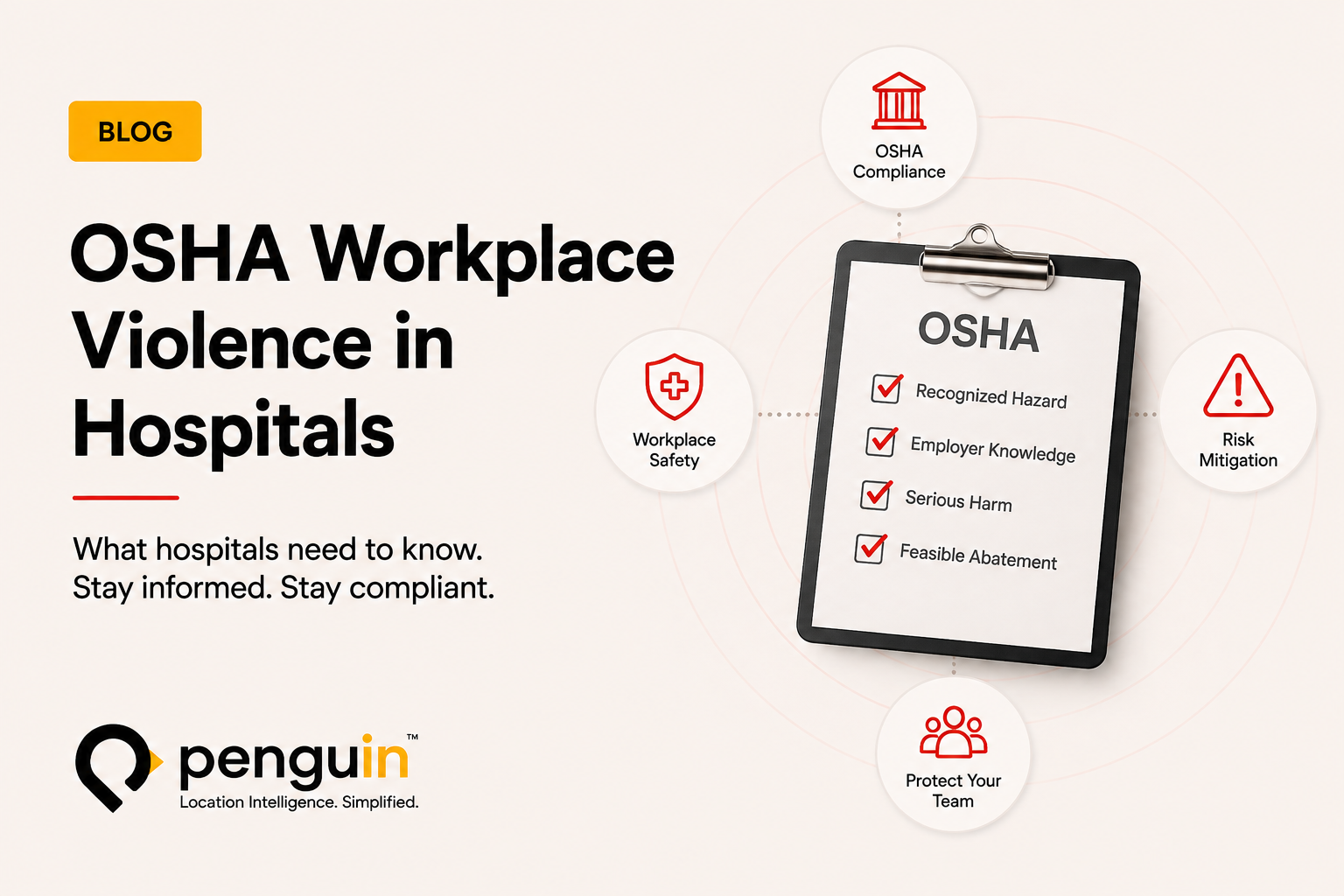
- A citation requires four elements: recognized hazard, employer knowledge, serious harm, and feasible means of abatement not implemented.
- Nursing carries nearly 4 times the duress risk of any other profession, according to industry data, this is OSHA’s “recognized hazard” evidence.
- Cal/OSHA’s dedicated workplace violence prevention standard takes effect December 2026, setting a precedent other states are actively tracking.
- An RTLS-based staff duress system, one that delivers room-level accuracy and documented alert trails, is the specific engineering control that satisfies the fourth citation element.
- Proposed federal deregulation for inherently risky professions does not eliminate General Duty Clause exposure. Hospitals that wait are accumulating risk, not avoiding it.
Table of Contents
› What Does OSHA Actually Require Hospitals to Do About Workplace Violence in 2026?
› How Widespread Is the Problem, and Why Is OSHA Treating It as a Recognized Hazard?
› How Does OSHA’s General Duty Clause Apply to Hospital Workplace Violence?
› What Are the Four Citation Elements, and What Does Each One Require Your Hospital to Do?
› How Does an RTLS-Based Staff Duress System Satisfy the ‘Feasible Abatement’ Requirement?
› What Do the 2026 State Laws Add to the Federal Baseline, and Does Cal/OSHA Change Everything?
› What Should Hospital Administrators Evaluate When Choosing a Workplace Violence Prevention Technology?
› Closing Thought
› Frequently Asked Questions
What Does OSHA Actually Require Hospitals to Do About Workplace Violence in 2026?
OSHA does not have a standalone healthcare workplace violence regulation at the federal level, at least not yet. What it does have is the General Duty Clause, and that clause is sufficient for enforcement. Under Section 5(a)(1) of the Occupational Safety and Health Act, every US employer must provide a workplace “free from recognized hazards that are causing or are likely to cause death or serious physical harm.” Workplace violence in hospitals meets every element of that definition, and OSHA has said so explicitly in its guidelines and enforcement actions.
In practice, what OSHA requires hospitals to do is threefold:
First, develop and maintain a written Workplace Violence Prevention Plan (WVPP) that identifies hazards specific to the facility, documents staff training, and describes the engineering and administrative controls in place.
Second, implement the controls described in that plan, and those controls must be real, documented, and operational. A plan that lists controls but cannot demonstrate deployment is not a defense; it is additional evidence of employer knowledge of an unaddressed hazard.
Third, demonstrate that the controls chosen represent feasible means of abatement, meaning they are technically possible, economically reasonable, and capable of materially reducing the hazard. This is the element most hospital administrators misunderstand. Feasibility is not aspirational. It is an evidentiary standard OSHA uses in enforcement proceedings.
The General Duty Clause does not require a perfect workplace. It requires documented action on recognized hazards. A hospital with a written plan, deployed technology, and recorded alert history is in a fundamentally different legal position than a hospital with a plan and no controls.
How Widespread Is the Problem, and Why Is OSHA Treating It as a Recognized Hazard?
The legal concept of a “recognized hazard” under the General Duty Clause has two sources: industry recognition and employer knowledge. Workplace violence against healthcare workers clears both bars without ambiguity.
The risk of staff duress in nursing is nearly four times that of any other profession, according to industry data. That single statistic is the kind of evidence OSHA uses to establish that the hazard is universally recognized across the healthcare industry, not just known to a particular employer.
The burnout data reinforces the exposure picture. According to the American Nurses Association, 56% of nurses report emotional exhaustion and burnout symptoms. According to industry data, more than 60% of nurses report symptoms of emotional fatigue, job dissatisfaction, and depersonalization. These are not abstract workforce metrics. They describe a clinical workforce operating under sustained pressure, which is directly correlated with increased vulnerability during patient interactions.
Isolation compounds the risk. According to HIMSS, nurses spend up to 60 minutes per shift searching for lost equipment. That time is spent alone, in supply rooms, in corridors, away from the nurse station, exactly the conditions that make duress incidents more likely and response more delayed.
In a 196-nurse study (industry data) at a North American hospital, 52 were classified low-risk for burnout, 110 moderate-risk, and 38 high-risk. The high-risk cohort represents staff who are most likely to be in crisis, least likely to ask for help, and most exposed to the physical and emotional conditions that precede a workplace violence incident.
Less than 30% of nurses feel adequately supported by hospital management in managing work-related stress, according to industry data. That gap between the scale of the hazard and the perceived organizational response is precisely what OSHA’s recognized hazard standard captures.
How Does OSHA’s General Duty Clause Apply to Hospital Workplace Violence?
The General Duty Clause is a catch-all provision. Congress designed it to address hazards that are real and serious but not yet covered by a specific OSHA standard. Workplace violence in healthcare is its textbook application.
OSHA has issued guidance documents, most notably its 2015 Guidelines for Preventing Workplace Violence for Healthcare and Social Service Workers, that establish the agency’s position: workplace violence in healthcare is a recognized hazard, hospitals are expected to address it through a hierarchy of controls, and the absence of documented engineering controls is an enforceable deficiency under the General Duty Clause.
“Employers are required to provide their employees with a place of employment that is free from recognized hazards that are causing or are likely to cause death or serious physical harm to the employees.”, OSH Act Section 5(a)(1), the General Duty Clause
OSHA’s enforcement approach focuses on the documented record. An inspector reviewing a citation will look for: evidence that the hospital knew about violence incidents (OSHA 300 logs, incident reports, police reports), evidence that the hospital assessed its risk (written hazard assessments), and evidence that it implemented, not just planned, controls proportionate to the assessed risk.
The deregulatory discussion in 2025 and 2026 has created some confusion. A proposed rulemaking in the Federal Register (2025) suggested limiting General Duty Clause applicability to professions with inherently dangerous conditions, the argument being that hospitals should not be cited for violence incidents that are intrinsic to caring for agitated patients. That proposal has not been finalized. Even if finalized in some form, it would not eliminate employer obligations: it would shift the burden of proof, requiring hospitals to demonstrate that their controls were proportionate to an unavoidable residual risk. The practical compliance response is identical in both scenarios: document the hazard, deploy engineering controls, maintain the records.
Hospitals that wait for regulatory certainty are making the costlier bet.
What Are the Four Citation Elements, and What Does Each One Require Your Hospital to Do?
To cite an employer under the General Duty Clause, OSHA must prove all four of the following elements. Understanding each element tells you exactly what your hospital needs to do, and document, to reduce citation risk. Explore Penguin’s workforce safety solutions for healthcare facilities alongside this checklist to see how each element maps to technology controls.
Element 1, The employer failed to keep the workplace free from a hazard.
OSHA must show that a hazard existed and that the employer did not eliminate or materially reduce it. For hospitals, this means OSHA will point to your OSHA 300 injury log, your incident reports, your employee complaints, and any police reports from the facility. What your hospital must do: Conduct a formal written hazard assessment of all units, document findings, and show that controls are calibrated to the findings. A hazard assessment that identifies the ED and psychiatric units as high-risk but deploys no additional controls in those units fails this element.
Element 2, The hazard was recognized.
OSHA can establish recognition either through industry-wide evidence (trade associations, published guidance, peer literature) or through employer-specific evidence (past incidents, complaints, prior OSHA notices). In healthcare, industry recognition is beyond dispute, OSHA’s own 2015 guidelines establish it. What your hospital must do: Acknowledge the hazard explicitly in your WVPP. A plan that describes “potential risks” vaguely is weaker than one that states “assault and battery of clinical staff by patients and visitors is a recognized hazard in acute care settings, as documented by OSHA and our facility incident history.” Explicit acknowledgment does not create liability, it demonstrates compliance with the recognition prong.
Element 3, The hazard was causing or likely to cause death or serious physical harm.
Assaults that result in contusions, lacerations, fractures, or psychological trauma qualify. OSHA does not require a fatality, serious physical harm is sufficient. The data is sufficient to meet this element in any US hospital: a profession carrying nearly 4 times the duress risk of the national average, with 56% of practitioners reporting emotional exhaustion per the American Nurses Association. What your hospital must do: Record all violent incidents in your OSHA 300 log accurately. Underreporting, which is endemic in healthcare, is itself a liability: it can be characterized as evidence of inadequate hazard recognition at audit, and it creates a gap between what your plan says and what your logs show.
Element 4, A feasible means of abatement existed that the employer failed to implement.
This is the element that separates hospitals with genuine compliance posture from those with paperwork. OSHA must show that a technically and economically feasible control existed and was not deployed. The engineering controls OSHA cites most consistently for healthcare workplace violence include: physical barriers, controlled access systems, alarm systems, and, most relevant to 2026, real-time staff location and duress alerting. What your hospital must do: Deploy at least one documented engineering control proportionate to your assessed risk level in each high-risk unit. The control must be operational, not planned. It must have a documented implementation date, a maintenance record, and a usage log showing it has been used or tested. A staff duress system with no alert history raises more questions than it answers.
Element 4 is where citations are won or lost. OSHA does not need to prove your hospital was negligent. It needs to prove a feasible control existed and was not deployed. In 2026, RTLS-based staff duress systems are that control, documented, commercially available, and deployed in hospitals of comparable size and risk profile.
How Does an RTLS-Based Staff Duress System Satisfy the ‘Feasible Abatement’ Requirement?
The term “feasible means of abatement” has two components under OSHA’s enforcement framework: technical feasibility and economic feasibility. An RTLS-based staff duress system satisfies both, and it satisfies them with documentation that legacy panic buttons cannot match.
Technical Feasibility: Why Room-Level Accuracy Matters for OSHA
A traditional panic button tells security that an alert was triggered somewhere in the building. A legacy wired duress system might narrow that to a floor or zone. Neither produces the specific, actionable location evidence that OSHA’s engineering control standard requires, or that security needs in a real incident.
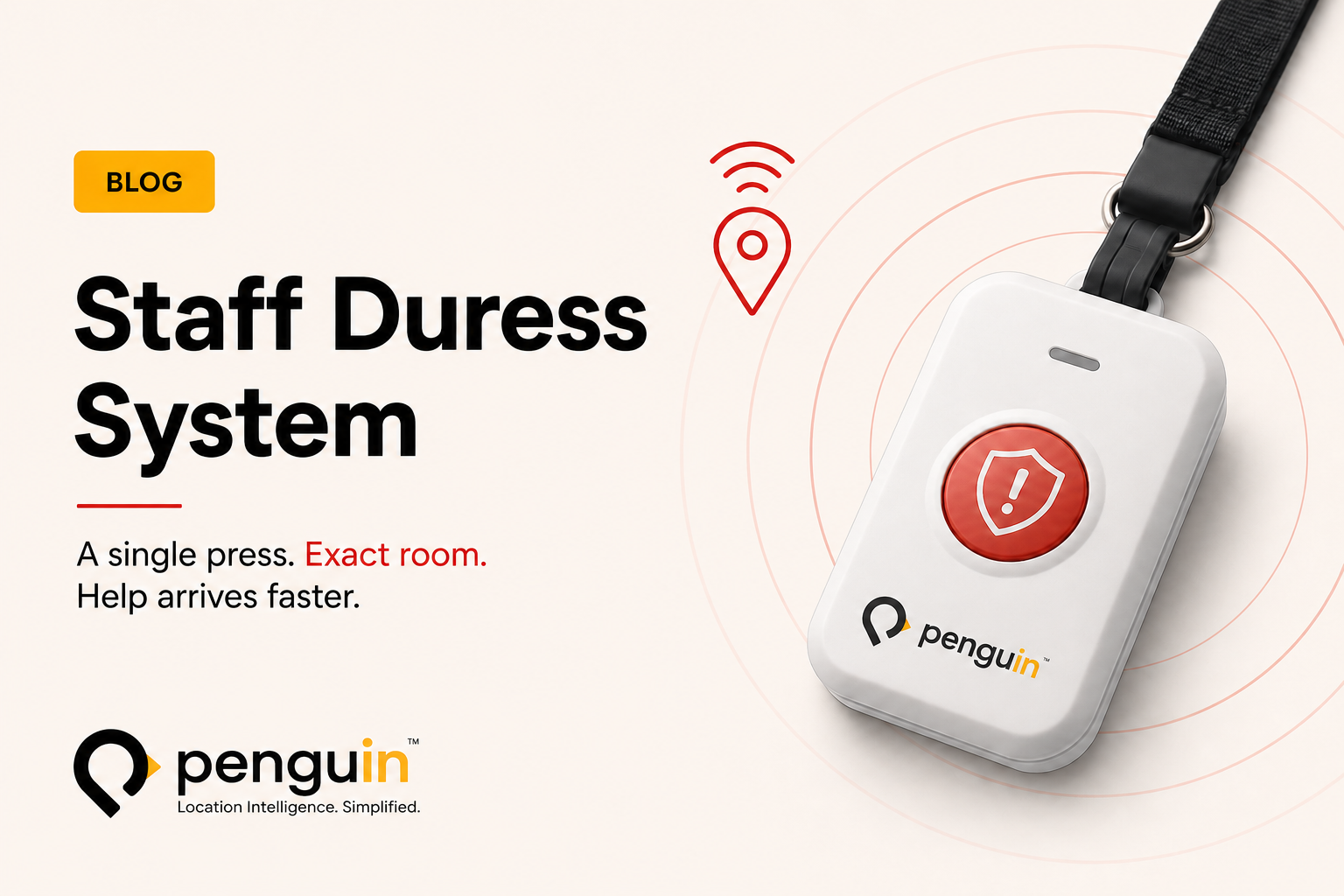
An RTLS-based staff duress system uses BLE 5.1 wearable badges paired with a location engine to deliver room-level accuracy in real time. When a nurse triggers a silent duress alert, security receives the nurse’s exact room, not a floor, not a wing, not a coordinate that straddles a shared wall between two adjacent spaces. Room-level accuracy is a life-safety requirement for duress, not an operational preference. Responding to the wrong room costs seconds that cannot be recovered.
For OSHA purposes, the technical feasibility argument is documented by commercial availability. RTLS-based duress platforms are deployed in hospitals of comparable size and clinical complexity across North America. That commercial deployment record is exactly the evidence OSHA uses to establish that a control is technically feasible for an employer of your type, and that a hospital which has not deployed it cannot claim the control was unavailable.
To understand how RTLS-based staff duress systems work in hospital settings, including gateway placement, badge configuration, and alert routing, the technical architecture is straightforward: BLE 5.1 wearable badges transmit continuously to BLE gateways mounted on ceilings or walls throughout the facility. The location engine processes those signals using AI/ML algorithms, analyzing the totality of signals across all antenna elements, not just angle-of-arrival estimates, to resolve the badge’s exact room with certainty. When the nurse presses the badge, the alert routes instantly to the security platform with a real-time location pin.
Economic Feasibility: What “Proportionate Cost” Means in Practice
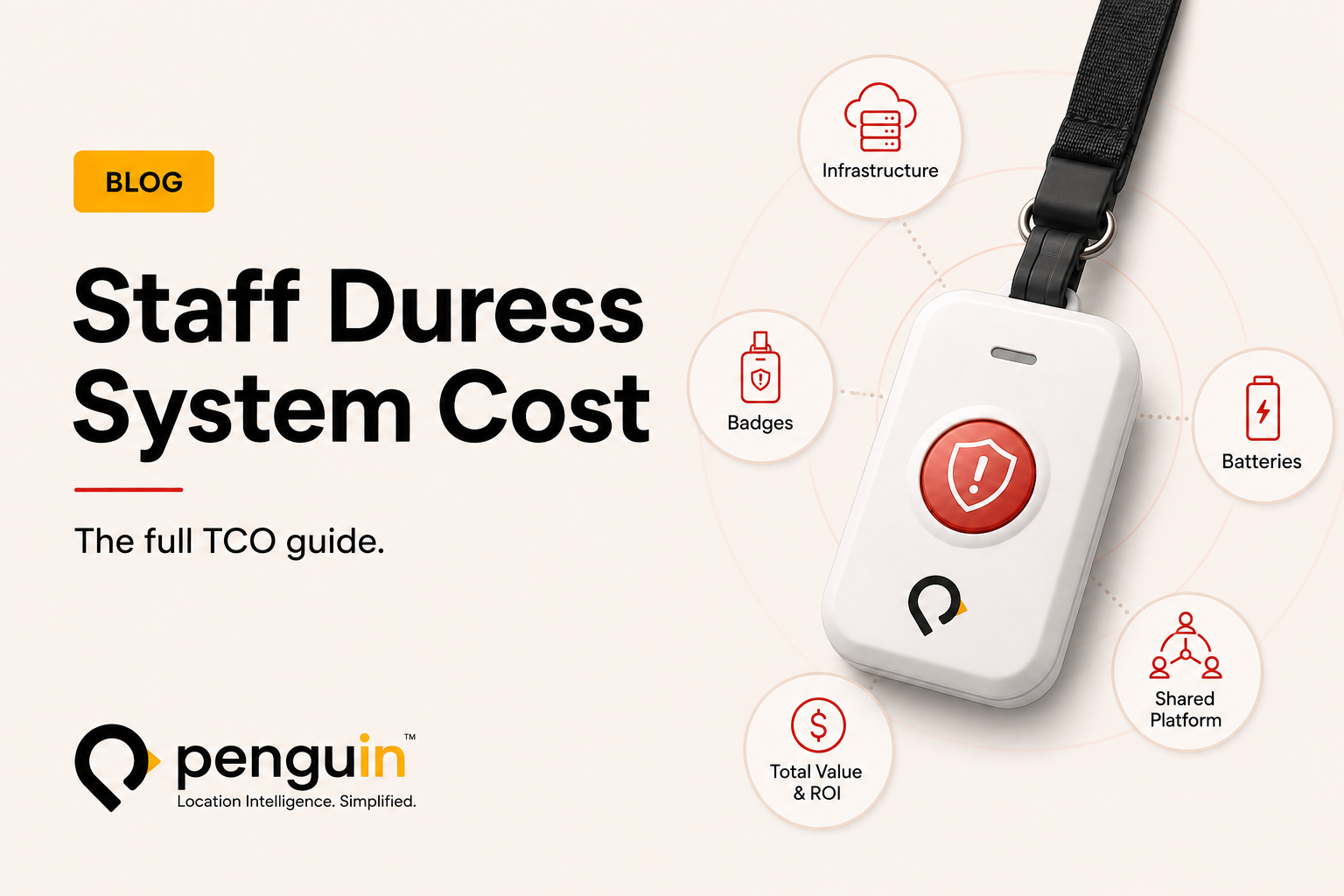
Economic feasibility under the General Duty Clause does not mean lowest-priced. It means the cost of the control is not so disproportionate to the employer’s resources that implementation would be unreasonable. For hospitals with annual operating budgets in the tens or hundreds of millions, a staff duress deployment costing $300,000–$500,000 for a 200-bed facility clears that bar without ambiguity.
Modern BLE 5.1-based duress platforms are substantially less expensive than the proprietary infrastructure-based systems that preceded them. BLE 5.1 hardware is produced at commodity scale. No proprietary wireless networks are required. No dedicated hardwired locator runs are needed. Existing enterprise infrastructure supports the deployment. The cost argument that once made RTLS economically unfeasible for mid-size hospitals no longer holds.
The PenSafe staff duress platform from Penguin Location Services uses standard BLE 5.1 wearable badges paired with Penguin’s AI/ML location engine to deliver room-level accuracy with minimal infrastructure. The platform integrates with existing nurse call systems, access control, and security monitoring platforms, producing the documented alert trail that OSHA’s feasible abatement standard requires. Configurable escalation paths route alerts to charge nurses, security teams, and management simultaneously, so the response chain is as documented as the control itself.
What Do the 2026 State Laws Add to the Federal Baseline, and Does Cal/OSHA Change Everything?
The federal General Duty Clause sets the floor. State laws in 2026 are raising it, and California is raising it furthest.
California (Cal/OSHA): California’s dedicated Cal/OSHA workplace violence prevention standard for healthcare takes effect in December 2026. It requires hospitals to maintain a written WVPP, conduct annual workplace violence hazard assessments, provide unit-level training, and implement engineering controls documented in the plan. For California hospitals, this is no longer a General Duty Clause risk calculation, it is a specific standard with specific audit criteria. For hospitals in other states, California’s standard is the clearest preview of where federal rulemaking is heading.
Virginia: Virginia amended its workplace violence reporting requirements for healthcare facilities in 2025, adding real-time incident documentation obligations that increase the paper trail available to OSHA inspectors. A Virginia hospital that is not documenting incidents accurately is now simultaneously exposed to state penalty and producing deficient records that weaken its federal General Duty Clause defense.
Washington and Missouri: Both states have enacted or significantly strengthened healthcare workplace violence prevention laws, adding training requirements and hazard assessment mandates on top of the federal baseline. Utah has moved in the same direction. The state patchwork is not converging on uniformity, it is converging on escalating requirements.
The question hospital administrators outside California sometimes ask is whether their state’s relative inaction provides cover. It does not. OSHA’s federal General Duty Clause enforcement operates independently of state law. A Texas or Florida hospital with no state-specific violence prevention mandate is still subject to federal enforcement on exactly the same four-element standard as a California hospital. The only difference is that the California hospital also faces a specific state standard with its own penalties.
The North American trend is consistent. For Canadian hospitals navigating parallel obligations under provincial law, our analysis of Bill 168 workplace violence requirements for Ontario hospitals shows how legislative frameworks differ in structure but converge on the same operational outcome: documented hazard assessment, written prevention plan, and deployed engineering controls. US and Canadian administrators facing these obligations are asking the same questions.
Penguin’s healthcare RTLS solutions are deployed across hospital networks in North America and the Middle East, environments that span multiple regulatory frameworks and have tested the platform against real-world compliance audit requirements.
What Should Hospital Administrators Evaluate When Choosing a Workplace Violence Prevention Technology?
Not all staff duress systems produce equivalent OSHA compliance documentation. The evaluation criteria below map directly to what OSHA inspectors and legal counsel will look for when auditing your engineering controls. For broader context on how the category has changed, our article on how staff duress technology has evolved beyond legacy panic buttons covers the spectrum from hardwired pull stations to modern RTLS-based platforms.
Does the system produce room-level location accuracy, not just a floor or zone?
This is the non-negotiable criterion. A duress system that tells security “third floor, north wing” is not the same as one that routes responders to “Room 314.” For OSHA purposes, room-level accuracy is what distinguishes a documented engineering control from a ceremonial one. Zone-level accuracy may suffice for asset tracking; for staff duress, it introduces response delays that are both operationally dangerous and legally problematic. Ask vendors for accuracy validation data, not marketing claims.
Does the platform produce a documented alert trail that survives an OSHA audit?
An alert log, timestamped, room-specific, linked to the responding staff member, is the documentation your legal counsel needs if OSHA opens an inspection. Systems that alert in real time but do not maintain a retrievable historical record of every alert, location, response time, and outcome are incomplete as compliance controls. Before selecting a platform, ask the vendor to show you the incident report output. If it cannot export a compliance-grade record, it will not serve your OSHA defense.
Does the system integrate with your existing nurse call and security infrastructure?
A duress platform that operates as an island, separate from your nurse call system, your access control, and your security monitoring station, creates response gaps that undermine its value as an engineering control. Integration means that a triggered duress alert simultaneously notifies the charge nurse, routes to the security desk, and can trigger door lock or access control responses in high-risk units. The integration capability is also a deployment cost factor: a system that requires a parallel infrastructure build is more expensive than one that layers on top of your existing network.
Is the wearable badge form factor designed for clinical wear patterns?
A staff duress badge that nurses find cumbersome, forget to charge, or leave in their locker is not a deployed engineering control, it is a liability. Badge form factor, battery life, charging workflow, and clip or lanyard compatibility all affect real-world adoption. Ask vendors for adoption rate data from comparable deployments. A platform with 95% theoretical coverage and 60% actual daily wear is not providing the protection your WVPP describes.
The OSHA audit question is not whether you purchased a duress system. It is whether staff were wearing it, whether it was operational, and whether the alert history reflects actual use. Deployment records matter as much as the technology itself.
Closing Thought
The General Duty Clause has required US hospitals to address workplace violence since 1970. What has changed in 2026 is the enforcement environment, the state legislative landscape, and the commercial availability of the specific engineering controls OSHA’s fourth citation element requires. A hospital that cannot demonstrate a deployed, documented, room-accurate staff duress system is carrying an exposure it can reduce, and in a regulatory environment where Cal/OSHA’s standard takes effect in December and federal enforcement actions are accelerating, the cost of that exposure is rising every quarter.
For hospital administrators evaluating their options, the question is no longer whether to deploy a staff duress system. It is how to choose the right one, one that delivers room-level accuracy for real-time response, produces a compliance-grade alert trail for OSHA documentation, integrates with existing infrastructure, and achieves genuine staff adoption rather than ceremonial deployment.
The proposed federal deregulation changes nothing operationally. Hospitals that act now reduce their exposure under current law. They build the documentation record that protects them regardless of how rulemaking resolves. And they protect the nurses who are carrying four times the duress risk of any other profession in the American workforce.
Frequently Asked Questions
The following questions represent the most common queries from US hospital administrators, safety officers, legal counsel, and clinical engineering teams evaluating OSHA workplace violence compliance requirements in 2026.
Q: Does OSHA have a specific workplace violence standard for hospitals, or does it use the General Duty Clause?
OSHA does not have a finalized federal standard specifically governing workplace violence in hospitals as of 2026. Enforcement relies on the General Duty Clause (Section 5(a)(1) of the OSH Act), supported by OSHA’s 2015 Guidelines for Preventing Workplace Violence for Healthcare and Social Service Workers. That guidance document, while not a binding standard, establishes the agency’s enforcement expectations and is used by inspectors to evaluate whether a hospital’s controls are proportionate to its assessed risk. A dedicated federal standard has been under development for years, but rulemaking timelines remain uncertain. The General Duty Clause is sufficient for citation and penalty in the interim.
Q: What is the “feasible means of abatement” requirement under OSHA’s General Duty Clause?
Feasible means of abatement is the fourth element OSHA must establish in a General Duty Clause citation. It requires OSHA to show that a control existed, technically possible and economically reasonable for an employer of the cited hospital’s type and size, that would materially reduce or eliminate the hazard, and that the employer failed to implement it. For workplace violence in hospitals, OSHA has consistently identified engineering controls including alarm systems, controlled access, physical barriers, and real-time staff location and alerting as feasible abatement measures. The commercial availability of RTLS-based staff duress systems at current price points makes the economic feasibility argument difficult for hospitals to contest.
Q: What happens if a hospital gets cited under OSHA’s General Duty Clause for workplace violence?
A General Duty Clause citation for workplace violence is classified as a serious violation, carrying a penalty of up to $16,131 per violation as of current OSHA penalty tables (adjusted annually for inflation). Willful or repeated violations carry penalties up to $161,323 per instance. Beyond the direct financial penalty, a citation creates a documented enforcement record, which is discoverable in civil litigation brought by injured staff. Hospitals that have received a prior citation and have not implemented the abatement measures specified in the citation agreement face elevated repeat-violation exposure. The litigation risk from an injured employee who can point to an unaddressed OSHA citation substantially exceeds the penalty itself.
Q: Does the proposed OSHA deregulation for inherently risky professions mean hospitals can wait before acting?
No. The proposed Federal Register rulemaking (2025) that would limit General Duty Clause applicability to professions with inherently dangerous conditions has not been finalized. Even if it were finalized, it would shift the burden of proof rather than eliminate the obligation, hospitals would need to demonstrate that their controls were proportionate to an unavoidable residual risk, which requires the same documentation as current compliance: written hazard assessment, deployed controls, maintenance records, and alert history. Waiting for regulatory certainty produces a hospital that has accumulated a larger incident history with less documentation than a hospital that acted. The compliance response is the same in both scenarios; the risk calculus favors acting now.
Q: How does California’s new Cal/OSHA workplace violence standard affect hospitals in other states?
California’s dedicated workplace violence prevention standard for healthcare takes effect in December 2026 and establishes specific requirements: written WVPP, annual hazard assessments, unit-level training, and documented engineering controls. For California hospitals, this is a binding standard with specific audit criteria, separate from and in addition to the federal General Duty Clause. For hospitals in other states, Cal/OSHA’s standard is the clearest signal of where federal rulemaking is heading and where other progressive state legislatures are looking for models. The practical effect is that a hospital in any state that builds its WVPP and engineering controls to meet California’s standard will be well-positioned regardless of how federal or state rulemaking evolves in its own jurisdiction.
Q: What documentation does a hospital need to demonstrate compliance with OSHA workplace violence requirements?
At minimum, OSHA inspectors reviewing a General Duty Clause workplace violence matter will look for: a written Workplace Violence Prevention Plan (WVPP) current within the last 12 months; a unit-level hazard assessment with documented findings and control mappings; OSHA 300 and 301 logs with accurate violent incident recording; staff training records; engineering control deployment records including implementation dates, maintenance logs, and system test records; and, for duress systems specifically, an alert history showing the system has been operational and used. A gap in any of these categories is evidence of an unaddressed recognition or abatement failure. The documentation does not need to be perfect, it needs to be honest, current, and proportionate to the assessed risk level.
Q: How is an RTLS-based staff duress system different from a standard panic button for OSHA compliance purposes?
The critical difference is location specificity and documentation. A standard panic button confirms that an alert was triggered; it does not reliably identify where the staff member is at the time of the alert. An RTLS-based system delivers room-level location in real time, routing responders to the specific room where the nurse is, not to a floor or zone. For OSHA compliance, this distinction matters because “feasible means of abatement” is evaluated against the hazard’s severity and the control’s capacity to materially reduce it. A system that cannot reliably locate the distressed employee to a specific room is harder to characterize as effective abatement in a serious incident. The RTLS platform also produces a timestamped, location-specific alert log that serves as the compliance documentation record a panic button system typically cannot generate.
Q: What workplace violence prevention plan does OSHA require hospitals to maintain in 2026?
Under the General Duty Clause, OSHA does not prescribe a specific WVPP format, but its 2015 guidelines describe five core program elements that inspectors use as an evaluation framework: management commitment and employee involvement; worksite analysis (unit-level hazard assessment); hazard prevention and control (hierarchy of engineering, administrative, and behavioral controls); safety and health training; and recordkeeping and program evaluation. California’s December 2026 standard goes further, requiring specific plan components, annual review cycles, and employee participation procedures. Hospitals building or updating their WVPP in 2026 should use California’s standard as the template regardless of their state, since it represents the most fully developed regulatory articulation of what a defensible plan looks like.
Penguin Location Services provides RTLS-based staff safety solutions for hospitals and healthcare networks across North America and the Middle East. Our PenSafe staff duress platform delivers room-level accuracy, configurable escalation paths, and compliance-grade alert documentation, the specific engineering control that satisfies OSHA’s feasible abatement standard. To discuss how PenSafe supports your workplace violence prevention plan, visit penguinin.com/pensafe or explore our workforce safety solutions for healthcare facilities.