
Penguin Location Services is excited to announce its strategic technology partnership with Cisco Meraki and is now proudly featured on the Meraki.io app store platform, advancing digital workplace transformation through cutting-edge indoor positioning solutions.
“We recently launched our indoor positioning solutions with Cisco DNA Spaces and today we continue to expand our collaboration with the extended Cisco ecosystem by offering comprehensive location-based application use cases through the meraki.io app store marketplace.”
Penguin Location Services delivers AI-powered location intelligence through three product suites: PenNav (indoor navigation), PenTrack (RTLS tracking and workflow), and PenSafe (enterprise safety). This page covers how Penguin’s RTLS platform works alongside Meraki network infrastructure.
What Is RTLS?
Real-Time Location Systems, commonly referred to as RTLS, are technology platforms that determine and continuously track the precise physical location of people, assets, and equipment inside buildings, campuses, and complex facilities, in real time.
Unlike GPS, which works outdoors using satellite signals, RTLS is designed specifically for indoor environments where satellite signals cannot penetrate. RTLS uses a combination of wireless infrastructure, including Bluetooth Low Energy (BLE), Wi-Fi, QR codes, and sensor networks, to calculate and update the location of tagged objects or people continuously.
The result is a live, digital map of your facility showing exactly where things are, where people are, how they move, and how spaces are being used. This data is the foundation of what Penguin Location Services calls Location Intelligence, turning raw positioning data into actionable operational insights.
Location Intelligence is not just knowing where something is. It is understanding what that location data means for your operations, your people, and your outcomes.
RTLS is not a single product, it is a platform that powers multiple enterprise applications simultaneously. A hospital deploying RTLS might use the same underlying infrastructure to navigate patients to appointments, track infusion pumps, protect staff with panic alert systems, monitor hand hygiene compliance, and prevent at-risk patients from wandering, all from one unified platform.
Penguin Location Services and Cisco Meraki: RTLS on Your Existing Network
This page is published as an official documentation reference for Penguin Location Services’ listing on the Cisco Meraki Marketplace. If you arrived here from the Meraki Marketplace or are evaluating Penguin as a Meraki-compatible RTLS partner, this section is for you.
Why Meraki and Penguin Work Together
Cisco Meraki is one of the most widely deployed enterprise networking platforms in the world, used across hospitals, universities, airports, enterprise campuses, and industrial facilities in every major market. Meraki’s cloud-managed Wi-Fi and networking infrastructure creates a foundation that Penguin Location Services is purpose-built to extend.
Rather than requiring organizations to install a parallel, proprietary wireless network to support RTLS, Penguin’s platform is designed to operate on top of existing Meraki infrastructure. This means organizations that have already invested in Meraki networking can layer real-time location intelligence, asset tracking, indoor navigation, staff safety, workflow analytics, on top of that investment, without a separate network buildout.
If your facility already runs on Cisco Meraki, you already have the network foundation for enterprise RTLS. Penguin turns that existing infrastructure into a location intelligence platform.
Use Cases Supported on Meraki Infrastructure
The strategic partnership with Cisco Meraki offers existing and future enterprise clients access to comprehensive location-based applications. These include:
A Note on Integration Depth
Penguin’s integration with Cisco Meraki is designed to be additive and non-disruptive. Your Meraki network configuration, management, and security posture remain unchanged. Penguin adds a location intelligence layer that reads from the network environment without modifying it. Implementation is managed by Penguin’s deployment team and requires no changes to your Meraki dashboard or network architecture.
For detailed technical integration documentation, deployment requirements, or to discuss how Penguin can work within your specific Meraki environment, contact our team directly.
The Five Core Applications of RTLS
RTLS technology powers five primary categories of enterprise applications. Understanding how these work, and how they interconnect, is the foundation for evaluating any location intelligence platform.
Indoor Navigation and Wayfinding
Indoor navigation solves one of the most fundamental challenges in large facilities: helping people find where they need to go. In hospitals, airports, university campuses, and large commercial buildings, the inability to navigate efficiently has measurable consequences, missed appointments, congestion at information desks, frustrated visitors, and unnecessary staff time spent giving directions.
There are two primary approaches to indoor navigation:
Active navigation (beacon-based mobile): Users receive real-time, turn-by-turn guidance on their smartphones as they move through the building, powered by beacon infrastructure.
Passive navigation (QR code and kiosk): Users scan a QR code at their current location, which instantly opens a map in their phone’s browser with directions, no app download required. Ideal for visitor-facing deployments where speed and cost matter most.
For a complete breakdown of how indoor navigation works across different environments, see our Indoor Navigation Complete Guide.
Asset Tracking
Asset tracking is the most operationally mature use case for RTLS in enterprise and healthcare environments. Hospitals contain thousands of mobile assets, IV pumps, wheelchairs, beds, ECG machines, ultrasound devices, that move constantly between departments, floors, and buildings.
Without RTLS, clinical staff spend significant time searching for equipment. Studies in hospital settings document nurses spending 30 to 60 minutes per shift locating equipment. At scale, this represents tens of thousands of hours of clinical time diverted from patient care annually. For a detailed look at the ROI of hospital asset tracking, see our hospital asset tracking guide.
Key outcomes that RTLS asset tracking delivers:
- Equipment utilization improvement: Right-sizing inventories and reducing unnecessary rental costs.
- Loss and shrinkage reduction: Chokepoint alerts notify staff when assets move through exits or restricted zones.
- Search time elimination: Any asset locatable in seconds via a map-based dashboard.
- Maintenance and compliance tracking: Usage-based service triggers rather than fixed schedules.
- PAR level management: Automatic alerts when equipment quantities per zone drop below acceptable levels.
Workflow Optimization and Operational Intelligence
Operational Intelligence is the application of AI-powered analytics to real-time location data, transforming raw positional signals into decisions that improve how a facility runs. This is the fastest-evolving category in RTLS and the one that delivers the highest long-term enterprise value.
Where traditional RTLS answers the question “where is it?”, Operational Intelligence answers the questions that actually drive business outcomes: Where are the bottlenecks in our patient flow? Which zones are chronically understaffed? How does equipment utilization correlate with patient wait times?
Penguin’s AI-powered Operational Intelligence layer sits on top of the location engine, continuously analyzing movement data, space utilization, workflow patterns, and time-in-zone metrics to surface insights that human operators would never see manually.
Core capabilities within Operational Intelligence:
- Staff deployment analytics: Real-time visibility into which staff are in which zones, with AI-driven recommendations for optimal deployment based on demand patterns.
- Patient flow optimization: Measuring throughput across triage, consultation, procedure, and discharge stages. Identifying where delays accumulate and automatically alerting coordinators when thresholds are breached.
- Space utilization intelligence: Understanding which rooms, floors, and zones are over- or under-utilized, informing capital planning, redesign decisions, and dynamic space allocation.
- Occupancy-triggered automation: Integrating with building management systems to adjust HVAC, lighting, and access control based on real-time occupancy, reducing energy costs and improving compliance.
- Predictive maintenance: Using equipment location and usage patterns to forecast when assets will require servicing, shifting from reactive to proactive maintenance cycles.
Automated Attendance and Presence Detection
Traditional attendance systems, biometric scanners, card swipes, manual sign-in, create friction, introduce compliance gaps, and generate data that is difficult to audit. RTLS-based automated attendance replaces these with passive, location-based presence detection that is continuous, accurate, and tamper-resistant.
Key advantages:
- No tap-in required: Presence detected automatically, eliminating manual check-in and proxy attendance.
- Hot-desking and hybrid workplace management: RTLS data enables dynamic desk allocation, meeting room management, and workplace analytics without manual check-in processes.
- Zone-specific granularity: Track attendance not just for a building but for specific rooms, floors, or functional areas.
- Real-time reporting: Live dashboard of who is present, where, and for how long.
- HR system integration: Automated payroll and record-keeping, reducing administrative overhead.
Enterprise Safety and Compliance
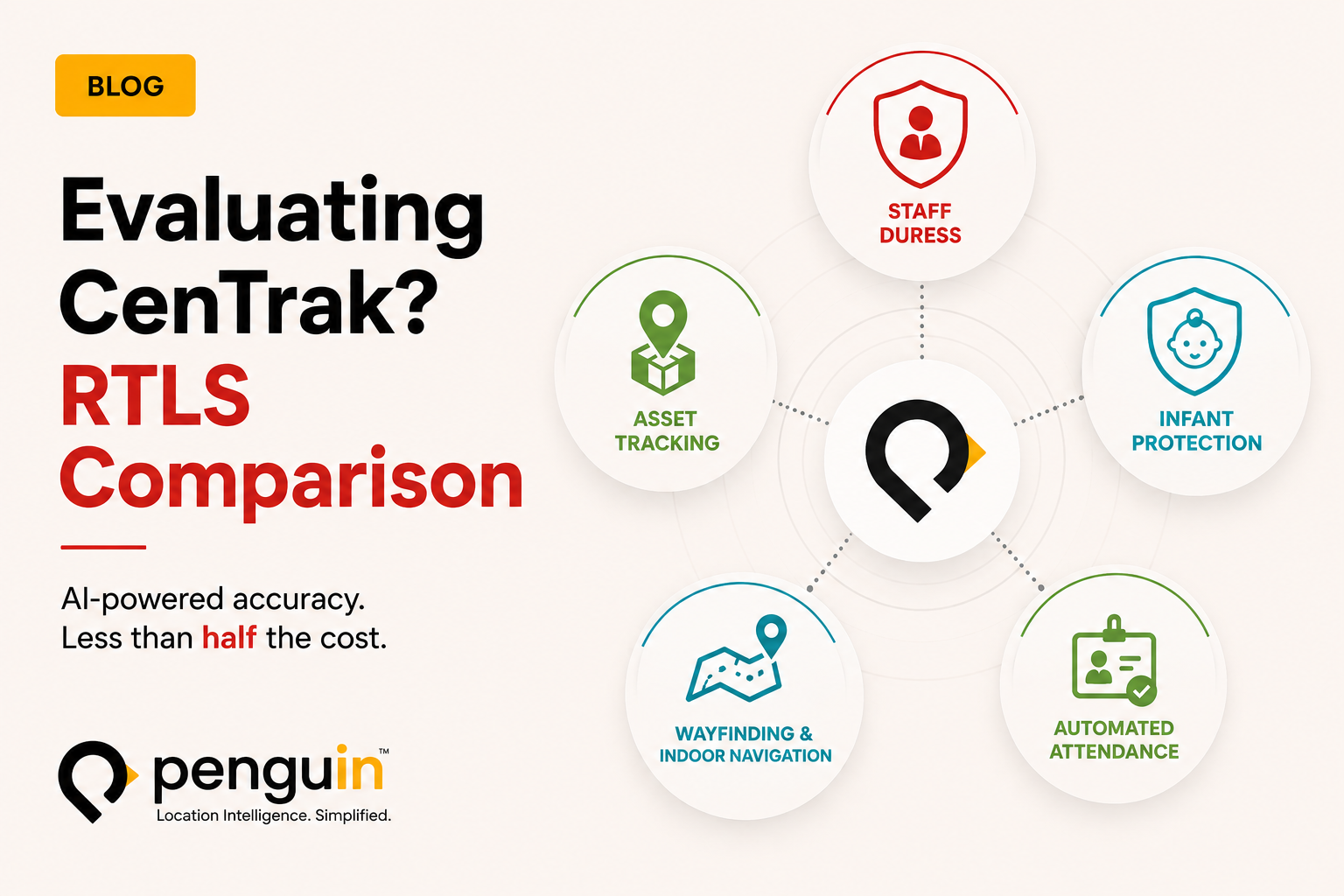
RTLS-powered safety systems apply real-time location intelligence to the protection of staff, patients, vulnerable individuals, and physical environments. In healthcare, this spans staff duress alerting, infant protection, wander prevention, and infection control. In industrial settings, it extends to worker safety monitoring, emergency response, and hazardous zone compliance.
Penguin’s safety solutions are available through PenSafe, covering every safety use case on a single BLE 5.1 sensor infrastructure.
AI-Powered Location Intelligence: Smarter Decisions for Healthcare
Real-time location data becomes exponentially more valuable when artificial intelligence is applied to it. AI does not replace the location engine, it sits on top of it, continuously learning from movement patterns, operational rhythms, and environmental signals to surface insights, predict problems, and recommend actions faster than any human analyst could.
Penguin Location Services has built AI-powered analytics directly into its platform, making Operational Intelligence available not as an add-on but as a core capability.
Healthcare is the most data-rich, operationally complex, and high-stakes environment where RTLS operates. Hospitals run 24 hours a day, manage thousands of assets, serve hundreds of patients simultaneously, and operate under regulatory scrutiny that demands documentation of nearly every decision. AI-powered RTLS is uniquely positioned to make hospitals safer, more efficient, and more responsive.
Predicting and Preventing Patient Deterioration
When RTLS location data combines with clinical data feeds, from EHR systems, nurse call platforms, and monitoring devices, AI can identify early warning patterns that predict patient deterioration. If a patient who has been stationary begins showing movement patterns consistent with disorientation, combined with vital sign deviations, an AI layer can flag this for immediate clinical review before a fall or adverse event occurs.
Eliminating the Equipment Search Problem
AI-powered asset tracking goes beyond showing where an IV pump is right now. It learns the utilization patterns of every asset category, which pumps get used on which floors, at which times, across which patient populations. Over time, it can predict when a shortage is likely to occur on a given ward before it happens, automatically triggering restocking workflows or flagging underutilized equipment elsewhere in the facility.
Staff Burnout Detection and Prevention
Nurse burnout costs the healthcare industry billions annually in turnover and diminished care quality. AI-powered RTLS can analyze staff movement patterns, time spent on high-demand tasks, frequency of interruptions, time pressure across shift cycles, to identify early indicators of burnout risk at the individual and team level. Managers receive actionable intelligence to intervene before staff reach the point of crisis.
Download the Penguin white paper on AI and nurse burnout prevention →
Hand Hygiene and Infection Control Intelligence
AI analysis of hand hygiene data goes far beyond compliance percentages. By correlating staff movement patterns, dispenser interaction data, patient room assignments, and infection event logs, AI can identify which specific behavioral patterns correlate most strongly with HAI transmission risk, and target intervention at exactly the right touchpoints rather than applying blanket protocols uniformly.
Operational Flow and Capacity Optimization
One of the most transformative applications of AI in healthcare RTLS is real-time capacity intelligence. By modeling patient flow across the entire facility, from emergency department triage through to discharge, AI can predict bottlenecks before they form, suggest dynamic bed reallocation, and alert administrators to emerging capacity constraints hours before they become crises. The result is a hospital that does not just react to operational problems, it anticipates and prevents them.
How to Evaluate an RTLS Platform: A Buyer’s Framework
Selecting an RTLS provider is a significant investment. The following dimensions are critical to evaluate when comparing platforms and vendors.
- Accuracy and technology foundation: Understand the underlying technology (BLE, Wi-Fi, QR) and verify accuracy in environments similar to your own.
- Infrastructure requirements: Assess hardware installation scope, density requirements, and total cost of ownership across the full lifecycle.
- Software and dashboard capabilities: The software layer is where operational value is delivered. Evaluate map management, analytics, alert configuration, and API availability.
- Integration ecosystem: Verify the vendor’s track record integrating with EHR, CMMS, nurse call, BMS, access control, and HR systems.
- Scalability: Can the platform expand to additional buildings, use cases, and tags without architectural change?
- Deployment and support model: Evaluate implementation methodology, project management, and post-deployment support, especially for live hospital or industrial environments.
Penguin Location Services: Our Full RTLS Platform
Penguin Location Services is a specialist location intelligence provider built on a unified AI-powered location engine. Our three product suites, PenNav, PenTrack, and PenSafe, share a common infrastructure and data layer, enabling organizations to deploy one solution and expand to others without replacing their foundation.
· Deployed across 4M+ sq ft · 10+ multi-campus environments · 70+ experts worldwide
PenNav, Indoor Navigation Solutions
PenNav Pro, Beacon-Powered Turn-by-Turn Navigation
PenNav Pro delivers a premium indoor navigation experience using beacon infrastructure installed throughout a facility. Users receive real-time, turn-by-turn directions on their mobile devices across multi-floor, multi-building environments. Designed for hospitals, airports, universities, and enterprise campuses where continuous real-time positioning is required.
- Real-time position tracking as users move through the facility
- Multi-floor navigation with elevator and stairwell guidance
- Points of interest directory and search
- SDK for integration with existing mobile applications
- Analytics on navigation usage, popular destinations, and user flows
PenNav Q, QR Code Wayfinding
PenNav Q is Penguin’s instant-access wayfinding solution and the most cost-effective indoor navigation deployment model available. Users scan a QR code posted anywhere in the facility, their phone’s browser instantly opens an interactive map with directions. No app, no login, no hardware investment beyond printed codes.
- Instant QR-to-directions, no app installation required
- Works on any smartphone browser
- Virtual kiosk and digital signage integration
- Fast, low-cost deployment, no beacon hardware required
- Visitor movement insights and destination analytics
PenTrack, RTLS Asset Tracking and Operational Intelligence
Asset Tracking
Complete real-time visibility over mobile equipment and assets. Long-life wireless tags transmit continuous location data to a centralized dashboard, supporting par-level management, chokepoint alerts, utilization reporting, and CMMS integration.
Workflow and Operational Intelligence
AI-powered analytics on staff, patient, and visitor movement across the facility. Identifies bottlenecks, automates alerts, measures space utilization, and delivers the operational intelligence layer that transforms location data into management decisions.
Automated Attendance
Passive, zone-based presence detection for staff and students. Fully configurable for different zones, shifts, and compliance rules. Integrates with HR and payroll systems for automated, auditable reporting.
PenSafe, Location-Enabled Enterprise Safety
Workforce Safety and Staff Duress
Badge-based panic alerting with precise real-time location. Instant notification to designated responders with the staff member’s exact position. Critical for healthcare, education, and high-risk industrial environments.
Infant Protection
Secure anklet tags for newborns with geo-fencing and instant alerts. Integrates with access control and public announcement systems to prevent abduction and protocol violations in maternity wards.
Wander Prevention
Continuous monitoring of at-risk patients, including those with dementia, memory loss, or behavioral health conditions. Instant caregiver alerts when patients cross defined boundaries. Minimizes elopement risk and reduces manual supervision burden.
Hand Hygiene Compliance
Dispenser sensors integrated with real-time staff location tracking. Zone-level and role-level compliance reporting with automated protocol violation alerts. Directly linked to HAI prevention outcomes in healthcare environments.
Frequently Asked Questions About RTLS
The following questions represent the most common queries from healthcare administrators, facility managers, procurement leaders, and technology teams evaluating real-time location systems.
What is RTLS and how does it work?
RTLS, Real-Time Location System, is a technology platform that tracks the precise location of people, assets, and equipment inside buildings in real time. Unlike GPS, which uses satellites and works outdoors, RTLS is designed specifically for indoor environments where satellite signals cannot reach.
Small wireless tags attach to assets or are worn by people. These tags continuously broadcast a signal, typically using Bluetooth Low Energy or Wi-Fi. Fixed sensors installed throughout the building receive these signals and calculate each tag’s location. A central software platform processes all of this data and displays it as a live map, updated in real time.
More advanced RTLS systems, like Penguin’s, layer artificial intelligence on top of this location engine. Rather than just showing where things are, the AI analyzes movement patterns, identifies anomalies, predicts problems, and delivers operational intelligence that informs smarter decisions.
RTLS answers three questions no other technology can answer at scale: Where is it right now? Where has it been? What does that pattern mean for my operations?
What is staff duress, and why does it matter in healthcare?
Staff duress refers to a situation in which a healthcare worker is under threat, facing verbal aggression, physical assault, or a dangerous emergency, and needs to summon immediate help. In hospitals and healthcare environments, workplace violence against clinical staff is a serious and growing problem.
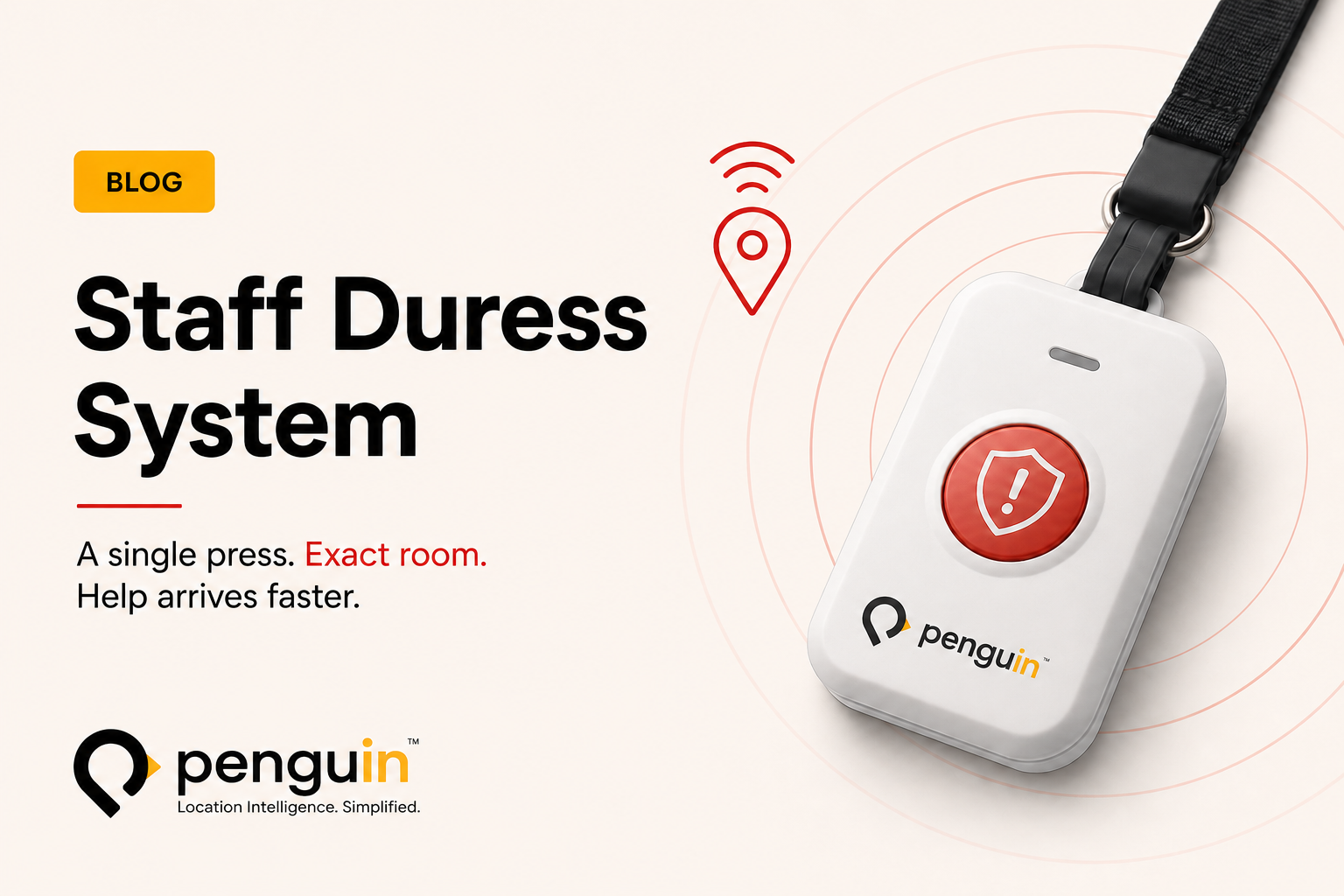
A staff duress system allows a worker to trigger an emergency alert instantly and discreetly, typically by pressing a button on a wearable badge. The moment that button is pressed, designated responders receive an immediate alert, and the system displays the precise real-time location of the staff member who triggered the alert.
This combination, instant notification plus exact location, is what makes RTLS-powered staff duress fundamentally different from older systems like pull-cord alarms or manual radio calls. Responders do not have to search. They know exactly which room the staff member is in. Response times drop from minutes to seconds.
Staff duress systems also serve a compliance function. Regulations in several jurisdictions, including healthcare accreditation bodies and occupational health and safety standards, increasingly require facilities to demonstrate active measures to protect staff from workplace violence. For a full breakdown, see our guide on RTLS staff duress in hospitals.
What is indoor navigation and what is indoor wayfinding?
Indoor wayfinding is the broader concept, any system that helps people orient themselves and find their way through a physical indoor space. This can be printed directional signs, static floor maps, digital wayfinding kiosks, or QR-based maps.
Indoor navigation is a more specific and sophisticated capability: the technology knows where the user currently is and provides dynamic, real-time, turn-by-turn directions, adapting as the user moves. This is the indoor equivalent of how Google Maps works outdoors.
The practical difference matters for deployment decisions. QR-based wayfinding (like PenNav Q) establishes the user’s starting point from the QR code location and provides a static route. Beacon-based indoor navigation (like PenNav Pro) tracks the user’s position continuously as they move and updates the route in real time. For most healthcare facilities, the right answer combines both approaches.
Can RTLS be affordable? How do you deploy it without a massive infrastructure investment?
Yes, and this is one of the most important shifts in the RTLS industry over the past several years. RTLS was historically associated with expensive, proprietary hardware and long payback periods. That perception is outdated.
Several factors have fundamentally changed the cost structure of RTLS deployment. Modern RTLS platforms work with the Wi-Fi and BLE infrastructure that most enterprise facilities already have installed. Instead of expensive proprietary tags, modern platforms use commodity BLE tags that cost a fraction of what proprietary tags cost a decade ago. QR-based wayfinding solutions like PenNav Q require no beacon infrastructure at all. SaaS pricing models spread cost over time and align with operational budgets. Modular deployment means you can start with asset tracking in your highest-value area, demonstrate ROI, and expand from there.
The ROI case makes affordability a relative question. A hospital that deploys asset tracking and reduces equipment rental costs by even 20% typically recovers the full cost of deployment within 12 to 18 months.
Why is RTLS asset tracking important?
Healthcare facilities are among the most asset-intensive environments in the world. A typical medium-sized hospital manages thousands of mobile medical devices that move constantly between departments, floors, storage rooms, and patient areas. Without RTLS, clinical staff spend 30 to 60 minutes per shift searching for equipment. Facilities over-purchase because they cannot account for what they already own. Equipment sits idle while other departments rent additional units at high daily rates.
RTLS asset tracking solves all of these problems simultaneously. Every tagged asset is findable in seconds. Utilization analysis reveals which assets are chronically idle and where the mismatches exist between supply and demand. PAR level alerts notify staff when counts drop below configured thresholds. Chokepoint alerts trigger when assets approach exits or restricted zones. For detailed ROI documentation, see our healthcare asset tracking ROI guide.
What industries use real-time location systems?
RTLS technology is deployed across a broad range of industries. The common thread is complexity, large physical environments where people, equipment, or assets need to be located, managed, or guided efficiently.
Healthcare is the largest and most mature RTLS market. Hospitals use RTLS for asset tracking, patient flow management, staff safety, infant protection, wander prevention, and hand hygiene compliance.
Oil and Gas and Industrial facilities use RTLS for worker safety monitoring, permit-to-work compliance, hazardous zone enforcement, emergency mustering, and equipment tracking.
Education institutions deploy RTLS for automated student and staff attendance across large multi-campus footprints, campus navigation, and space utilization analytics.
Airports and Transportation Hubs use indoor navigation to reduce passenger confusion, decrease missed boarding events, and reduce pressure on ground staff answering wayfinding questions.
Enterprise and Commercial Real Estate campuses use RTLS to manage hybrid workplaces, hot-desking, meeting room management, and space utilization reporting.
Retail and Hospitality environments use indoor navigation to guide shoppers and guests, analyze foot traffic patterns, and manage staff deployment across large floor areas.
Does Penguin integrate with Cisco Meraki?
Yes. Penguin Location Services is a listed partner on the Cisco Meraki Marketplace, and our RTLS platform is designed to operate on top of existing Meraki network infrastructure.
The core principle is simple: rather than requiring you to install a separate, proprietary wireless network, Penguin leverages the Meraki infrastructure you already have. Your Meraki network continues to function exactly as it does today, same configuration, same management, same security posture. Penguin adds a location intelligence layer on top of it without modifying anything in your Meraki environment.
Use cases supported on Meraki-connected facilities include asset tracking, indoor wayfinding (PenNav Q requires no additional hardware), staff safety and duress alerting, automated attendance, and workflow analytics. For detailed technical integration documentation or to discuss deployment in your specific Meraki environment, contact our team.
Resources and Downloads
Case Studies
- STC Smart Campus, Indoor navigation across a 40-acre mixed-use technology campus in Saudi Arabia
- KAFD (King Abdullah Financial District), Wayfinding across 1.6 million square meters in central Riyadh
- MNGHA / King Abdulaziz Medical City, Patient navigation in one of Saudi Arabia’s largest healthcare institutions
- KSAU, RTLS-based automated student attendance across 14 colleges on 3 campuses
White Papers
- Asset Tracking Buyer’s Guide for Healthcare, How RTLS reduces search time, optimizes utilization, and saves costs
- AI + Operational Intelligence White Paper, How AI transforms raw location data into predictive operational intelligence
- The Burnout Epidemic in Nursing, How location intelligence supports staff wellbeing and reduces turnover
© Penguin Location Services | penguinin.com | Published as a documentation reference for Cisco Meraki Marketplace partners | penguinin.com/documentation-meraki