
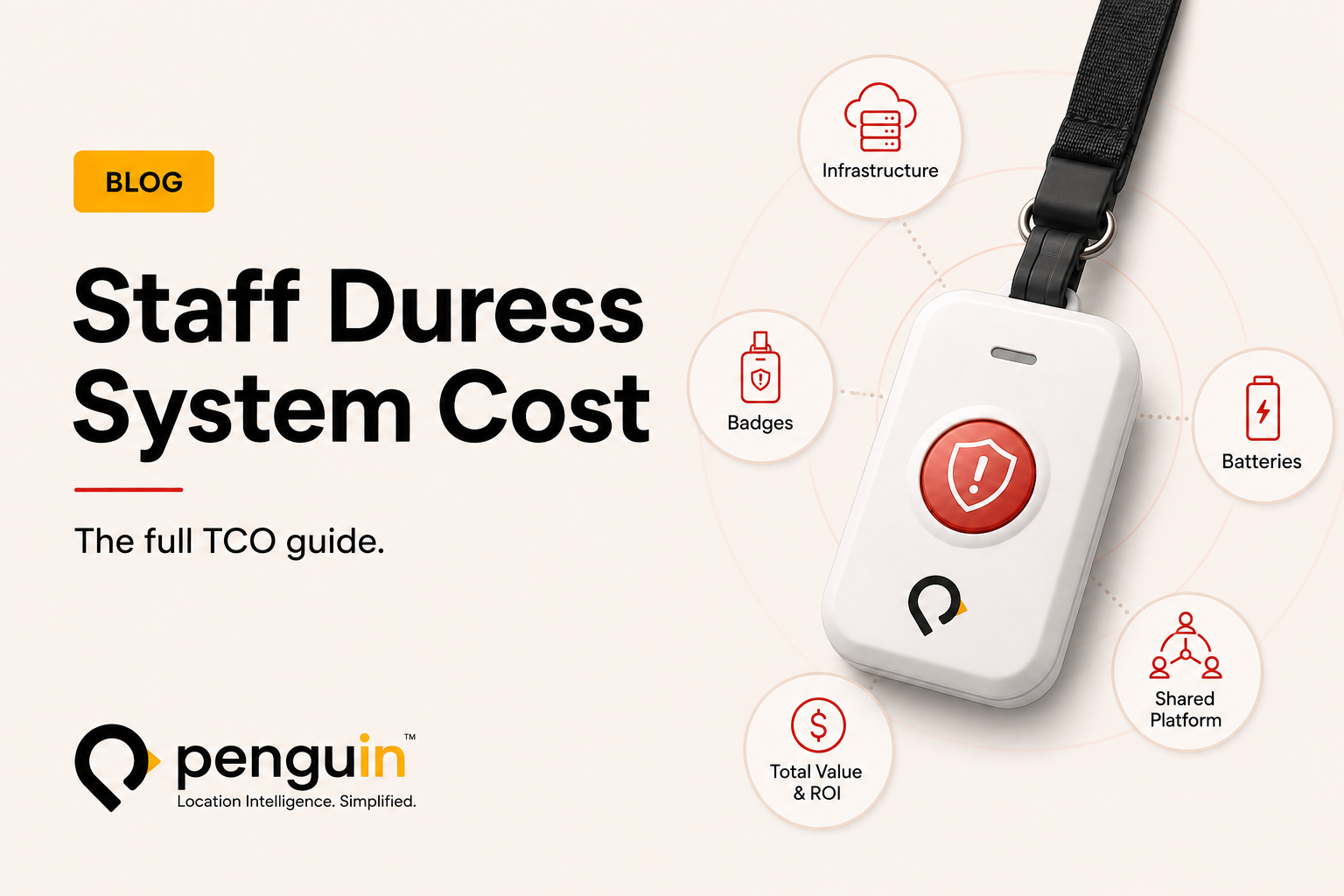
A hospital staff duress system costs between $300,000 and $500,000 for a modern BLE 5.1 deployment at a 200-bed facility, or more than $2,000,000 if you are still buying legacy proprietary infrastructure. That gap is not a rounding error. It is the difference between a capital project your board approves and one that dies in committee. The risk that justifies the investment is real: nursing staff face duress at nearly four times the rate of any other profession, according to Penguin Location Services. The financial case to act has never been stronger, or easier to make.
The problem is that most hospital administrators walk into a vendor conversation without a financial model. They get a proposal with a total number, no line-item breakdown, and no honest comparison to what the alternative actually costs over seven years. The $300K vs. $2M gap exists, but nobody in the industry has published the data behind it. Badge battery economics alone can swing your total cost of ownership by hundreds of thousands of dollars over a deployment lifecycle. That story has never been the headline of a serious buyer’s guide.
This guide changes that. It breaks down every cost driver in a hospital staff duress system, infrastructure, tags, software, maintenance, and battery economics. It compares legacy proprietary systems to modern BLE 5.1 deployments with actual numbers. It shows you how to build a board-ready ROI model. And it explains how a shared RTLS platform converts a single-use safety line item into an operational investment that pays for itself across multiple use cases.
What Does a Hospital Staff Duress System Actually Cost?
The short answer: it depends on which generation of technology you are buying. The long answer is why this guide exists.
A legacy proprietary staff duress system at a 200-bed hospital typically runs $1,500,000 to $2,500,000 for full deployment. That number includes proprietary locators hardwired into ceilings, proprietary tags that cost $300–$800 each, a closed software platform with annual license fees, and an ongoing battery replacement program that never ends. Most proposals do not show you this math across seven years. They show you year one.
A modern BLE 5.1 staff duress system at the same 200-bed hospital runs $300,000 to $500,000. Standard off-the-shelf hardware. No proprietary networks. Rechargeable badges that eliminate the disposable battery cost entirely. Software that integrates with the systems you already own.
The delta is not incremental. It is transformational.
According to the Kaiser Family Foundation, hospital operating margins rebounded to an average of 5.2%, but 39% of hospitals still reported negative margins. For those CFOs, a $2M safety system is a non-starter. A $400K system with a defensible ROI model is a fundable project.
The question is not whether your nurses need a duress system. The question is whether your financial model can survive the vendor you are about to call.
Why Legacy Staff Duress Systems Cost So Much More Than You Think
Legacy systems were built on a closed-infrastructure model. The vendor sells you proprietary locators that only work with their proprietary tags, running on a proprietary network that only their software can read. Every component locks you in. Every upgrade requires their approval. Every hardware failure requires their technician.
The cost consequences compound over time.
Infrastructure Lock-In
Proprietary locators require hardwired installation, conduit, cabling, junction boxes, and electrician labor for every unit across every floor. A 200-bed hospital might require 400–600 locator units at $400–$800 per unit, before installation labor. That is $200,000–$500,000 in infrastructure before you have tagged a single nurse.
When the vendor releases a new generation of hardware, you cannot upgrade selectively. The proprietary protocol means the old locators and new tags are incompatible. You buy the infrastructure again.
Tag Unit Cost
Legacy staff duress badges cost $300–$800 per unit. A 200-bed hospital typically needs one badge per clinical FTE on shift, plus spares, that is commonly 250–400 badges in active circulation. At $500 average per badge, the tag fleet alone costs $125,000–$200,000. And those badges use disposable batteries.
That last fact matters more than most proposals acknowledge. We cover it in detail in the battery economics section below.
Software and Annual Fees
Proprietary platforms charge annual license fees of $50,000–$150,000 for a mid-sized hospital deployment. Maintenance contracts typically add 15–20% of the hardware cost per year. Neither fee disappears after year one. Over seven years, the software and maintenance line alone can exceed the original hardware investment.
“The total cost of ownership for a legacy duress system at a 200-bed hospital frequently exceeds $2 million over seven years, yet the year-one proposal rarely shows more than $800,000.”, Penguin Location Services competitive positioning analysis
How Modern BLE 5.1 Staff Duress Systems Drive Cost Down
The cost revolution in staff duress systems traces directly to one technology shift: BLE 5.1, combined with AI-powered location algorithms that extract room-level accuracy from standard, mass-produced hardware.
BLE 5.1 hardware is manufactured at commodity scale. Over 646 million BLE-enabled devices are in active use across hospitals, clinics, and medical offices, according to Penguin’s 2024 RTLS whitepaper. That volume drives unit costs to a fraction of what proprietary locators cost. You are not buying a specialty product, you are buying from a global supply chain that already serves the consumer electronics industry.
For readers who want a deeper explanation of how the technology works before engaging with the cost data, our guide on how RTLS staff duress works in hospitals covers the full mechanism, BLE gateways, wearable tags, the MUSIC algorithm, and room-level location resolution.
No Proprietary Network Required
Modern BLE 5.1 systems deploy on existing enterprise infrastructure. No hardwired proprietary locators. No dedicated wireless network. Existing Wi-Fi access points and standard BLE gateways handle signal collection, and the AI layer does the heavy lifting on location resolution. Installation labor drops dramatically when you are not pulling cable to 500 ceiling-mounted proprietary units.
Room-Level Accuracy Without Legacy Infrastructure
The critical accuracy requirement for staff duress is room-level, not sub-meter coordinates, and not floor-level zones. When a nurse triggers a silent duress alert, security cannot afford ambiguity. A sub-meter coordinate that sits on a shared wall boundary between two adjacent rooms sends responders to one of two possible rooms. Responding to the wrong room costs seconds that matter.
Modern BLE 5.1 systems with AI pattern detection resolve the exact room with certainty, even at wall boundaries. That is the life-safety requirement. Legacy proprietary systems required supplemental infrared or ultrasound hardware to achieve this, adding infrastructure cost and maintenance overhead. BLE 5.1 achieves it with the same standard hardware used for everything else on the platform.
What Are the Real Cost Drivers? A Line-by-Line Breakdown
Every staff duress proposal contains the same five cost categories. The difference between a $400K project and a $2M project lives in how each category is priced, and what the vendor does not put on the line item at all.
1. Infrastructure (Locators / Gateways)
Legacy: $200,000–$500,000 for hardwired proprietary locators, installed.
Modern BLE 5.1: $50,000–$120,000 for standard BLE gateways, largely leveraging existing Wi-Fi cabling.
2. Wearable Tags / Badges
Legacy: $300–$800 per badge. Fleet of 250–400 badges: $75,000–$320,000.
Modern rechargeable: A fraction of legacy badge cost. Rechargeable design eliminates battery replacement cost across the full fleet lifecycle.
3. Software Platform
Legacy: $50,000–$150,000/year in license fees. Proprietary platform with limited integration.
Modern: Integrated platform with EHR, nurse call, and access control. Annual fees structured per-use-case or per-bed, with transparent pricing.
4. Installation and Commissioning
Legacy: $100,000–$250,000 in electrician and integration labor for hardwired proprietary infrastructure.
Modern BLE 5.1: $30,000–$80,000. Standard mounting, no conduit runs, faster commissioning timeline.
5. Ongoing Maintenance
Legacy: 15–20% of hardware cost per year. Proprietary parts. Vendor-only servicing.
Modern: Standard hardware maintained by in-house biomedical or IT teams. Vendor maintenance contracts are optional, not mandatory.
Behavioral health units represent a distinct deployment scenario worth noting here. Higher badge density requirements, tamper-resistant enclosures, and extended alert escalation paths add cost, but the BLE 5.1 infrastructure model still delivers meaningful savings versus proprietary alternatives. Our dedicated guide on staff safety in behavioral health facilities covers the specific design requirements and cost implications for those environments.
The line item most CFOs miss is not on the proposal. It is the battery replacement program that runs for the entire life of the system, every badge, every ward, every quarter, forever.
The Hidden Cost Nobody Puts in the Proposal: Badge Battery Economics
This is the cost argument that changes the conversation, and almost no vendor surfaces it voluntarily.
Legacy staff duress badges use disposable batteries. A typical badge battery lasts 60–90 days under active use. A 200-bed hospital with 300 active badges replaces batteries 1,200–1,500 times per year. At $3–$5 per battery replacement (parts plus labor), that is $3,600–$7,500 per year. Over seven years: $25,000–$52,500 in battery replacement costs alone.
That math understates the real burden. Battery replacement is not just a parts cost, it is a labor cost. Someone tracks which badges are low. Someone collects them, replaces the batteries, and redistributes them. In a busy clinical environment, that process fails. Dead badges go unnoticed. A nurse triggers a duress alert with a badge that has been dead for three days.
A dead badge in a duress situation is not a maintenance failure. It is a patient safety failure and a liability event.
The Rechargeable Badge Model
Modern rechargeable staff duress badges eliminate this entirely. Badges charge at the end of each shift, the same way a mobile phone charges. No disposable batteries. No battery replacement program. No tracking which badge is due for a change. No dead badge on shift.
The unit cost of a rechargeable badge is a fraction of a legacy disposable-battery badge. Combined with zero ongoing battery replacement overhead, rechargeable badge savings over seven years frequently exceed the hardware cost difference between a legacy and modern system. That is not a marketing claim, it is arithmetic the CFO can verify with the vendor’s own SKU pricing.
Ask every vendor you evaluate: what is the battery replacement cost for your badge fleet over seven years? If they cannot answer that question on the spot, you are looking at an unquantified ongoing cost that will appear in your operational budget every year for the life of the system.
How to Build the ROI Case for Board Approval
A board-ready ROI model for a staff duress system has four components: cost avoidance, liability reduction, retention impact, and regulatory compliance value. Each can be quantified with numbers already in your possession.
Cost Avoidance: Nurse Retention
Nursing turnover costs $40,000–$60,000 per nurse in recruitment, onboarding, and lost productivity. The risk of duress incidents in nursing is nearly four times that of any other profession, according to Penguin Location Services. Nurses who experience unresolved safety incidents leave at higher rates. A measurable improvement in incident response time and staff confidence directly reduces that turnover cost. If a staff duress system retains five nurses who would otherwise leave, the avoided cost is $200,000–$300,000, in year one alone.
For a broader picture of the financial case for workforce safety investment, our workforce safety solutions page covers the retention ROI model in full.
Liability Reduction
Unresolved workplace violence incidents generate legal exposure. A documented, defensible duress response system, with timestamped location data showing exactly where staff were when an alert was triggered and how quickly security responded, is evidence in any legal proceeding. It is also evidence for OSHA compliance. The cost of one unresolved liability event routinely exceeds the cost of the entire duress system.
Insurance Premium Impact
Some hospital liability insurers offer premium reductions for documented workplace violence prevention investments. The reduction percentage varies by insurer and state, but it is a direct, recurring cash benefit that belongs in your TCO model.
Regulatory Compliance Value
OSHA’s workplace violence prevention guidance and Joint Commission Environment of Care standards both create compliance obligations that a documented duress system satisfies. The cost of a corrective action plan or citation is not zero, and it is not budgeted. Include it as a risk-adjusted cost avoidance item.
The board does not need to believe in staff safety to approve this project. They need to believe the math. Build the model with retention cost, liability exposure, and regulatory risk, and the $400K investment becomes the cheaper option on every line.
How PenSafe Delivers Staff Duress on a Shared RTLS Platform
The most important cost argument for a modern staff duress system is one that rarely appears in the vendor’s proposal: shared infrastructure.
The PenSafe staff duress platform runs on the same BLE 5.1 infrastructure as Penguin’s asset tracking, patient elopement prevention, infant protection, and hand hygiene compliance solutions. The gateways, the network, the location engine, all shared. Deploy staff duress today, and when the board approves asset tracking next year, you are not buying new infrastructure. You are adding a use case to infrastructure you already own.
That shared infrastructure model fundamentally changes the per-use-case cost calculation. A dedicated, single-purpose staff duress system costs $300,000–$500,000 for a 200-bed hospital. A multi-use RTLS platform that includes staff duress, asset tracking, and workflow automation can deliver three or four funded use cases on infrastructure that costs the same $300,000–$500,000. The per-use-case cost drops to $100,000–$170,000. That is a capital project that funds itself across departments.
What PenSafe Delivers at the Clinical Level
When a nurse wearing a PenSafe badge feels threatened, she presses the badge. The alert triggers silently and immediately, no voice call, no visible action that escalates the situation. The centralized platform shows the exact room where the alert originated in real time. Security receives the location-specific alert and responds directly to the right room. Escalation paths are configurable: charge nurse, security team, management, in whatever sequence your clinical operations require.
PenSafe uses BLE 5.1 and the MUSIC algorithm’s AI pattern detection to resolve room-level location with certainty, even at wall boundaries where sub-meter coordinates alone would be ambiguous. For staff duress, room-level accuracy is a life-safety requirement, not a feature preference.
The largest hospital group in the Middle East has deployed PenSafe for staff duress across its network, alongside infant protection, hand hygiene compliance monitoring, and wander prevention, all running on the same shared BLE 5.1 infrastructure.
What the Regulatory Landscape Adds to Your Cost Calculation
Regulatory pressure on hospital workplace violence is not static. It is accelerating, and that acceleration has a direct cost implication for hospitals that delay investment.
OSHA has maintained General Duty Clause obligations for workplace violence prevention since 1970. Its 2015 healthcare-specific guidelines and subsequent enforcement activity make clear that hospitals without documented prevention programs face citation risk. Cal/OSHA enacted mandatory workplace violence prevention regulations for California hospitals in 2018. Federal OSHA proposed a formal healthcare workplace violence rule that would create enforceable standards nationwide. Each escalation increases the compliance cost of inaction.
The Joint Commission Environment of Care standard EC.02.01.01 requires hospitals to manage risks associated with the care environment, which accreditation surveyors have increasingly interpreted to include staff safety from workplace violence. A hospital that cannot demonstrate a functioning duress response system during a survey faces findings that require corrective action plans, documentation, and follow-up reviews. That process is not free.
For a complete mapping of OSHA’s workplace violence prevention obligations and how a staff duress system satisfies each requirement, our article on OSHA workplace violence prevention standards for hospitals covers the regulatory framework in full.
The strategic context for hospital administrators is this: the cost of regulatory non-compliance is not fixed. It compounds as regulations tighten. A hospital that invests in a documented, functional duress system today acquires an asset with increasing regulatory value over time. A hospital that delays funds a growing liability.
For administrators evaluating the full scope of their RTLS investment across staff safety, asset tracking, and patient flow, the Penguin healthcare RTLS platform overview maps each regulatory obligation to a specific platform capability.
56% of nurses report emotional exhaustion and burnout symptoms, according to the American Nurses Association. A workforce that does not feel safe does not stay. The regulatory cost of inaction and the retention cost of inaction are the same problem.
What CFOs and Administrators Should Ask Before Signing Any Contract
These are the seven questions that separate a well-structured procurement from an expensive regret.
What is the seven-year total cost of ownership, including badge battery replacement?
If the vendor cannot provide this number, ask them to model it. A proposal that shows only year-one hardware cost is not a TCO, it is a down payment disclosure. Get the full seven-year model in writing before signing.
Are the badges rechargeable or disposable-battery?
Rechargeable badges eliminate a perpetual operational overhead. Disposable-battery badges create a permanent maintenance program and a failure mode (dead badge on shift) that has safety consequences. This question alone filters out a generation of legacy products.
Is the infrastructure proprietary or standard BLE 5.1?
Proprietary infrastructure locks you into a single vendor for every future upgrade. Standard BLE 5.1 infrastructure supports competitive hardware sourcing, lower replacement costs, and multi-use-case deployment without additional infrastructure investment.
What accuracy does the system deliver, and how is room-level resolved at wall boundaries?
Zone-level accuracy is insufficient for staff duress. Ask specifically how the system resolves a location when the badge coordinate falls on a shared wall between two adjacent rooms. A credible answer names the algorithm and explains the AI layer. A non-answer reveals that the system cannot do it.
Does the platform support additional use cases on the same infrastructure?
A single-use staff duress system is a single-use cost. A shared RTLS platform amortizes the infrastructure cost across asset tracking, patient elopement, hand hygiene compliance, and other funded use cases. The per-use-case cost of a shared platform is dramatically lower than building separate point solutions.
What are the annual software license and maintenance contract terms?
Get the year-three and year-five renewal pricing in writing at signing. Vendors that offer favorable year-one pricing and reserve the right to increase license fees at renewal are selling you a subscription, not a capital asset. Understand what you are buying.
What integration does the platform support, and at what cost?
A duress system that does not integrate with your nurse call system, access control, and security command center is a standalone silo. Integration with EHR, HL7, and nurse call platforms is standard on modern systems. Ask for the integration list and the cost of each integration project.
The Financial Decision in Front of You
For hospital CFOs evaluating staff duress system options in 2026, the technology question is settled. BLE 5.1 delivers room-level accuracy without proprietary infrastructure, at $300,000–$500,000 versus $2,000,000+ for legacy systems at a 200-bed hospital. Rechargeable badges eliminate an ongoing operational cost that compounds invisibly for the life of the deployment. Shared RTLS infrastructure converts a single-use safety line item into a multi-use platform investment.
The remaining question is not whether to invest. It is which system to choose, and whether the vendor you are evaluating has been honest about the seven-year cost of what they are selling you.
The system that costs least in year one is rarely the system that costs least by year seven. The vendor who answers the battery question, the proprietary infrastructure question, and the seven-year TCO question without hesitation is the vendor who has built a product they can defend financially. That is the vendor worth your board presentation.
Frequently Asked Questions
The following questions represent the most common queries from hospital CFOs, administrators, and procurement teams evaluating staff duress system investments and pricing.
Q: How much does a hospital staff duress system cost in 2026?
A modern BLE 5.1 staff duress system costs $300,000–$500,000 for a 200-bed hospital, including infrastructure, badges, software, and installation. Legacy proprietary systems at the same scale run $1,500,000–$2,500,000. The difference comes from infrastructure model (standard vs. proprietary), badge unit cost ($300–$800 legacy vs. a fraction for modern rechargeable), and annual software licensing. Over seven years, the TCO gap between legacy and modern systems frequently exceeds $1,000,000 at a 200-bed hospital when badge battery replacement and maintenance escalation are included.
Q: What is the difference between a legacy staff duress system and a modern RTLS-based system?
Legacy systems use proprietary locators hardwired into ceilings, proprietary tags with disposable batteries, and closed software platforms with limited integration. Modern RTLS-based systems use standard BLE 5.1 hardware, rechargeable badges, and open platforms that integrate with EHR, nurse call, and access control systems. The accuracy difference matters clinically: legacy systems required supplemental infrared or ultrasound hardware to achieve room-level accuracy. Modern BLE 5.1 systems with AI pattern detection achieve room-level location resolution on standard hardware, without the supplemental infrastructure cost.
Q: How many staff duress badges does a 200-bed hospital need?
A 200-bed hospital typically needs 250–400 active badges, sized to cover one badge per clinical FTE per shift plus a spare inventory buffer of 10–15%. High-acuity units, emergency departments, and behavioral health floors require higher badge density. The badge fleet size directly drives both the hardware cost and, for disposable-battery systems, the ongoing battery replacement program. Sizing the fleet accurately before procurement prevents both under-coverage (staff without badges on shift) and over-procurement (idle inventory that still requires maintenance).
Q: Do rechargeable staff duress badges really save money compared to disposable ones?
Yes, the math is straightforward. A 300-badge fleet using disposable batteries at a 60–90 day replacement cycle requires 1,200–1,500 battery replacements per year. At $3–$5 per replacement in parts and labor, that is $3,600–$7,500 annually, or $25,000–$52,500 over seven years, before accounting for the operational overhead of tracking which badges are low. Rechargeable badges eliminate this entirely: badges charge at shift end, battery status is monitored automatically, and the replacement program does not exist. The unit cost of a rechargeable badge is also a fraction of a legacy disposable-battery badge, meaning the savings compound from day one.
Q: Can a staff duress system run on our existing hospital Wi-Fi network?
Modern BLE 5.1 staff duress systems are designed to leverage existing enterprise network infrastructure, which substantially reduces installation cost compared to legacy proprietary networks. However, BLE 5.1 gateways are typically distinct from Wi-Fi access points, they collect BLE signals from wearable badges and transmit data over the existing wired or wireless network. The key question for your IT team is gateway placement density: room-level accuracy requires adequate gateway coverage per square foot. A site survey will confirm whether your existing infrastructure can support the required coverage or whether supplemental gateways are needed.
Q: Does a staff duress system satisfy Joint Commission and OSHA workplace violence requirements?
A documented, functional staff duress system contributes directly to Joint Commission Environment of Care standard EC.02.01.01 compliance and supports OSHA’s General Duty Clause obligation to provide a workplace free from recognized hazards. The critical word is “documented”, the system must generate timestamped location data showing alert origin, response time, and escalation path. That audit trail is what satisfies surveyors and OSHA inspectors. A duress button that triggers a call to the security desk without location data is not the same as a location-specific, escalation-mapped, audit-logged duress system. Ask vendors specifically what compliance documentation the system generates automatically.
Q: What is the total cost of ownership for a hospital staff duress system over 5–7 years?
For a modern BLE 5.1 system at a 200-bed hospital, the seven-year TCO typically runs $500,000–$750,000, including initial deployment, annual software fees, maintenance, and badge replacement for units that are lost or damaged. For a legacy proprietary system at the same scale, the seven-year TCO commonly exceeds $2,000,000 when hardware refresh cycles, proprietary maintenance contracts, battery replacement programs, and annual license escalation are included. The single largest driver of TCO difference is the infrastructure model: standard BLE 5.1 hardware can be maintained and upgraded competitively, while proprietary infrastructure is serviced exclusively by the original vendor at their pricing.
Q: How does a multi-use RTLS platform reduce the per-use-case cost of staff duress?
When a staff duress system runs on a shared BLE 5.1 infrastructure platform, the gateway network, location engine, and software layer are shared across every use case, staff duress, asset tracking, patient elopement prevention, hand hygiene compliance monitoring, and others. A dedicated single-purpose duress system at $400,000 delivers one funded outcome. The same $400,000 infrastructure investment on a shared RTLS platform can deliver three or four funded use cases, each drawing on the same hardware. The effective per-use-case cost drops to $100,000–$170,000. For hospital CFOs managing capital against negative margins, that amortization argument is often what converts a deferred project into an approved one.
Penguin Location Services delivers hospital staff duress on a shared BLE 5.1 RTLS platform designed for modern healthcare budgets. Our PenSafe staff duress platform provides room-level location accuracy, rechargeable wearable badges, configurable escalation paths, and full integration with nurse call, access control, and EHR systems, at a fraction of legacy system cost. To discuss how PenSafe supports your staff safety program and board-ready financial model, visit penguinin.com/pensafe or explore our full workforce safety solutions.