
Hospitals are losing $14 billion every year to a problem that shows up on no dashboard, inefficient medical equipment management, according to HIMSS. Nurses spend up to 60 minutes per shift searching for equipment that should take seconds to find. Meanwhile, only 20% of healthcare facilities have deployed the technology proven to solve it, according to industry data.
A healthcare RTLS, real-time location system, is the platform that tracks equipment, staff, and patients continuously across a facility using BLE sensors and an AI location engine, turning location data into operational intelligence. Done right, it eliminates equipment hunts, supports staff safety, and generates documented savings exceeding $10 million annually at health systems that get the deployment right. Done wrong, it becomes a $500,000 infrastructure project that never delivers room-level accuracy, never integrates with your CMMS, and locks you into a proprietary ecosystem you cannot escape.
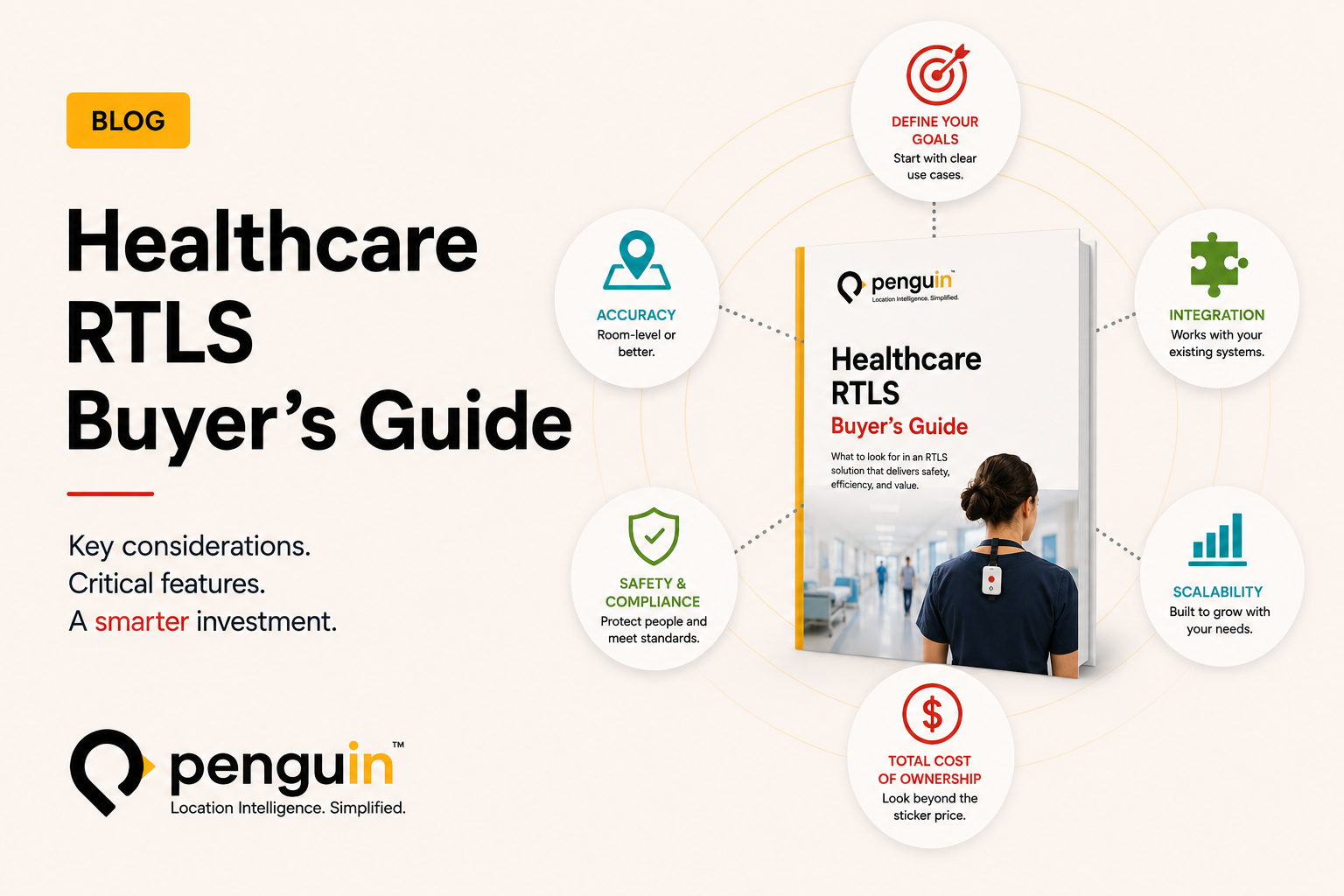
This guide gives hospital administrators, clinical engineers, and IT directors a concrete evaluation framework: 15 proof-demanding questions you should put to every RTLS vendor before signing a contract, each backed by a specific ROI threshold a credible vendor should be able to demonstrate. This guide also covers how RTLS technology actually works, why the architecture decision is permanent, what the 2026 market shift toward AI and unified platforms means for buyers, and how to structure a pilot that produces real evidence.
Table of Contents
› What Is an RTLS Vendor Evaluation, and Why Do Most Hospitals Get It Wrong?
› The Real Cost of Choosing the Wrong RTLS Platform
› How RTLS Technology Actually Works, and Why the Architecture Decision Is Permanent
› The 15 Questions Every Hospital Must Ask Before Signing an RTLS Contract
› How Penguin’s PenTrack Platform Answers Each Evaluation Criterion
› RTLS in 2026, What the Market Shift Toward AI and Unified Platforms Means for Buyers
What Is an RTLS Vendor Evaluation, and Why Do Most Hospitals Get It Wrong?
A vendor evaluation is the structured process a hospital uses to select the technology platform, hardware, software, and services, that will track equipment and people across its facility in real time. It sounds straightforward. In practice, most hospitals get it wrong in the same two ways.
First, they evaluate features instead of proof. A vendor demo is a controlled environment. What matters is what happens at 3 AM on a Wednesday in a 400-bed hospital with 2,000 BLE tags in motion simultaneously. Feature lists do not answer that question. Documented deployment data does.
Second, they underestimate how permanent the decision is. RTLS infrastructure, gateways, locators, tag ecosystems, integration layers, is not something you swap out in 18 months. The architecture you choose today determines what you can expand to, what you pay for ongoing maintenance, and whether you can integrate with the CMMS, EHR, and nurse call systems that arrive in the next five years.
The buyers who make the best decisions treat RTLS vendor selection like a capital infrastructure decision, because that is exactly what it is.
Most RTLS RFP processes ask vendors what their system can do. The right question is: what has it already proven, at what scale, and can you show the numbers?
The Real Cost of Choosing the Wrong RTLS Platform
The wrong RTLS platform costs more than the contract value. It costs the operational savings you were supposed to capture.
A major health system in North Carolina documented $10 million in annual savings from RTLS asset tracking, as reported by HIT Consultant. That figure represents recovered equipment time, reduced shrinkage, deferred capital purchases, and clinician hours returned to patient care. A hospital that deploys the wrong platform, one with zone-level-only accuracy, no AI layer, and no CMMS integration, captures none of that.
The math on the clinical side is equally blunt. Nurses spend up to 60 minutes per shift searching for lost equipment, according to HIMSS. At a 200-bed hospital with 150 nurses across three shifts, that is 450 nurse-hours lost daily to equipment hunts. That is not an operational inconvenience. That is a structural drain on clinical capacity at a moment when 39% of hospitals reported negative margins even as the industry rebounded to a 5.2% average, according to the Kaiser Family Foundation.
For a deeper look at how the ROI case is built and documented, the healthcare asset tracking ROI use cases breakdown covers the categories in detail.
What a Failed RTLS Deployment Actually Costs
The direct costs of a failed deployment include rip-and-replace hardware, data migration, re-training, and a second procurement cycle. The indirect costs are harder to measure but larger: two to three years of unrealized operational savings, clinical staff distrust of the technology, and a CMMS that never got the integration it was supposed to receive.
The question is not whether RTLS delivers ROI. The documented evidence at scale is unambiguous. The question is whether your vendor can prove it will deliver ROI in your specific environment, before you sign.
How RTLS Technology Actually Works, and Why the Architecture Decision Is Permanent
At its core, an RTLS platform has three components: tags attached to assets or worn by staff, locators or gateways distributed across the facility to receive tag signals, and a software layer that converts raw signal data into location intelligence. The accuracy of that location intelligence, and the ceiling on what the system can ever do, is determined entirely by the technology and algorithm running in the software layer.
Legacy systems used infrared emitters or ultrasound to determine location. Both required dense, expensive, proprietary hardware installations and delivered room-level accuracy at best. Both are maintenance-heavy and closed ecosystems, once you are in, you are in.
Modern RTLS platforms use BLE 5.1 (Bluetooth Low Energy version 5.1) with multi-antenna support. BLE 5.1 hardware is mass-produced at commodity scale, which is what drives the cost difference between a $2M legacy deployment and a $300,000–$500,000 modern one. But the hardware is only half the story. Raw BLE signal data, RSSI, received signal strength, fluctuates unpredictably in real hospital environments due to multipath reflections off walls, equipment, and people. A vendor that processes only RSSI will give you zone-level accuracy. A vendor with an AI/ML algorithm processing signal data across multiple antennas simultaneously can achieve room-level and sub-meter accuracy on the same hardware.
For a detailed technical comparison of the two dominant modern architectures, the BLE 5.1 vs. UWB technology comparison covers the tradeoffs hospitals face in 2026.
Why does this matter permanently? Because the accuracy tier you get on day one is the accuracy tier the system is architecturally capable of. You cannot software-update a zone-level system into room-level accuracy. The algorithm running the location engine is either capable of resolving signal ambiguity at shared wall boundaries, or it is not. Choose accordingly, because you will live with this decision for seven to ten years.
Penguin’s PenTrack asset tracking platform uses BLE 5.1 with the MUSIC (Multiple Signal Classification) algorithm, an approach that analyzes the totality of signals across all antenna elements simultaneously rather than estimating individual angle-of-arrival values. The result is room-level and sub-meter accuracy on standard off-the-shelf hardware, without proprietary infrastructure.
The architecture decision determines the accuracy ceiling. The accuracy ceiling determines which clinical use cases the system can ever support. A vendor that cannot tell you which algorithm processes their signal data is a vendor whose accuracy claims cannot be verified.
The 15 Questions Every Hospital Must Ask Before Signing an RTLS Contract
These questions are structured to separate documented performance from sales claims. For each question, a specific answer threshold is included, what a credible vendor with real deployment data should be able to provide. If a vendor cannot answer these questions with specifics, that is your answer.
Q1–Q5: Accuracy and Infrastructure
Q1: What is your actual location accuracy in a live hospital environment, not a demo lab?
A credible answer names the accuracy tier (zone, room, sub-meter), the percentage of time the system hits that tier in production, and a reference site you can call. Any answer that only references a controlled demo is incomplete.
Q2: What algorithm processes your BLE signal data, and how does it resolve signal ambiguity at shared wall boundaries?
This is the question that separates architectures. RSSI-only processing delivers zone-level accuracy at best. An ML-enhanced approach analyzing signals across multiple antennas, such as Penguin’s MUSIC algorithm, resolves wall-boundary ambiguity and achieves room-level certainty. If the vendor cannot name their algorithm, the accuracy claim cannot be verified.
Q3: Does your system require proprietary hardware, or does it run on standard off-the-shelf BLE 5.1 infrastructure?
Proprietary hardware creates vendor lock-in and inflated replacement costs. Standard BLE 5.1 hardware is mass-produced, which is what drives modern RTLS deployments down to $300,000–$500,000 for a 200-bed hospital versus the $2M+ required by legacy proprietary systems.
Q4: Can your system achieve room-level accuracy for staff duress alerts, and how do you verify the exact room, not just coordinates near a wall?
This distinction matters in life-safety scenarios. A sub-meter coordinate on a shared wall boundary is ambiguous, it could belong to either of two adjacent rooms. For staff duress, security must respond to the correct room, not the most probable room. A credible vendor explains exactly how their system resolves room assignment at boundaries, whether through AI pattern detection, additional locator density, or other means.
Q5: What is your locator density requirement per square foot, and what does full-facility deployment cost for a facility of our size?
This is where total cost of ownership diverges from hardware purchase price. A system requiring dense locator installations to achieve claimed accuracy has a higher infrastructure cost than advertised. Ask for a per-square-foot infrastructure cost estimate for your specific facility size, and request a reference site of similar square footage.
Q6–Q10: ROI, Integration, and Interoperability
Q6: What documented ROI benchmarks can you share from live hospital deployments, not projections?
The industry benchmark is $10 million in annual savings at a major North Carolina health system, as reported by HIT Consultant. A vendor with real deployment data should be able to share specific figures: equipment hunt-time reduction, IV pump inventory reduction, shrinkage reduction, and avoided capital purchases. The threshold to accept: at minimum, documented 20–30% reduction in clinician hunt time across a reference deployment.
Q7: Can your platform achieve a 15–20% reduction in IV pump inventory through real-time utilization tracking?
According to industry data, 50% of IV pumps are idle most of the day in a typical hospital. A platform that surfaces real-time utilization data enables supply chain teams to defer capital purchases and consolidate inventory. Ask the vendor to show you how their dashboard surfaces idle vs. in-use vs. on-maintenance asset status in real time, and ask for the inventory reduction percentage they have documented at reference sites.
Q8: How does your platform integrate with our CMMS, and can it trigger automated maintenance scheduling based on actual asset usage?
This is one of the highest-value integration points in hospital RTLS, and the one most vendors gloss over. An RTLS platform that integrates with your CMMS can automatically schedule preventive maintenance based on actual usage hours, alert biomedical engineering when an asset has reached a service interval, and document the chain of custody for regulatory compliance. For detail on how this integration works in practice, the RTLS and CMMS integration in hospital workflows guide covers the full workflow. Ask the vendor to name the specific CMMS platforms they have live integrations with, not planned integrations, live ones.
Q9: What EHR and HL7 integrations does your platform support, and do you have live deployments using them?
An RTLS platform that cannot exchange data with your EHR is a siloed system. The highest-value RTLS integrations in healthcare connect location data to patient records, appointment scheduling, bed management, and capacity planning. Ask for the HL7 message types the system supports and a reference site using the same EHR you run.
Q10: Can a single infrastructure support asset tracking, staff duress, and patient flow, or does each use case require separate hardware?
This is the unified platform question. A single BLE 5.1 infrastructure that supports multiple use cases delivers a fundamentally different total cost of ownership than deploying separate systems for each application. Ask the vendor to map which use cases run on a single tag-and-gateway infrastructure and which require additional proprietary hardware.
Q11–Q15: Deployment, Scale, and Long-Term Fit
Q11: What is your deployment timeline for a facility of our size, and who owns project management?
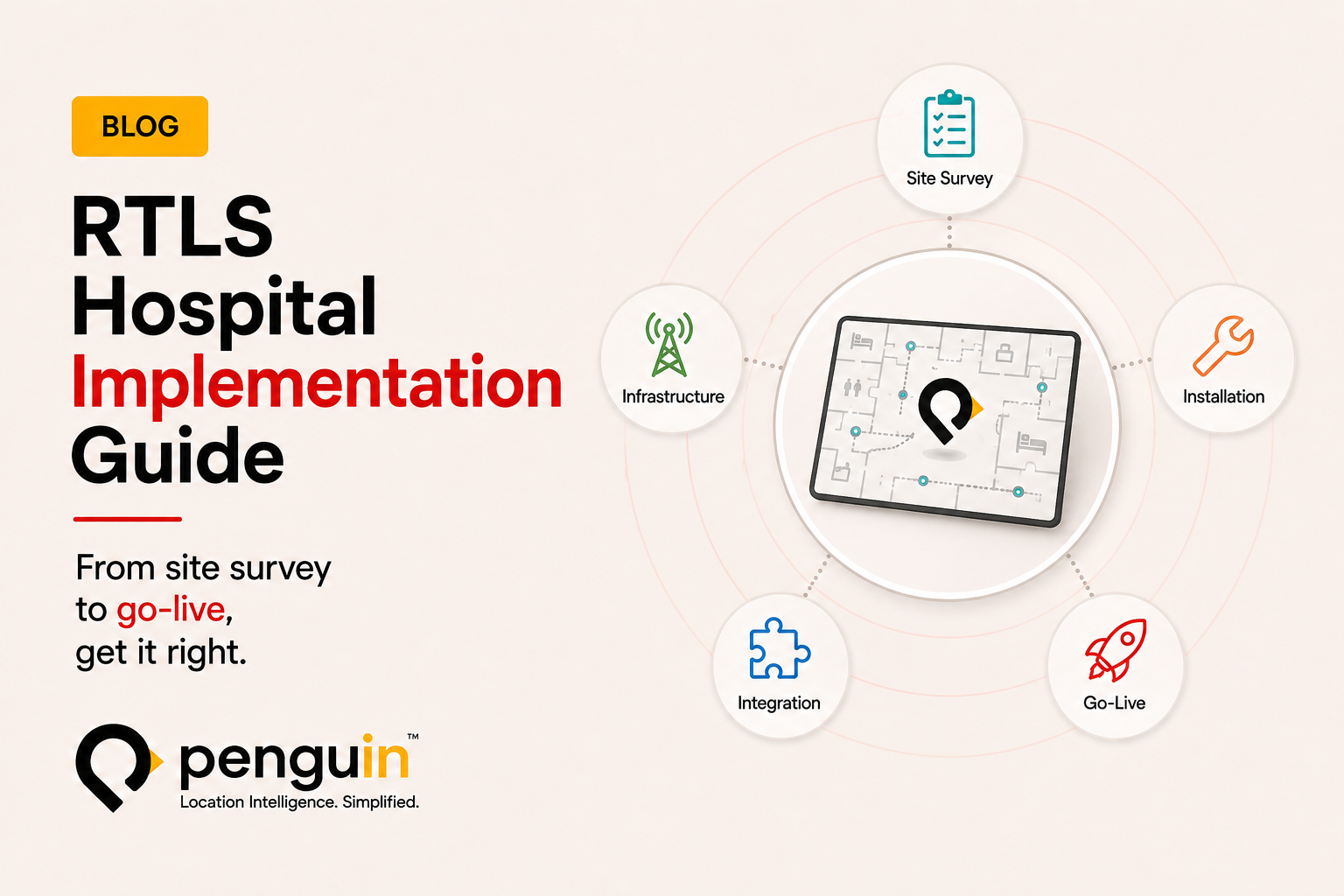
A credible vendor provides a phased deployment plan with named milestones, a dedicated project manager, and a commissioning process that validates accuracy before go-live. Ask for a reference site that went live within the committed timeline and request their project manager’s contact for a reference call.
Q12: What does your AI and machine learning layer actually do, and how does it improve over time?
Vendors increasingly claim AI capabilities. The right question is: AI that does what, specifically? A genuine AI layer in RTLS surfaces predictive utilization patterns, reduces false positives in duress alerts, learns room boundaries from historical signal data, and improves location accuracy with every tag reading. An AI claim that amounts to a rule-based alerting engine is not machine learning. Ask for a specific description of how the model is trained and how accuracy improves after the first 30 days of deployment.
Q13: How do you handle tag battery management at scale, and what is the five-year battery replacement cost for our facility?
Battery management is the hidden cost most vendors understate during the sales cycle. Legacy disposable-battery tags at $300–$800 per badge generate recurring replacement costs that compound over a seven-year deployment horizon. Rechargeable badge savings over seven years frequently exceed the hardware cost difference between platform tiers. Ask for the total battery replacement cost at your expected tag count over five years, in writing.
Q14: What cybersecurity controls govern your platform, and how does it comply with HIPAA data security requirements?
RTLS platforms that integrate with EHR and patient data touch protected health information. Ask the vendor for their HIPAA compliance documentation, their data encryption approach for both data-in-transit and data-at-rest, and their process for reporting a potential security incident. Any vendor without written HIPAA compliance documentation is not ready for clinical deployment.
Q15: What does your customer success model look like at 12 months and 36 months, and what is your SLA for accuracy degradation?
RTLS deployments drift. Hospital environments change, new walls, new equipment, renovations, and new use cases. A vendor’s long-term value is determined by how they respond when accuracy degrades or when you want to expand to a new use case. Ask for the SLA response time for accuracy issues and the process for adding new use cases to an existing infrastructure.
How Penguin’s PenTrack Platform Answers Each Evaluation Criterion
Penguin built PenTrack against exactly the criteria above. Here is how the platform answers each category.
Accuracy. PenTrack uses BLE 5.1 with the MUSIC algorithm, analyzing signal totality across all antenna elements simultaneously. The result is room-level accuracy for staff duress scenarios and sub-meter accuracy for workflow automation, on standard off-the-shelf hardware. No proprietary hardware required. No infrared supplemental layer needed.
ROI benchmarks. Penguin’s AI and Location Intelligence whitepaper documents a 30% reduction in clinician hunt time, a 15–20% reduction in IV pump inventory, and AI assistance on 70% of asset searches across deployed facilities. These are not projections, they are documented outcomes from production deployments.
Integration depth. PenTrack integrates with EHR systems via HL7, with CMMS platforms for automated maintenance scheduling based on actual usage data, and with nurse call and access control systems. The medical asset tracking solutions page details the integration architecture and supported platforms.
Unified infrastructure. A single PenTrack BLE 5.1 infrastructure supports asset tracking, workflow automation, and PAR-level supply management simultaneously. The platform’s location continuum, from zone-level presence detection through room-level tracking to sub-room workflow intelligence, means the same hardware investment supports progressively more sophisticated use cases as your team’s operational maturity grows.
Workflow automation. The clinical workflow automation with RTLS tier of PenTrack adds AI-powered operational intelligence on top of location data: automated maintenance scheduling, capacity milestone alerts, wait-time measurement, and real-time utilization dashboards. This is the layer that converts RTLS from a location system into an operational platform.
Deployment and scale. PenTrack is deployed across healthcare facilities, enterprise campuses, and industrial sites covering more than 10 million square feet across multiple countries. The largest hospital group in the Middle East runs all Penguin solutions, asset tracking, staff safety, infant protection, hand hygiene compliance, and wander prevention, on a single Penguin infrastructure.
The platform a hospital deploys in 2026 should be capable of handling use cases that do not exist yet. An architecture built on open BLE 5.1 standards with an AI location engine can expand. A closed proprietary system cannot.
RTLS in 2026, What the Market Shift Toward AI and Unified Platforms Means for Buyers
The 2026 RTLS market is at an inflection point. Only 20% of healthcare facilities have deployed RTLS, according to industry data. Over 60% of health systems are actively exploring AI-based operational use cases. The gap between those two numbers represents both the market opportunity and the warning: most hospitals that deploy RTLS in the next three years will be making first-time decisions with permanent architecture implications.
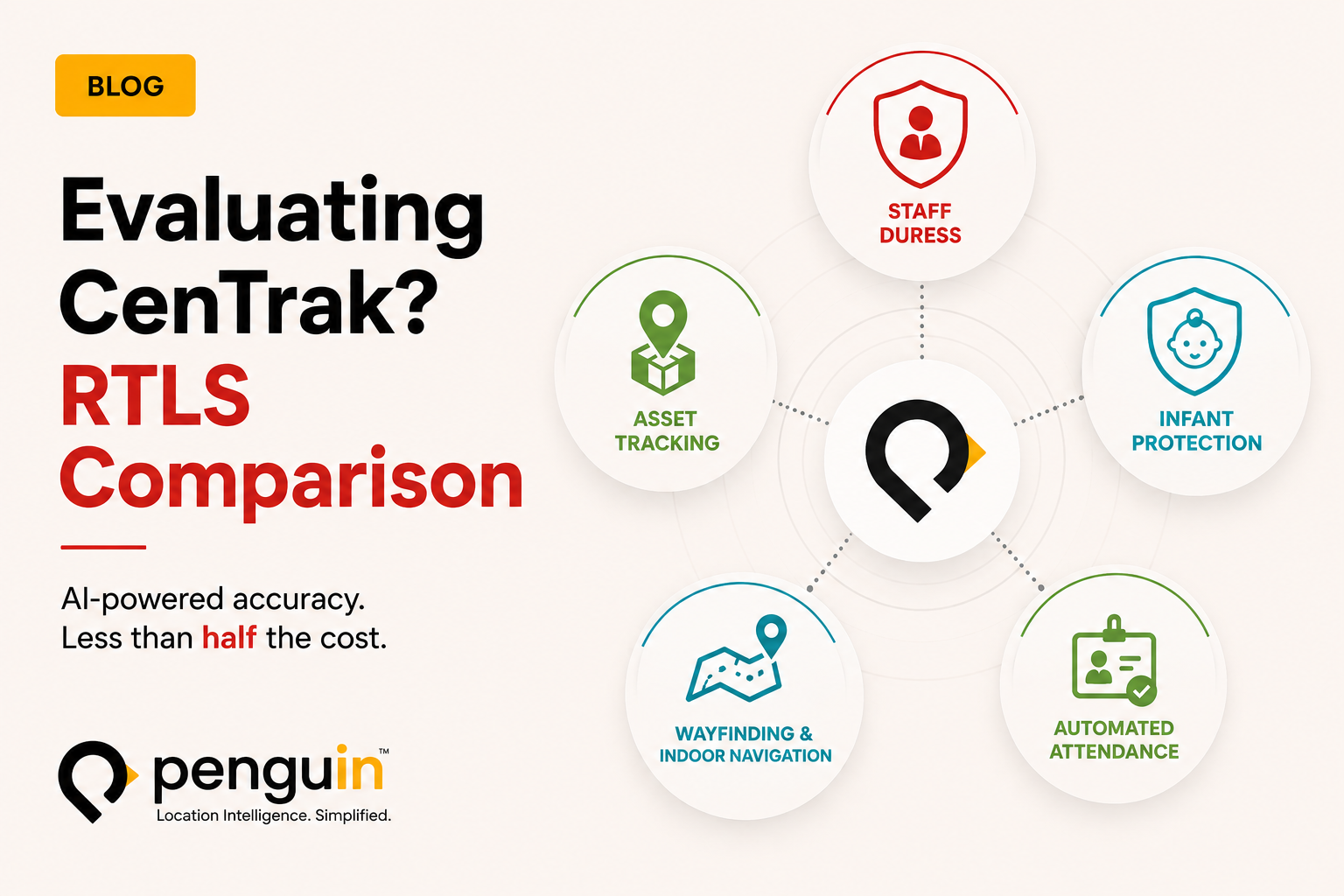
Two shifts define the current market. First, the move from single-use-case RTLS to unified platforms. Early RTLS deployments tracked one asset class, IV pumps, or wheelchairs, on dedicated infrastructure. Modern buyers understand that a single BLE 5.1 infrastructure can support asset tracking, staff duress, patient flow, hand hygiene compliance, and infant protection simultaneously. The infrastructure cost is fixed; the use case count is not.
Second, the addition of a genuine AI layer on top of location data. Location alone tells you where an asset is. AI tells you when an asset is about to run short, which rooms are consistently understocked, how long each equipment type sits idle before someone hunts for it, and when a maintenance event is approaching based on actual usage, not a calendar. This is the shift from real-time location to operational intelligence.
For hospital administrators evaluating vendors, both shifts point to the same question: does this platform have an AI layer with documented outcomes, or is the AI claim marketing language for a rule-based alerting engine? Explore how Penguin approaches this across the full healthcare vertical at Penguin healthcare RTLS solutions.
How to Structure Your RTLS Pilot and Evaluate the Results
A well-designed pilot is a proof test, not a demo. The goal is to generate deployment data specific to your facility, data you own and can use to hold the vendor accountable post-contract.
Pilot Design Principles
Choose a high-friction department, not the easiest one. Running a pilot in a single-occupancy storage room proves nothing. Run it in the ED, the ICU, or the floor with the highest equipment turnover. If the system performs in a high-traffic, high-interference environment, it will perform anywhere in your facility.
Establish a baseline before the pilot starts. Measure current equipment search time, equipment hunt frequency per shift, and IV pump idle time using manual observation over two weeks before tag deployment. Without a pre-pilot baseline, you cannot document the improvement. Without documented improvement, you have no ROI evidence when you present to the CFO.
Test the specific accuracy tier you need. For asset tracking, test zone-level and room-level accuracy, document what percentage of locate queries resolve to the correct room within 30 seconds. For staff duress, test the system’s ability to correctly identify the room (not just coordinates) when a badge is triggered from four different positions along a shared wall boundary.
Test integration before go-live. Any CMMS, EHR, or nurse call integration the vendor promises must be demonstrated live in your environment before you sign a full contract. An integration that works in the vendor’s test environment but requires 90 days of post-contract professional services to function in yours is a failed integration.
Evaluate the dashboard, not the demo. Ask the vendor to give your supply chain manager, your biomedical engineer, and your charge nurse access to the live pilot dashboard for 30 days. If they cannot find what they need without vendor assistance, the system will not be adopted after go-live. User adoption is the single biggest predictor of long-term RTLS ROI.
For a complete walkthrough of hospital asset tracking with BLE 5.1 from infrastructure to clinical workflow, Penguin’s asset tracking content covers the end-to-end deployment sequence in detail.
What Good Pilot Results Look Like
A successful 30-day RTLS pilot in a single department should produce three measurable outcomes: a documented reduction in equipment search time (target: 20–30% against your pre-pilot baseline), a measurable increase in asset utilization rate (target: idle pump percentage down from a typical 50% toward 35–40%), and a confirmed accuracy rate for room-level locate queries (target: greater than 90% of queries resolve to the correct room on first search).
If the pilot cannot produce those numbers in a controlled 30-day window in one department, a facility-wide deployment will not produce them either.
Closing Thought
The case for RTLS in hospital operations is no longer theoretical. A major health system in North Carolina documented $10 million in annual savings, as reported by HIT Consultant. Clinician hunt time drops 30% with a platform that delivers room-level accuracy and an AI utilization layer, according to industry data. The $14 billion the US healthcare industry loses annually to inefficient equipment management does not have to be structural, it is recoverable, one well-deployed RTLS platform at a time.
For hospital administrators evaluating vendors in 2026, the question is not whether to deploy RTLS. It is which vendor can prove, with documented deployment data, not feature lists, that their platform delivers room-level accuracy, integrates with the systems you already run, and compounds value across multiple use cases on a single infrastructure investment.
Use the 15 questions in this guide as your proof test. Any vendor who cannot answer them with specifics has answered your most important question already.
Frequently Asked Questions
The following questions represent the most common queries from hospital administrators, clinical engineers, IT directors, and procurement teams evaluating RTLS vendors and building their evaluation framework.
Q: What questions should I ask an RTLS vendor before signing a hospital contract?
The highest-value questions focus on documented proof rather than feature capability. Ask the vendor to name the algorithm that processes their BLE signal data and explain how it resolves location ambiguity at shared wall boundaries. Ask for documented ROI figures, equipment hunt-time reduction and IV pump inventory reduction, from reference sites you can contact directly. Ask which CMMS and EHR platforms they have live integrations with today, not planned integrations. Ask what the total five-year cost of tag battery management is at your expected tag count. And ask what their SLA is for accuracy degradation after the first year. The 15 questions in this guide provide a complete structured framework.
Q: How accurate does hospital RTLS need to be for asset tracking vs. staff duress?
For asset tracking, zone-level or room-level accuracy is sufficient for most clinical workflows. Knowing which room a wheelchair or IV pump is in, rather than its precise coordinates, is enough for a nurse to locate and retrieve it. For staff duress, room-level accuracy is a life-safety requirement, not an operational preference. When a nurse triggers a duress alert, security cannot afford to respond to the wrong room because a sub-meter coordinate falls on a shared wall boundary between two adjacent spaces. A platform capable of resolving exact room assignment at wall boundaries, through AI pattern detection layered on top of location coordinates, is essential for staff safety deployments. The accuracy requirement for workflow automation goes further: sub-room or sub-meter precision is needed for bed-level or bay-level asset assignment.
Q: What is the difference between BLE 5.1 RTLS and legacy infrared RTLS systems?
Legacy infrared RTLS systems use line-of-sight infrared emitters installed in every room to detect tags passing within range. They deliver reliable room-level detection but require dense, expensive, proprietary hardware, typically an emitter in every room and corridor, and are closed ecosystems with no compatibility with standard BLE infrastructure. BLE 5.1 RTLS uses standard Bluetooth hardware mass-produced at commodity scale, eliminating the proprietary infrastructure cost. The key difference is in the software layer: a BLE 5.1 platform with an AI/ML algorithm processing multi-antenna signal data can achieve room-level and sub-meter accuracy that matches or exceeds infrared performance, without the infrastructure density or vendor lock-in. The total cost of ownership difference between a modern BLE 5.1 deployment and a legacy infrared system over seven years is substantial.
Q: How long does it take to deploy an RTLS system in a hospital?
Deployment timelines vary significantly by facility size, infrastructure complexity, and the number of use cases in scope. A single-department pilot on standard BLE 5.1 infrastructure can go live in two to four weeks. A full-facility deployment in a 200-bed hospital typically runs three to six months, with phasing determined by gateway installation, tag commissioning, software integration, and staff training. The integrations are often the long pole, CMMS and EHR integrations with custom HL7 configurations can add four to eight weeks to the timeline if not scoped and contracted in advance. Ask your vendor for a phased deployment plan with named milestones and request a reference site that completed deployment within the committed timeline.
Q: How does RTLS integrate with a hospital CMMS for maintenance scheduling?
An RTLS-CMMS integration connects real-time asset location and usage data to your maintenance management system. Instead of scheduling preventive maintenance on a calendar basis, the integrated system triggers service work orders when an asset reaches an actual usage threshold, hours of operation, number of cycles, or distance traveled. This approach eliminates both over-maintenance (servicing equipment that has not reached its service interval) and under-maintenance (missing service on equipment that ran longer than the calendar schedule predicted). The integration also enables automated chain-of-custody documentation for regulatory compliance audits. For a full breakdown of how this workflow operates and which CMMS platforms support it, the RTLS and CMMS integration guide covers the complete technical and operational picture.
Q: How much does a hospital RTLS system cost in 2026?
A modern BLE 5.1 RTLS deployment for a 200-bed hospital typically runs $300,000–$500,000 for hardware, software, and initial integration, compared to $2M or more for legacy proprietary infrastructure-based systems. Tag costs vary by type: standard asset tags are significantly less expensive than staff-worn rechargeable badges, and rechargeable badges eliminate the recurring battery replacement costs that compound over a seven-year deployment. Annual software licensing and support typically run 15–20% of the initial platform cost. The total cost of ownership calculation should include: hardware, software licensing, integration professional services, battery management over five years, and ongoing support SLA costs. A vendor that quotes only the hardware purchase price is not giving you the information you need to make a capital decision.
Q: What ROI should a hospital expect from an RTLS asset tracking deployment?
The documented industry benchmark is $10 million in annual savings at a major health system in North Carolina, as reported by HIT Consultant, driven by recovered clinician time, reduced equipment purchases, and lower shrinkage. Penguin’s AI and Location Intelligence whitepaper documents a 30% reduction in clinician hunt time and a 15–20% reduction in IV pump inventory across deployed facilities. For a hospital with 150 nurses across three shifts each spending up to 60 minutes per shift searching for equipment, the recovered time alone represents hundreds of nursing hours daily returned to patient care. The ROI timeline for a well-deployed RTLS system typically runs 18–36 months to full payback, with inventory and equipment purchase savings often appearing within the first 90 days of deployment.
Q: Can one RTLS platform handle asset tracking and staff duress on the same infrastructure?
Yes, on a modern BLE 5.1 platform with a unified location engine, the same gateway and locator infrastructure supports asset tags, staff-worn duress badges, and patient-worn wander prevention tags simultaneously. This is a significant total cost of ownership advantage over deploying separate systems for each use case. The critical requirement is that the platform’s accuracy tier must meet the highest-precision use case in your deployment: if staff duress requires room-level accuracy, the entire infrastructure must be commissioned to that standard. A platform that delivers room-level accuracy for duress will also deliver more than adequate accuracy for asset tracking, the reverse is not true.
Q: How do I evaluate RTLS vendor claims about AI and accuracy?
Ask the vendor to name the specific algorithm that processes their BLE signal data and explain how it performs in a high-multipath environment, one with metal equipment, dense walls, and hundreds of tags in motion simultaneously. A genuine AI/ML layer learns signal patterns over time, improves room-boundary resolution through historical data, and reduces false positives in alerting. Ask for the accuracy rate at a reference site after 30 days of operation versus on the day of go-live, a system with real machine learning gets more accurate over time, not less. Ask to see the dashboard showing AI-assisted asset searches and the percentage of searches that resolved without manual escalation. The documented threshold to accept: 70% or more of asset searches assisted using AI tools, according to industry data.
Q: What is the difference between zone-level, room-level, and sub-meter RTLS accuracy?
Zone-level accuracy tells you which wing, floor, or department an asset is in, useful for high-level inventory management but not sufficient for individual equipment retrieval or staff duress. Room-level accuracy tells you which specific room an asset or person is in, sufficient for most clinical asset tracking workflows and essential for staff duress. The critical challenge at room-level is wall-boundary ambiguity: a tag located within a meter of a shared wall may produce a coordinate that falls inside either of two adjacent rooms. A platform with AI room-assignment logic resolves this ambiguity definitively, even at boundaries. Sub-meter accuracy delivers precise coordinates within less than a meter in three-dimensional space, required for workflow automation use cases like bed-level or bay-level asset assignment, where knowing the room is not enough and the specific position within the room matters.
Penguin Location Services builds AI-powered RTLS platforms for hospitals that need documented results, not feature lists. Our PenTrack asset tracking platform delivers room-level and sub-meter accuracy on standard BLE 5.1 infrastructure, with documented 30% clinician hunt-time reduction and 15–20% IV pump inventory reduction across deployed facilities. To discuss how PenTrack addresses your specific evaluation criteria, visit penguinin.com/pentrack or explore our full Penguin healthcare RTLS solutions.