
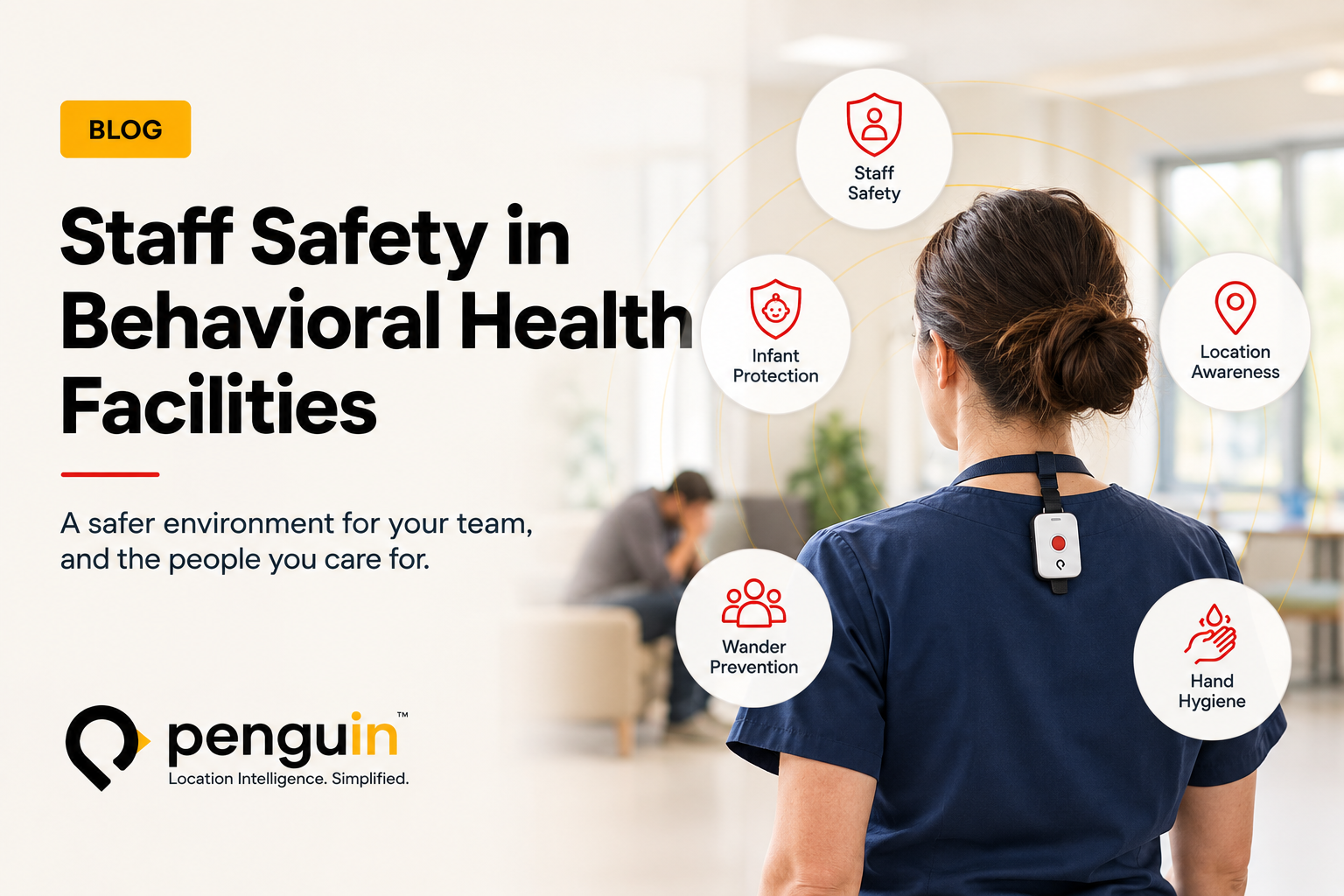
Psychiatric nurses are attacked at work at nearly four times the rate of any other profession, yet the duress systems installed to protect them routinely fail the moment they are needed most. The button gets pressed. The alert goes nowhere. Security responds to the wrong floor. Or the system simply times out because the signal died inside a shielded seclusion room.
The problem is not that hospitals are ignoring staff safety. Most behavioral health units have some form of duress system installed. The problem is that nearly every standalone duress system on the market was designed for a general hospital ward, open Wi-Fi coverage, standard drywall construction, minimal RF interference, and then deployed inside a behavioral health unit that has none of those conditions. The result is a system that looks compliant on paper and fails operationally every time a real incident occurs.
This guide covers what makes behavioral health units structurally different from general wards, the four infrastructure constraints that break standard duress systems, a fifth constraint that almost no vendor mentions, how an RTLS-native behavioral health staff duress system actually works, and what safety directors and CNOs should evaluate before they spend another dollar on a parallel standalone system.
- Nursing staff face a risk of workplace violence nearly 4 times higher than any other profession, according to industry data, and inpatient psychiatric settings carry the highest concentration of that risk.
- Behavioral health units have four physical infrastructure constraints, RF shielding, dead zones, device restrictions, and architectural isolation, that standard Wi-Fi and Bluetooth 4.0 duress systems cannot reliably overcome.
- A fifth constraint, the total cost of operating a standalone duress network in parallel with existing RTLS infrastructure, is never disclosed in standalone vendor proposals.
- An RTLS-native platform running BLE 5.1 delivers room-level duress accuracy on the same network used for asset tracking and patient safety, eliminating the parallel system cost entirely.
- The Joint Commission and OSHA both impose documented obligations on hospitals to prevent and respond to workplace violence, and a duress system that fails in a shielded room does not satisfy either standard.
› What Makes Behavioral Health Units Different
› How Serious Is the Violence Problem in Inpatient Psychiatric Settings?
› The Four Infrastructure Constraints That Break Standard Duress Systems
› The Fifth Constraint Nobody Talks About
› How an RTLS-Native Staff Duress System Works in a Psychiatric Unit
› How PenSafe Addresses All Five Behavioral Health Constraints
› Regulatory and Accreditation Standards for BH Staff Safety
› What Safety Directors Should Evaluate Before Choosing a System
What Makes Behavioral Health Units Different, and Why Standard Duress Systems Are Not Designed for Them
A general medical-surgical ward and an inpatient psychiatric unit share the same building. They do not share the same operating environment.
Behavioral health units are purpose-built to restrict, contain, and de-escalate. The architecture reflects that mission: reinforced walls that block radio frequency (RF) signals, seclusion rooms lined with materials that absorb or scatter wireless transmission, locked units where personal electronic devices are prohibited, and physical layouts designed to limit patient movement, not optimize Wi-Fi coverage. Every one of those design decisions degrades the performance of a standard hospital duress system.
Standard hospital duress systems are built on two assumptions: that the RF environment is predictable and that staff carry or wear devices compatible with the facility network. Both assumptions collapse inside a behavioral health unit. The result is a system that registers as deployed, passes the initial site survey, and then produces dead zones, missed alerts, and ambiguous location data precisely when a violent incident occurs and accuracy matters most.
The Design Principles That Break Standard Duress Technology
Three architectural principles define behavioral health unit design, and each one directly conflicts with the technical requirements of standard Wi-Fi or BLE 4.0 duress systems.
RF containment is the first. Seclusion rooms and high-acuity observation rooms use concrete block, steel framing, or dedicated shielding materials. These materials do not just attenuate signals, they can eliminate them. A staff member inside a seclusion room pressing a duress badge may generate zero detectable signal at any gateway outside that room if the system relies on RSSI (Received Signal Strength Indicator) thresholds.
Device restriction is the second. Most inpatient psychiatric units prohibit patients from bringing personal electronic devices onto the unit. Many extend this policy to staff smartphones during active shifts. A duress system that depends on a staff member’s personal phone as the alert transmitter fails the moment that phone stays at the nursing station.
Network isolation is the third. Many psychiatric units operate on segregated network segments by design, to prevent patient access to facility infrastructure. A duress system that routes alerts through the general hospital Wi-Fi network may find that its traffic path is blocked, throttled, or unreachable from inside the behavioral health unit’s isolated segment.
How Serious Is the Violence Problem in Inpatient Psychiatric Settings?
The scale of violence against psychiatric nursing staff is not a policy abstraction. It is a documented clinical reality that ends careers and drives the nursing workforce shortage.
According to industry data, nursing staff face a risk of workplace violence nearly four times higher than any other profession. Within healthcare, inpatient psychiatric and behavioral health settings carry a disproportionate share of that risk. Staff in these units face daily exposure to patients in acute psychiatric crisis, patients who may be experiencing command hallucinations, severe agitation, or substance withdrawal, and who may have no awareness that they are causing harm.
The downstream consequences extend well beyond individual incidents. According to industry data, more than 60% of nurses report symptoms of emotional fatigue, job dissatisfaction, and depersonalization. Less than 30% feel adequately supported by hospital management in managing work-related stress. Over 100,000 nurses leave the profession annually. Behavioral health nurses, the subset exposed to the highest violence risk, are overrepresented in every one of those exit numbers.
In a 196-nurse study (industry data) at a North American hospital, only 52 were classified as low-risk for burnout. One hundred and ten were moderate-risk. Thirty-eight were high-risk. A duress system that nurses do not trust, because they have watched it fail, does not reduce burnout risk. It amplifies it. Every nurse who knows her badge will not transmit from inside the seclusion room goes into that room carrying additional psychological load that compounds over every shift.
OSHA classifies healthcare workers as among the highest-risk occupations for workplace violence and has issued specific enforcement guidance targeting inpatient psychiatric settings. A hospital that cannot demonstrate a functioning, location-verified duress response capability now faces regulatory exposure on two fronts: Joint Commission accreditation and OSHA enforcement.
The Four Infrastructure Constraints That Break Standard Duress Systems in BH Units
These are not edge cases. Every behavioral health unit deployment encounters at least two of these constraints. Most encounter all four. For a deeper look at how RTLS-based staff duress works across hospital departments, the how RTLS-based staff duress works across hospital departments guide covers the full deployment context.
Constraint 1: RF-Shielded Seclusion Rooms
Seclusion rooms are the highest-risk physical environment in any behavioral health unit. They are also where standard duress systems are most likely to fail. Concrete block walls, steel door frames, and acoustic treatment materials all attenuate BLE and Wi-Fi signals. A BLE 4.0 system relying on RSSI thresholds to determine location loses signal coherence inside these rooms. The gateway outside the door may detect a faint ping, enough to register the badge as present on the unit, but not enough to resolve which room the staff member is in. Security responds to the wing, not the room, and loses critical seconds at the door.
BLE 5.1 with multi-antenna signal analysis resolves this differently. Rather than relying on signal strength from a single gateway, the algorithm analyzes phase and timing relationships across multiple antenna elements simultaneously. The result: even in a heavily attenuated environment, the system can resolve a precise location from the geometry of the signal rather than its strength alone.
Constraint 2: Wi-Fi Dead Zones and Network Segmentation
Wi-Fi-dependent duress systems depend on a facility’s existing wireless infrastructure. Behavioral health units frequently sit in older building wings, basement floors, or purpose-built additions that were not designed with Wi-Fi coverage density in mind. Dead zones are common. Yet even where coverage exists, network segmentation, isolating the behavioral health unit’s traffic from the general hospital network for patient safety and HIPAA reasons, can break the alert routing path entirely. The badge transmits. The gateway receives. The alert never reaches the security console because the network segment it needs to traverse is blocked.
Constraint 3: Device Restriction Policies
Many standalone duress vendors offer smartphone-based alert triggering as a primary or backup channel. Inside a behavioral health unit, that approach fails immediately. Staff smartphones are either prohibited on the unit floor or must remain at the nursing station. A duress system whose mobile app is the primary alert mechanism is a system that does not function in the environment it was sold for. The only reliable alert trigger in a behavioral health unit is a dedicated wearable badge, one that requires no smartphone, no personal device, and no cellular connection to transmit.
Constraint 4: Architectural Isolation and Non-Standard Layouts
Behavioral health unit floor plans do not look like general ward floor plans. Long corridors with right-angle blind turns, small rooms clustered around a central nursing station, observation bays with line-of-sight restrictions, these layouts create multipath RF environments where signals reflect off walls and arrive at gateways from unexpected angles. Standard RSSI-based systems interpret these reflections as location ambiguity. A staff member in a room at the end of a blind corridor may register as being in two adjacent rooms simultaneously. For asset tracking, that ambiguity is a minor inconvenience. For staff duress, it routes security to the wrong door.
The Fifth Constraint Nobody Talks About, Total Cost of a Standalone Duress System
Every constraint above is technical. This one is financial, and it is the one standalone duress vendors never include in a proposal.
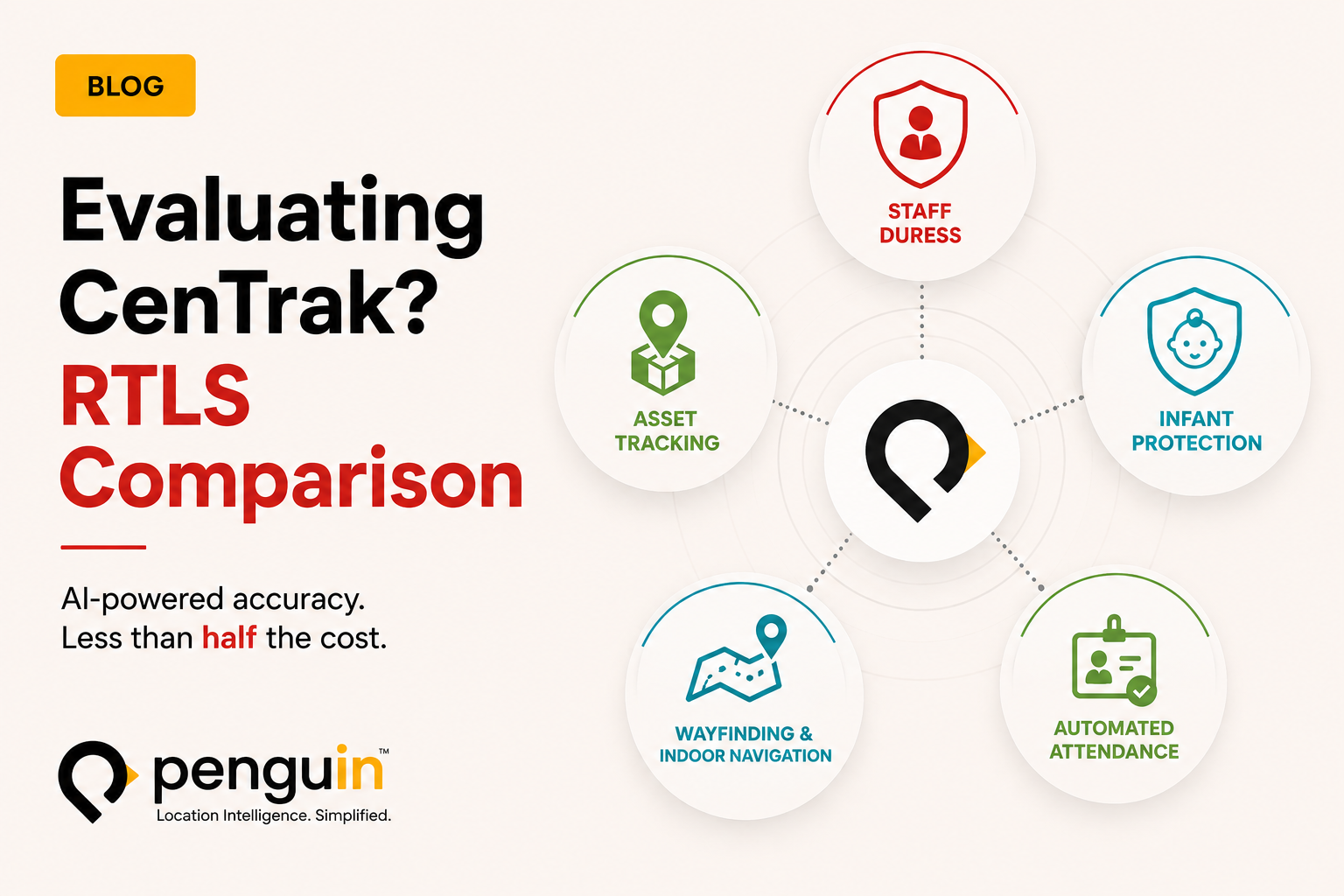
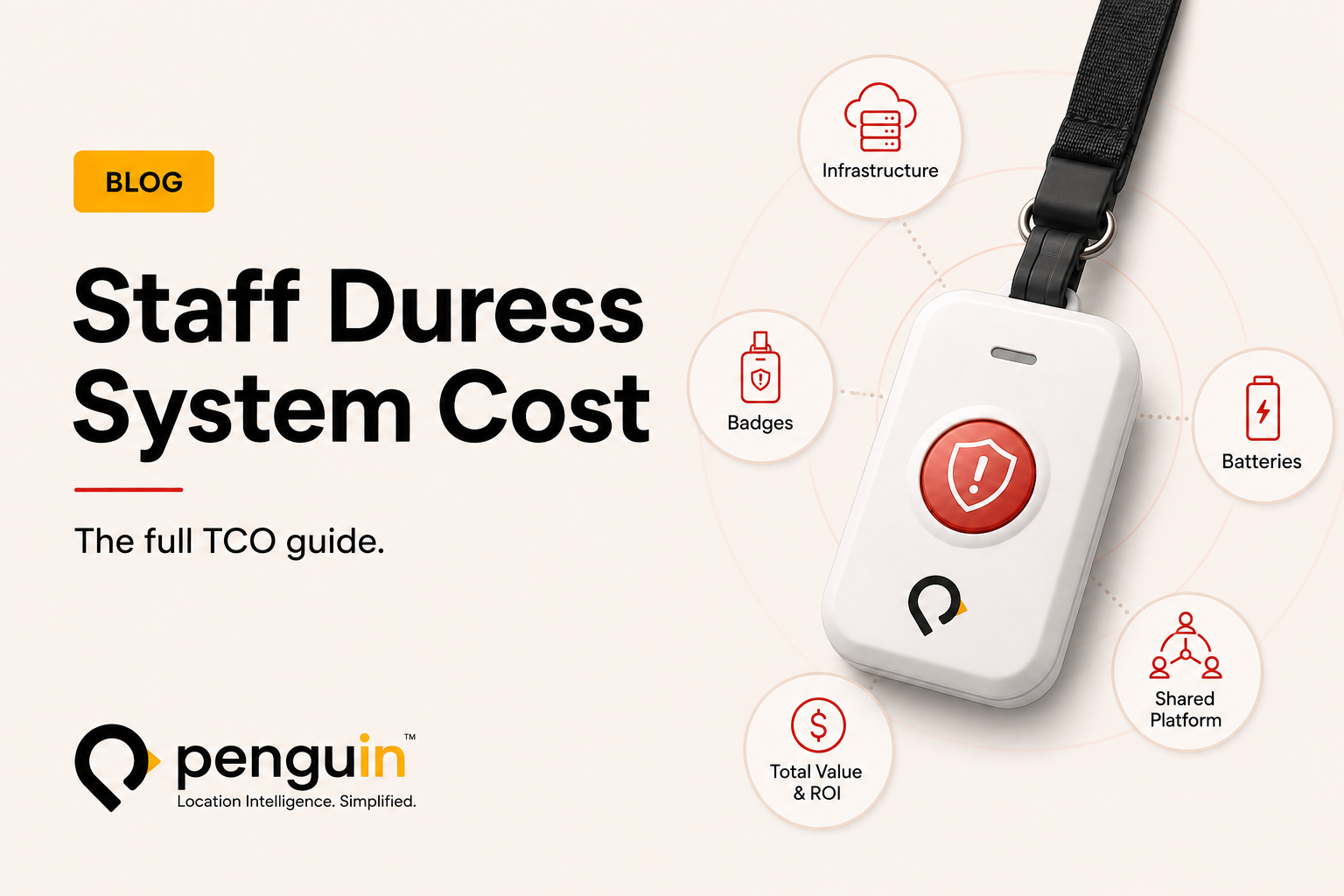
A standalone behavioral health staff duress system requires its own dedicated hardware infrastructure: gateways, locators, a separate server or cloud instance, a separate maintenance contract, a separate integration layer to reach the security console, and a separate badge charging and distribution workflow. That infrastructure runs in parallel with whatever RTLS infrastructure the hospital already uses or plans to use for asset tracking and patient safety. Every dollar spent on the standalone duress network is a dollar that produces exactly one outcome: duress alerts. The same dollar invested in an RTLS-native platform produces duress alerts, asset location, equipment utilization data, patient elopement protection, and workflow analytics, on a single network, under a single maintenance contract, from a single vendor.
The total cost of ownership divergence compounds over time. As the article on how staff duress technology has evolved from pagers to real-time location documents, hospitals that deployed first-generation standalone systems in the early 2010s are now facing a dual replacement cycle: aging duress hardware and aging asset tracking hardware, from two different vendors, on two contracts, requiring two separate upgrade projects. An RTLS-native deployment eliminates that duplication from day one.
This is not a hypothetical efficiency argument. A major health system in North Carolina documented $10 million in annual savings from RTLS asset tracking alone, as reported by HIT Consultant. Those savings came from a single RTLS use case. A platform that delivers that ROI on asset tracking while simultaneously running the behavioral health duress function on the same infrastructure does not add cost, it amortizes it across multiple lines of value.
How Does an RTLS-Native Staff Duress System Actually Work in a Psychiatric Unit?
The mechanism is specific, and understanding it clarifies why BLE 5.1 outperforms both Wi-Fi and legacy BLE 4.0 in the behavioral health environment.
The Badge
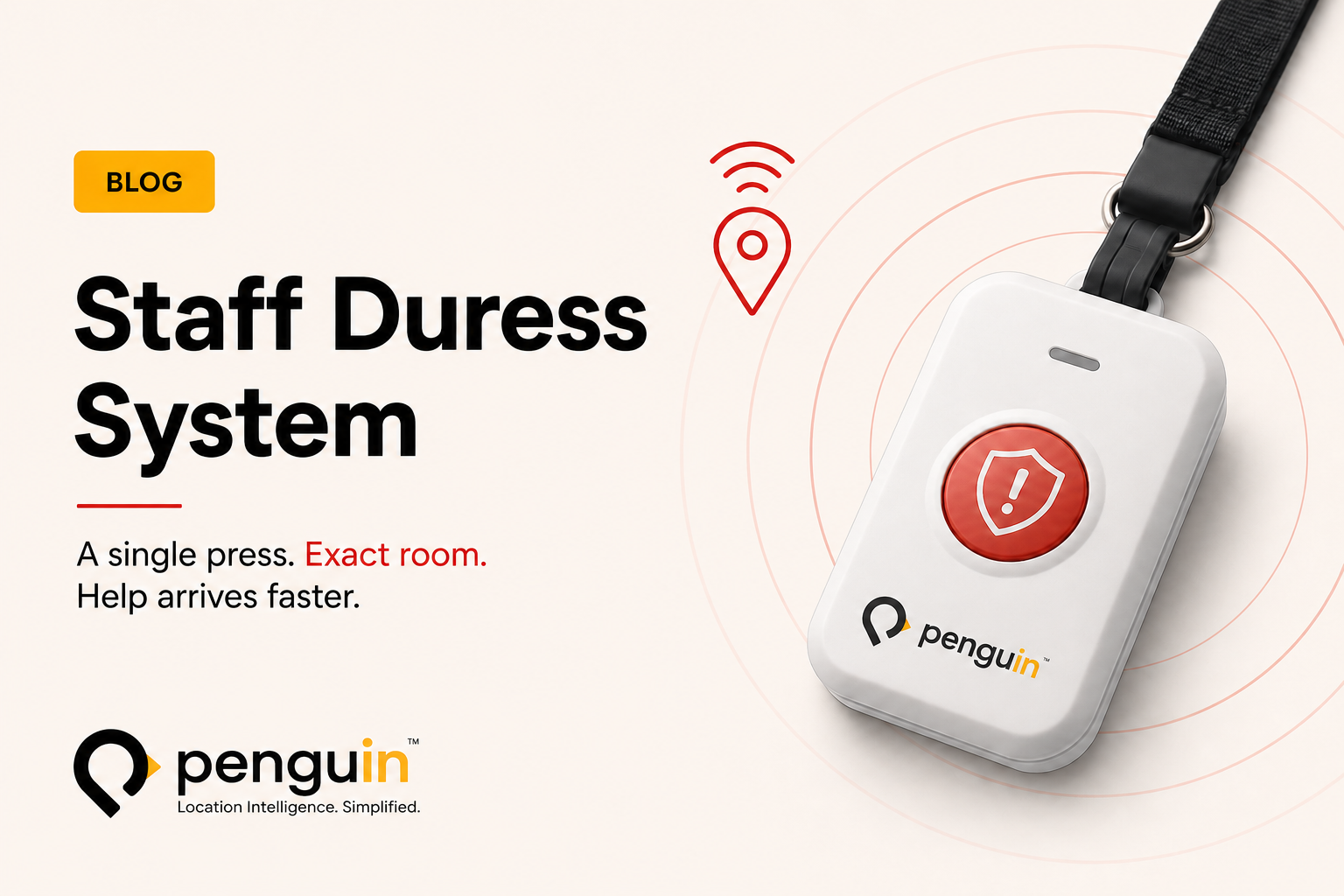
Each staff member wears a dedicated BLE 5.1 wearable badge. The badge requires no smartphone, no personal device, and no facility Wi-Fi connection. It communicates directly with BLE 5.1 gateways mounted throughout the unit. When the staff member presses the duress button, or when a configurable no-motion alert triggers automatically, the badge transmits an emergency signal to every gateway within range simultaneously.
The Location Engine
The RTLS location engine receives signals from multiple gateways at once. Rather than relying on which gateway has the strongest signal, the RSSI approach that fails in attenuated environments, the MUSIC (Multiple Signal Classification) algorithm analyzes phase and timing relationships across all antenna elements of all receiving gateways simultaneously. This matters in behavioral health units because attenuated signals arrive at multiple gateways at different strengths and phase offsets. The algorithm resolves those discrepancies into a precise coordinate set rather than defaulting to the nearest gateway’s zone assignment.
Room-Level Resolution: The Critical Distinction
Sub-meter coordinate accuracy and room-level accuracy are two different things, and in a psychiatric unit, room-level is the one that saves lives. A sub-meter coordinate placed on a shared wall between two adjacent seclusion rooms tells security exactly where the nurse is in physical space. It does not tell security which side of the wall to enter. Room-level AI resolution, the machine learning layer that maps coordinate sets to defined room polygons, answers that question with certainty. Security receives an alert that reads “Seclusion Room 4” and responds to that door, not the corridor outside it.
That distinction is not available in a standalone duress system with zone-level accuracy. It requires the ML layer that only an RTLS-native platform carries.
How PenSafe Addresses All Five Behavioral Health Constraints on a Single Platform
The PenSafe staff duress platform was built on the same BLE 5.1 + MUSIC algorithm infrastructure that Penguin deploys for asset tracking and patient safety. That architecture, one network, multiple safety applications, is what makes it structurally different from every standalone duress vendor in this category.
| Constraint | Standalone Duress Vendor | PenSafe (RTLS-Native) |
|---|---|---|
| RF-shielded seclusion rooms | RSSI degradation causes missed alerts | MUSIC algorithm resolves location from phase geometry, not signal strength alone |
| Wi-Fi dead zones and network segmentation | Alert routing breaks at segment boundary | BLE 5.1 gateways operate independently of facility Wi-Fi network |
| Device restriction policies | Smartphone-dependent alert triggers left at nursing station | Dedicated wearable badge, no personal device required |
| Architectural isolation and multipath layouts | Multipath reflections produce ambiguous room assignment | ML room-resolution layer maps coordinates to exact room polygon |
| Total cost of parallel infrastructure | Separate hardware, contract, maintenance, integration | Single platform, duress runs on the same network as asset tracking and patient safety |
Beyond the technical architecture, PenSafe delivers configurable escalation paths. When a nurse presses her badge, the alert routes simultaneously to the charge nurse console, the security team mobile device, and the unit manager, with the exact room displayed on every screen. Escalation timing is configurable: if security does not acknowledge within 60 seconds, the alert auto-escalates to the next tier. No manual relay. No radio chain that breaks when a security officer is off the floor.
For behavioral health units that also need wander prevention, tracking patients with elopement risk within designated safe zones, PenSafe runs both functions on the same gateway network. The incremental cost of adding wander prevention to an existing PenSafe duress deployment is a software configuration, not a second hardware installation. Explore the full range of workforce safety solutions for healthcare that Penguin delivers on this platform.
What Regulatory and Accreditation Standards Apply to BH Staff Safety Right Now?
Three regulatory frameworks impose specific obligations on hospitals operating inpatient behavioral health units, and each one has sharpened its enforcement posture since 2022.
The Joint Commission, Workplace Violence Prevention Standard
The Joint Commission requires accredited hospitals to implement a workplace violence prevention program that includes documented prevention strategies, incident reporting, and post-incident response. For behavioral health units specifically, the standard requires evidence that the physical environment supports staff safety, including the ability to summon help quickly. A duress system that cannot reliably transmit from inside a seclusion room is not evidence of a functioning rapid-response capability. It is evidence of a gap.
OSHA, Healthcare Workplace Violence Guidelines
OSHA’s workplace violence enforcement guidelines specifically identify inpatient psychiatric settings as high-risk environments and require employers to implement engineering controls, administrative controls, and response systems. OSHA’s General Duty Clause (Section 5(a)(1)) obligates employers to provide a workplace free from recognized hazards, and healthcare workplace violence is explicitly a recognized hazard. A documented history of duress system failures in a behavioral health unit creates direct General Duty Clause exposure.
State-Level Legislation
Across North America, state and provincial governments are enacting mandatory workplace violence prevention legislation that goes beyond Joint Commission and OSHA guidance. Ontario’s Bill 168 requirements, covered in detail in Penguin’s guide to workplace violence legislation hospitals must comply with, impose specific documentation and response obligations that a system with behavioral health dead zones cannot satisfy. California, New York, and several other states have enacted comparable requirements. The trend is consistent: regulators are moving from guidance to enforcement, and the evidentiary bar for a functioning duress capability is rising.
For safety directors building a compliance case, the documentation trail matters. An RTLS-native platform that logs every alert, every acknowledgment timestamp, every response time, and every location coordinate produces the audit evidence that regulators now require. A standalone system that triggers a radio call and closes the loop manually produces nothing.
Explore Penguin’s full healthcare RTLS solutions library for additional compliance context across Joint Commission, OSHA, and state-level frameworks.
What Should Safety Directors Evaluate Before Choosing a Behavioral Health Duress System?
The following six dimensions are the right framework for evaluating any behavioral health staff duress system. The first five come directly from standard duress vendor evaluation practice. The sixth is the one that changes every scoring outcome.
Network Independence
Ask the vendor: Does the system require facility Wi-Fi to transmit duress alerts, or does it operate on an independent BLE gateway network? Any system that routes alerts through the general hospital Wi-Fi infrastructure inherits all of that infrastructure’s coverage gaps, segmentation policies, and network maintenance windows. An independent BLE 5.1 gateway network is the only architecture that can guarantee coverage inside a segmented, shielded behavioral health unit.
Deployment Burden
Ask the vendor: How many gateways does the system require to achieve room-level coverage in a behavioral health unit with shielded seclusion rooms? Ask for a gateway density specification for your specific floor plan, not a general hospital average. Standalone systems frequently underbid gateway counts during the sales process, then require expensive additions to achieve the coverage they promised during the site survey.
Accuracy: Zone, Room, or Sub-Room
Ask the vendor: What is the specific accuracy tier this system delivers inside a shielded seclusion room, not in an open ward? Zone-level is insufficient for behavioral health duress. Room-level is the minimum. Sub-room is preferable in multi-bed observation bays where a staff member’s position within the room determines the fastest intervention path.
Outcome Documentation
Ask the vendor: What data does the system produce that satisfies Joint Commission and OSHA audit requirements? Ask specifically for alert logs, response time data, location accuracy validation reports, and escalation path records. A system that does not produce structured audit data does not reduce regulatory exposure, it delays the conversation about whether the system worked.
Staff Adoption
Ask the vendor: What does the badge wearing compliance rate look like at deployments in behavioral health settings 90 days post-go-live? Staff who have seen a duress system fail do not trust a new one immediately. Badge weight, comfort for a full 12-hour shift, and single-button simplicity directly determine whether staff wear the badge or leave it at the station.
Platform Unification, The Sixth Dimension
Ask the vendor: Does this system run on the same infrastructure you are using or planning to use for asset tracking, patient elopement, and hand hygiene compliance? If the answer is no, document the total cost of the parallel infrastructure, hardware, installation, integration, maintenance, and replacement cycle, and add it to the five-year TCO. In almost every behavioral health unit we have evaluated, that parallel cost exceeds the hardware cost difference between a standalone system and an RTLS-native platform by year three.
Closing Thought
The behavioral health staff duress problem is not a technology gap. It is a deployment context gap. Every major duress vendor has a product that works in the environment it was designed for. None of them was designed for a shielded seclusion room on a segmented network inside a locked psychiatric unit where staff cannot carry personal devices.
For safety directors and CNOs evaluating their options after a Joint Commission finding or a documented system failure, the question is no longer whether to upgrade the duress capability. It is whether to buy a better version of the same architecture that already failed, or to deploy the platform that addresses all five constraints, documents every response on a structured audit log, and runs the duress function on the same network that already tracks equipment and patients across the entire facility.
The nurse inside the seclusion room pressed the button. The system should know exactly where she is. That is not a stretch goal. It is the minimum the standard demands, and the minimum the people who work in those rooms deserve.
Frequently Asked Questions
The following questions represent the most common queries from safety directors, CNOs, and facilities managers evaluating staff duress systems for inpatient psychiatric and behavioral health units.
Q: Why do WiFi-based duress systems fail in psychiatric units?
Wi-Fi-based duress systems rely on the facility’s existing wireless network to route alert traffic from badge to security console. Psychiatric units frequently have Wi-Fi dead zones in shielded seclusion rooms, and many operate on network segments that are isolated from the general hospital infrastructure for patient safety and HIPAA compliance. When the alert traffic path hits a dead zone or a segment boundary, the alert does not reach its destination, regardless of whether the badge transmitted successfully. BLE 5.1 gateway networks operate independently of facility Wi-Fi, routing alerts through a dedicated infrastructure that is not subject to the same coverage gaps or segmentation policies.
Q: What is the best staff duress system for behavioral health units in 2026?
The best behavioral health staff duress system in 2026 is one that delivers room-level accuracy inside shielded seclusion rooms, operates on an infrastructure independent of facility Wi-Fi, uses dedicated wearable badges that require no personal device, and produces structured audit logs for Joint Commission and OSHA documentation. RTLS-native platforms running BLE 5.1 with ML-based room resolution meet all four criteria. Standalone duress vendors that rely on Wi-Fi routing, RSSI-based positioning, or smartphone-supplemented triggering meet none of them reliably in a behavioral health environment.
Q: Can staff wear duress badges on a psychiatric floor where personal devices are restricted?
Yes, a dedicated BLE wearable duress badge is not a personal device. It carries no data, has no camera, and cannot connect to external networks. Most behavioral health units that restrict patient and staff smartphone access explicitly permit dedicated safety wearables because they present no patient privacy or contraband risk. The badge worn on a lanyard or clipped to a uniform is operationally equivalent to a standard hospital ID badge, and most facilities can incorporate it into existing badge and uniform policies without amendment.
Q: How does a staff duress system meet Joint Commission workplace violence standards for inpatient behavioral health?
The Joint Commission requires hospitals to demonstrate a functioning rapid-response capability as part of their workplace violence prevention program. For inpatient behavioral health, that means a documented ability to summon help quickly from any location on the unit, including shielded high-acuity rooms. A system that logs alert timestamps, response times, acknowledging responder identity, and exact alert location for every incident provides the audit trail that satisfies this requirement. A system that triggers a radio call and closes the loop manually produces no structured documentation and leaves the accreditation record incomplete.
Q: What is the difference between a standalone duress alarm and an RTLS-native staff duress platform?
A standalone duress alarm is a single-purpose system: badge pressed, alert transmitted, security notified. It runs on its own hardware infrastructure, its own software platform, and its own maintenance contract. An RTLS-native staff duress platform runs the duress function on the same BLE 5.1 gateway network that also tracks medical equipment, monitors patient elopement risk, and supports workflow analytics. The hardware investment is shared across all of those use cases, which eliminates the parallel infrastructure cost of the standalone approach and typically delivers a lower five-year total cost of ownership even when the upfront hardware cost is comparable.
Q: How accurate does a staff duress system need to be in a psychiatric unit, zone-level or room-level?
Room-level is the minimum for a psychiatric unit. Zone-level accuracy, knowing that a staff member is somewhere in the west wing, is insufficient when a violent incident occurs inside a specific seclusion room. Security responding to the wrong door wastes critical seconds. Room-level accuracy, delivered by ML-based coordinate-to-room mapping, routes responders to the correct door on the first alert. Sub-room accuracy is preferable in multi-bed observation bays where the staff member’s position within the room, near the door versus at the far wall, affects the fastest entry path for the responding team.
Q: How much does a behavioral health staff duress system cost to deploy and maintain?
A standalone behavioral health duress system for a mid-size psychiatric unit (30–60 beds) typically ranges from $150,000 to $350,000 for hardware and installation, with annual maintenance contracts of $20,000–$50,000. An RTLS-native platform deployed across the same unit, covering duress, asset tracking, and patient safety on a shared BLE 5.1 infrastructure, carries a comparable or modestly higher upfront hardware cost, but the incremental cost of adding the duress function to an existing RTLS deployment is often $30,000–$80,000 in software licensing and badge hardware alone. Five-year TCO comparisons consistently favor the RTLS-native approach once parallel infrastructure costs are included.
Q: What does OSHA require hospitals to do about violence in behavioral health settings?
OSHA’s healthcare workplace violence guidelines identify inpatient psychiatric settings as high-risk environments and require employers to implement engineering controls, including physical environment modifications and alert response systems, alongside administrative controls and staff training. Under the General Duty Clause (Section 5(a)(1)), employers must provide a workplace free from recognized hazards. Healthcare workplace violence is explicitly a recognized hazard under OSHA enforcement practice. A documented history of duress system failures in a behavioral health unit, including missed alerts from shielded rooms, constitutes evidence of a recognized hazard that the employer failed to control, creating direct General Duty Clause exposure.