
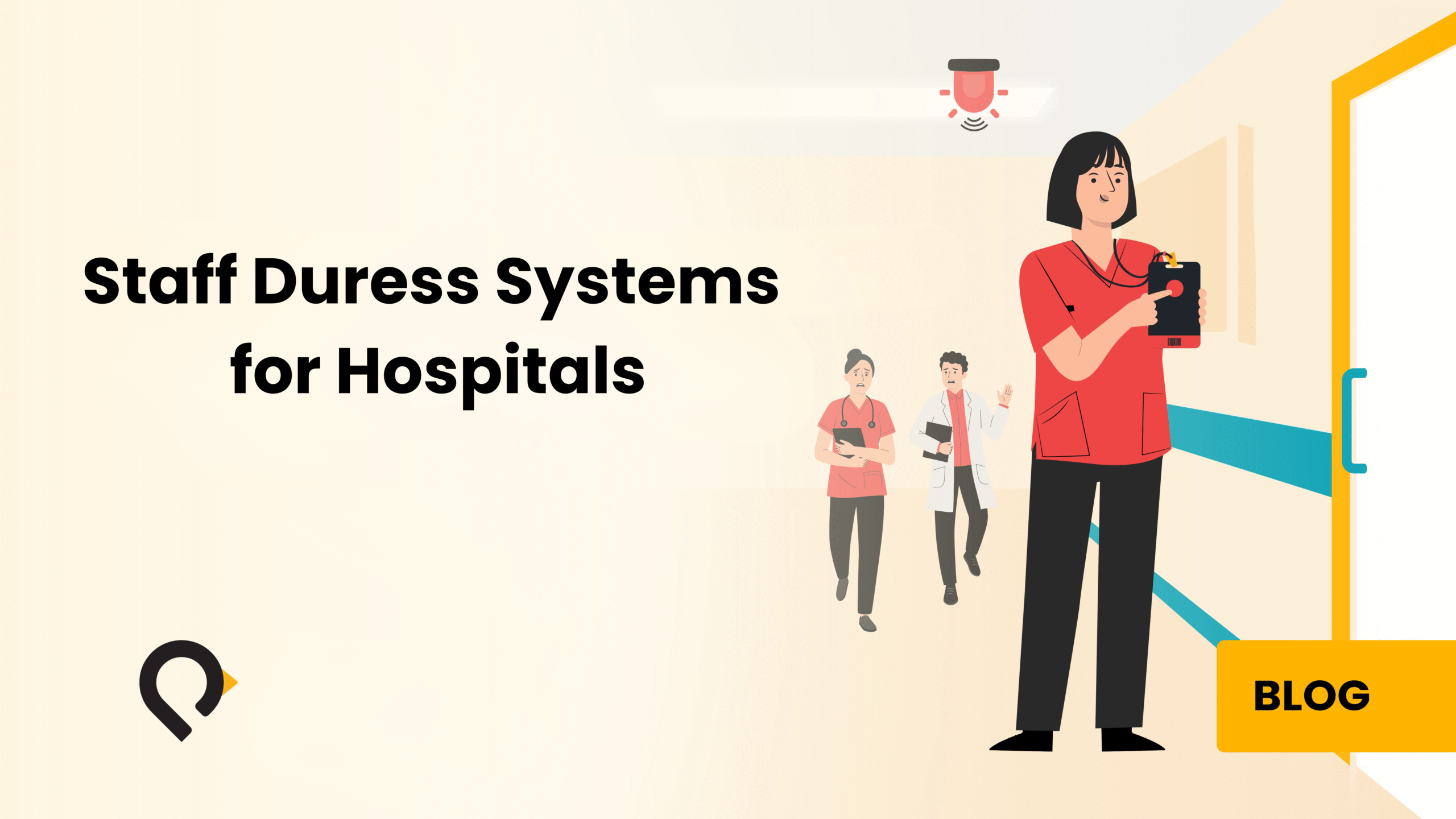
Two rooms share a wall. A nurse in one of them has just pressed her badge. A staff duress system is a wearable panic button tied to a real-time location platform, and everything it is worth comes down to one question: does the alert name the right room, or the room next door?
If you are the hospital security director or the chief nursing officer who signs off on that system, you already know the risk profile. The risk of staff duress in nursing runs at nearly four times that of any other profession, according to industry data, and OSHA treats healthcare as one of the most violent workplaces in the country. What most RFPs never pin down is location certainty. A system that tells security third floor, west wing has moved the search, not ended it.
This guide covers what staff duress systems for hospitals actually do, what accreditors expect to see, how the technology resolves a room, what workplace duress RTLS covers beyond the ward, what a deployment costs and why, and the questions to put to every vendor before you sign.
- Room-level certainty, not zone-level, is the life-safety requirement for duress: Penguin delivers sub-meter accuracy roughly 95% of the time and room-level accuracy roughly 99% where room-level certainty is required.
- The risk of staff duress in nursing is nearly 4x that of any other profession, according to industry data.
- The Joint Commission expects an active workplace violence prevention programme with measurable response data under Leadership Standard LD.03.01.01, set out in R3 Report Issue 30.
- A 200-bed hospital deploying modern BLE 5.1 runs $300,000 to $500,000, against $2M+ for legacy proprietary RTLS.
- Off-the-shelf rechargeable BLE badges remove disposable battery programmes, and the savings over seven years frequently exceed the hardware cost difference.
- One infrastructure carries duress, asset tracking, infant protection, hand hygiene and wander prevention, so duress is rarely a standalone purchase.
What a Staff Duress System for Hospitals Actually Is
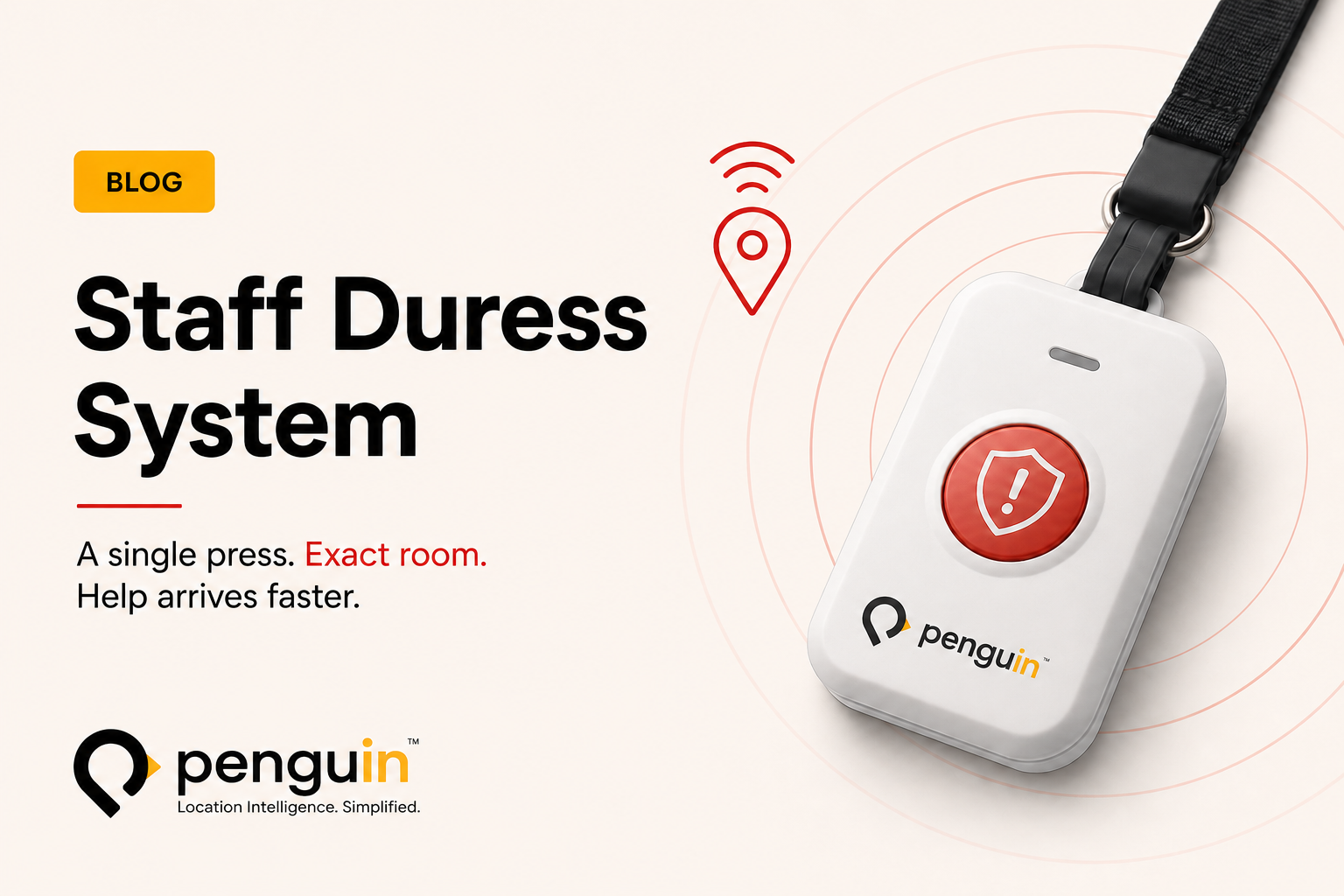
A staff duress system is a wearable badge with a discreet panic button, connected to a location platform that answers three questions the moment it is pressed: who needs help, where they are, and when it happened. The alert routes to named responders silently, without an overhead page that tells an agitated visitor exactly what is coming.
Nurse call tells you a patient wants something. A code called overhead tells the whole building something is wrong and leaves security to find it. A duress alert should do neither. It should put a room in front of the responder.

Sub-meter and room-level are not the same claim
Sub-meter accuracy is physics: the platform places a badge inside a metre of its true position. Room-level accuracy is an AI layer on top of that, deciding which room those coordinates belong to. Penguin delivers sub-meter accuracy roughly 95% of the time and room-level accuracy roughly 99% where room-level certainty is required, resolving position from the full pattern of signals across multiple antennas with machine learning, without relying on explicit angle-of-arrival estimation.
For asset tracking, zone-level is usually enough. For duress, it is not.
The Risk Your Safety Committee Already Tracks
Healthcare and social service workers absorb the largest share of nonfatal workplace violence injuries recorded in the United States, according to the Bureau of Labor Statistics. Research published in the American Journal of Emergency Medicine found that more than 80% of emergency nurses have experienced verbal or physical violence during their careers. Yet the reporting is patchy, because incidents that end without an injury rarely reach a form.
The staffing arithmetic sharpens it. Over 100,000 nurses leave the profession annually, and the US faces a projected shortage of nearly 200,000 registered nurses by 2030, according to industry data. A unit that feels unsafe loses people faster than a unit that feels backed up.
Accreditors have moved as well. The Joint Commission’s workplace violence prevention standards, anchored in Leadership Standard LD.03.01.01, expect a defined programme, incident reporting, and data showing whether response is improving. OSHA’s healthcare guidance sets a parallel expectation for employers under the General Duty Clause.
A surveyor cannot audit what a clipboard never recorded.
How Hospital Staff Duress Systems Work
Three things happen between the press and the response, and every vendor difference sits in the middle step.
A caregiver presses a rechargeable BLE 5.1 badge worn on the lanyard. Nothing sounds in the room.
Penguin’s own locator technology, replacing gateways, feeds the signal pattern to machine-learning algorithms that name the room, not the wing.
Identity, room and timestamp reach security dispatch, the charge nurse and mobile devices through configurable escalation paths.
Because the position keeps updating while the event is open, responders follow the caregiver instead of searching the area she was standing in ten seconds ago. That is the practical gap between a location-aware duress platform such as PenSafe staff duress and a plain panic button on a lanyard.
Match accuracy to clinical risk
| Area | Accuracy tier | Why |
|---|---|---|
| Emergency department | Sub-room | Bays, alcoves and curtained spaces sit inside one large room, so a room number is not enough. |
| Behavioral health and wards | Room-level | Adjacent rooms share walls. Certainty at the boundary decides which door opens first. |
| Corridors, docks, car parks | Zone | Open ground with sightlines. A zone plus a live track is sufficient for interception. |
Where hospitals deploy duress badges first
High acuity, long waits and behavioral health presentations produce the densest incident record.
Precise location lets a team arrive quietly and in the right number, protecting patient dignity too.
Difficult family conversations and code situations create sudden need for backup at the bedside.
Staff work in single rooms off main corridors, with no line of sight to a nursing station.
Workplace Duress RTLS: The Same Alert Beyond the Ward
Workplace duress RTLS is the same three-step pattern applied to any workforce that moves: a badge, a location engine, an escalation path. Hospitals buy it for clinical units first, then discover the rest of the estate has the same exposure. Imaging suites after hours, laboratories, loading docks, staff car parks and satellite clinics all put a lone employee somewhere a shout will not carry.
Indoors, BLE 5.1 handles the positioning. Outdoors, across car parks and campuses, LoRa carries the same badge alert at zone accuracy. That is why the identical platform runs in refineries and plants as well as wards. For the industrial version of this problem, including mustering and contractor headcount, see Penguin workforce safety for industrial sites.
Obligations differ by jurisdiction. US hospitals answer to The Joint Commission and OSHA, while Canadian facilities work to provincial legislation, which we cover in our guide to how a staff duress system works in Canada. The engineering question stays constant: can the alert name the room?
What It Costs, and the Architecture Behind the Number
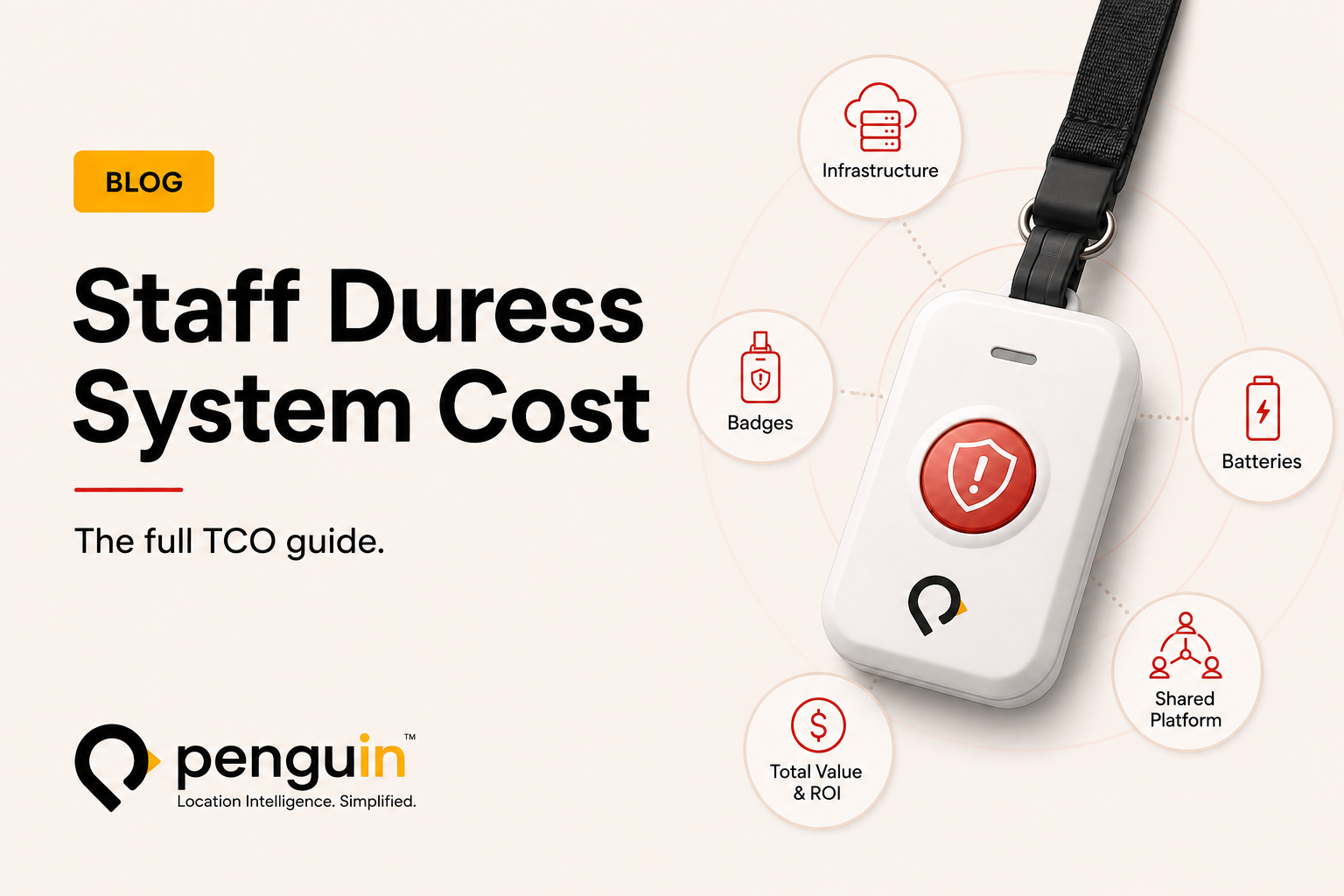
A 200-bed hospital that would once have spent $2M+ on legacy proprietary RTLS can deploy modern BLE 5.1 for $300,000 to $500,000. The number moves because of architecture, not discounting.
An emitter in every room, cabling to install and maintain, proprietary tags, and specialised batteries with a replacement programme attached. Capital cost rises with every door you add.
Off-the-shelf rechargeable BLE badges, Penguin’s own locator technology in place of gateways, no hardwiring for locators, no infrared emitter in every room, and delivery on the enterprise Wi-Fi and network infrastructure you already own.
Total cost lands at less than half that of legacy infrared RTLS, hardware and software combined. Rechargeable badges remove the disposable battery programme entirely, and those savings over seven years frequently exceed the hardware cost difference on their own.
PenSafe: Duress on the Same Infrastructure as Everything Else
PenSafe delivers staff duress as a wearable badge that silently triggers a location-specific alert, with escalation paths you configure by unit, shift and severity. Alerts route to security dispatch, charge nurses and mobile devices, and the platform integrates with nurse call, access control, HL7 and HIS feeds, so responders arrive with room context rather than a bare coordinate. PenSafe is deployed at HMG, the largest hospital group in the Middle East.
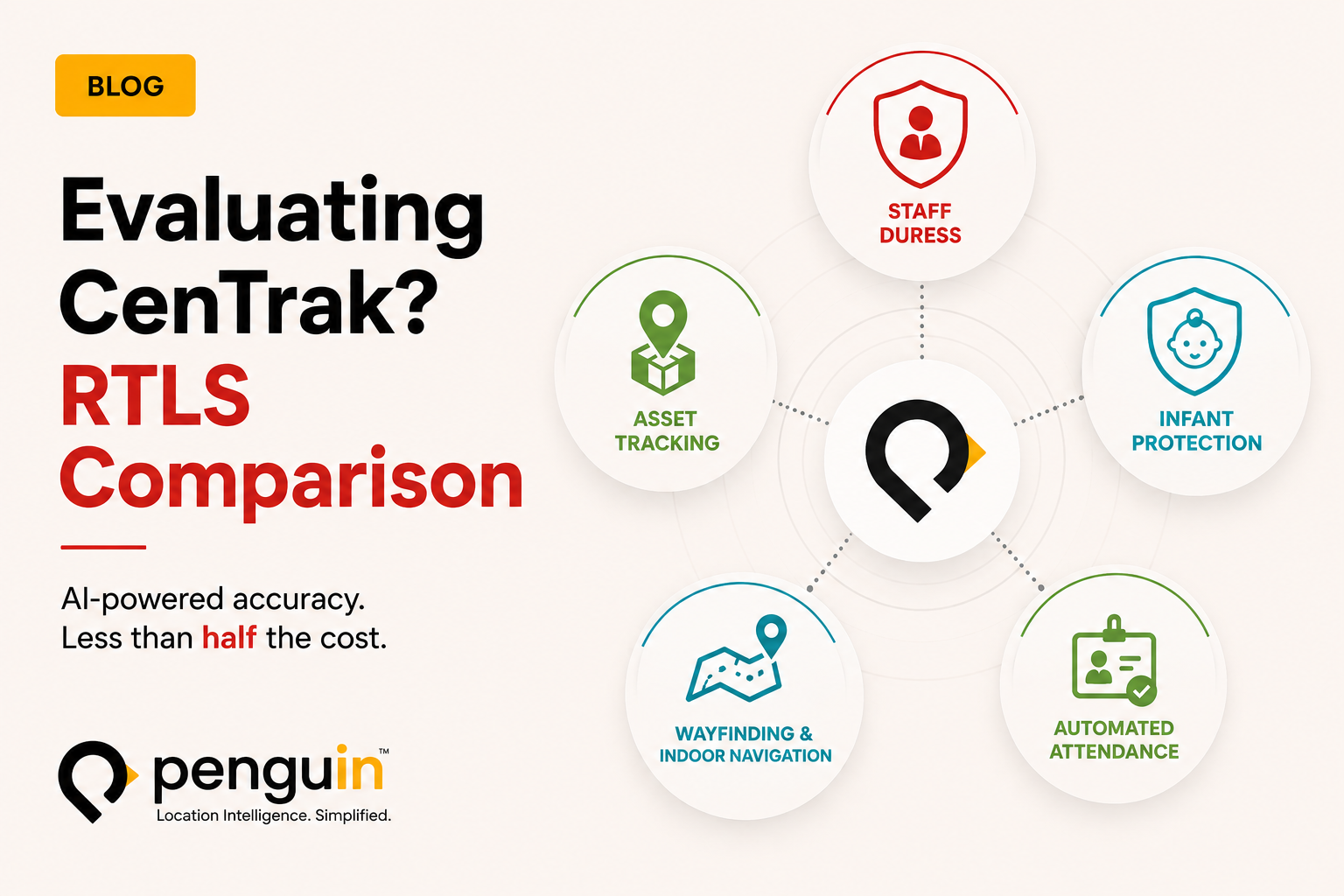
The same locators that resolve a duress alert also resolve everything else on the floor, which matters at budget time.
On one infrastructure a hospital runs RTLS asset tracking with PAR-level management, hospital equipment tracking for biomedical teams, hand hygiene monitoring, wander prevention for at-risk patients, and infant protection, including infant abduction prevention, which is only available in specific regions. For the wider picture, see our overview of RTLS in healthcare.
What to Ask a Duress Vendor Before You Sign
These are the questions your safety committee, your CFO and your surveyor will put to you, so put them to the vendor first.
How does the system decide between two rooms that share a wall? Ask for the mechanism, not the headline figure, and ask what happens in a corridor alcove, in a bathroom, and behind a lead-lined door.
What accuracy do we get per area, and what does each tier cost? A single site-wide number usually means the vendor is quoting the best case. Accuracy should be specified area by area against clinical risk.
Does the location keep updating while the alert is open? A frozen last-known position sends a team to where the nurse was, not where she is.
What do the badges cost to keep running for seven years? Include batteries, replacements, charging hardware and the staff time to manage the programme.
What does it integrate with on day one? Nurse call, security dispatch, access control and the communication tools your teams already carry. Alerts arriving in a new dashboard nobody watches are not alerts.
What evidence does it produce for a survey? Response times, incident locations, heatmaps by shift and unit. This is the documentation that supports a workplace violence prevention programme under LD.03.01.01, and it should export without a services engagement.
The Decision in Front of You
The question stopped being whether to give clinical staff a duress badge. Between OSHA’s expectations, Leadership Standard LD.03.01.01 and a workforce that leaves units where it feels exposed, the programme is coming either way. The real decision is what standard of location certainty you write into the specification, and whether the architecture behind it lets you extend the same infrastructure to asset tracking and patient safety without buying it twice.
Write room-level into the RFP. Ask how the boundary case is resolved. Price the badges over seven years, not one.
Frequently Asked Questions About Staff Duress Systems for Hospitals
The questions security directors and chief nursing officers ask most often when they start scoping a duress programme.
Q: What is a staff duress system for hospitals?
It is a wearable badge with a discreet panic button, tied to a real-time location platform. When a caregiver presses it, the system sends her identity, her location and the time to security dispatch, charge nurses or a mobile app, silently and without an overhead announcement. Modern systems resolve the room rather than the floor or the wing, and they keep updating if the staff member moves. That location certainty is what separates a duress system from a standalone panic button.
Q: How accurate does a hospital staff duress system need to be?
Room-level accuracy is the minimum wherever a caregiver works alone with a patient. Sub-room accuracy, meaning bay or alcove level, is worth the extra locator density in emergency departments and behavioral health units where one room contains several treatment spaces. Penguin delivers sub-meter accuracy roughly 95% of the time and room-level accuracy roughly 99% where room-level certainty is required. Zone accuracy is adequate for corridors, docks and car parks, and nowhere else.
Q: How does staff duress integrate with nurse call and security dispatch?
Alerts trigger nurse call dashboards and mobile apps at the same moment they reach security, so the charge nurse and the responding officer see the same event. Two-way integration with HL7, HIS and access control can pull room occupancy and recorded behavioral flags into the alert, giving responders context before they arrive. Routing through tools the team already uses matters, because a duress platform that requires a new monitoring habit will fail on a busy night shift.
Q: Does a staff duress system support Joint Commission workplace violence requirements?
It supports them, and no product delivers them on its own. The Joint Commission’s workplace violence prevention standards, including Leadership Standard LD.03.01.01, expect a defined programme with measurable outcomes and evidence of continuous improvement. An RTLS duress platform logs response times, incident locations and alert patterns, which is the documentation surveyors ask to see, and heatmaps reveal the shifts and areas that justify staffing changes. Policy, training and the safety committee review process remain yours to run.
Q: What does a hospital staff duress system cost?
For a 200-bed hospital, a modern BLE 5.1 deployment runs $300,000 to $500,000, against $2M+ for legacy proprietary RTLS. Total cost lands at less than half that of legacy infrared RTLS, hardware and software combined. The difference is architectural: off-the-shelf rechargeable badges, Penguin’s own locator technology in place of gateways, no infrared emitter in every room and no hardwiring for locators. Ask any vendor to quote hardware, licensing and seven years of badge running costs on one page.
Q: How long does deployment take, and can the same system do more than duress?
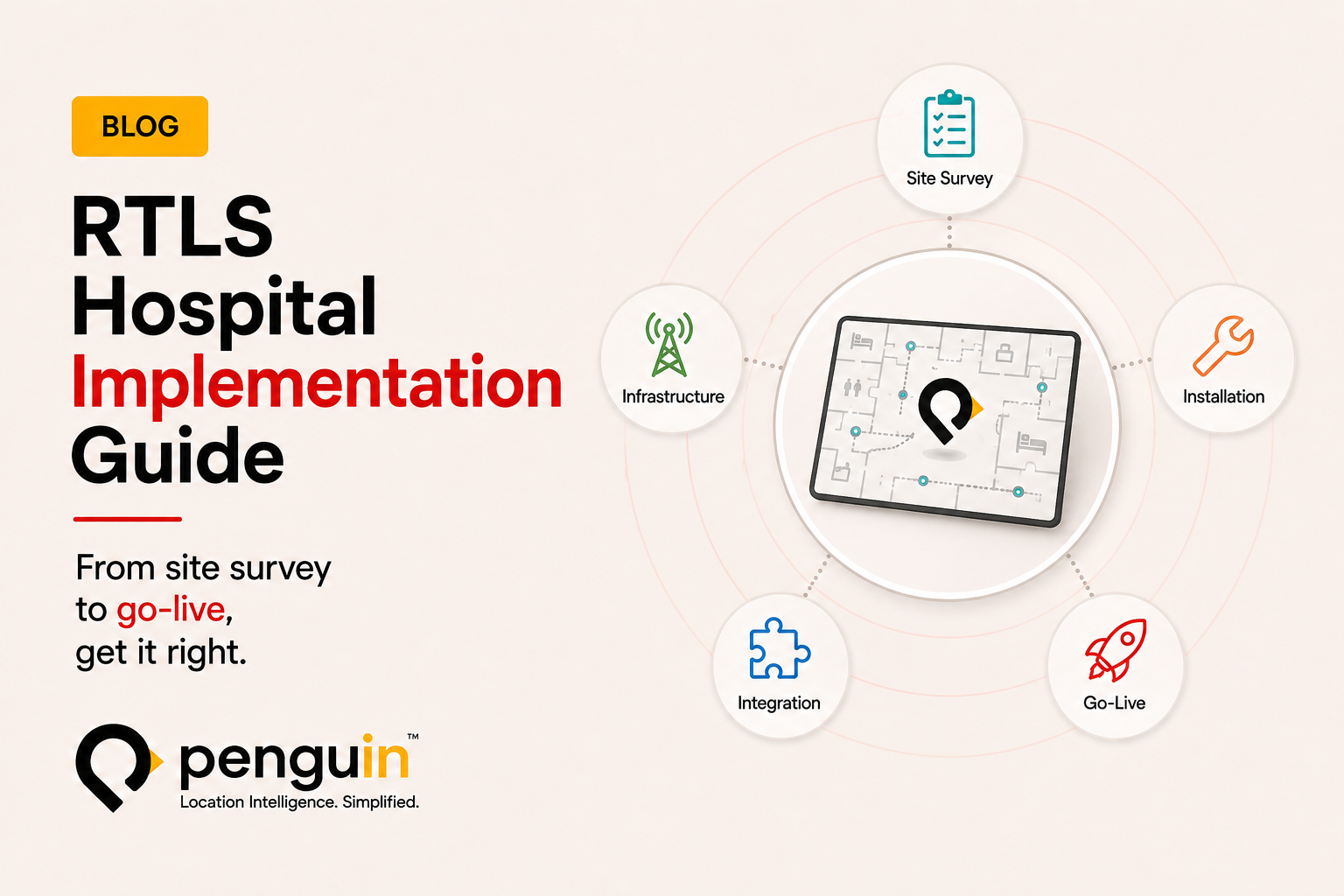
A mid-size facility deploys in 8 to 12 weeks, helped by the fact that locators need no hardwiring and the platform runs on existing enterprise Wi-Fi and network infrastructure. The same locators support asset tracking, wander prevention, hand hygiene monitoring and infant protection, which is only available in specific regions. Most hospitals phase it: duress in the highest-risk units first, then additional use cases on infrastructure that is already installed and paid for.
See a duress alert name the right room
PenSafe pairs off-the-shelf rechargeable BLE 5.1 badges with Penguin’s own locator technology to deliver room-level certainty on the network you already own, with escalation paths you configure by unit and shift.
or see workforce safety beyond the ward, request a demo, or talk to our team.
Improve Healthcare Staff Safety with Modern Duress Systems
Healthcare workers dedicate their time to caring for patients. Implementing modern
staff duress systems for hospitals helps create safer healthcare environments
and ensures medical staff can quickly request help during emergencies.
Advanced technologies such as RTLS staff safety systems, panic buttons, and real-time alerts
enable hospitals to respond faster to incidents and strengthen workplace violence prevention programs.