
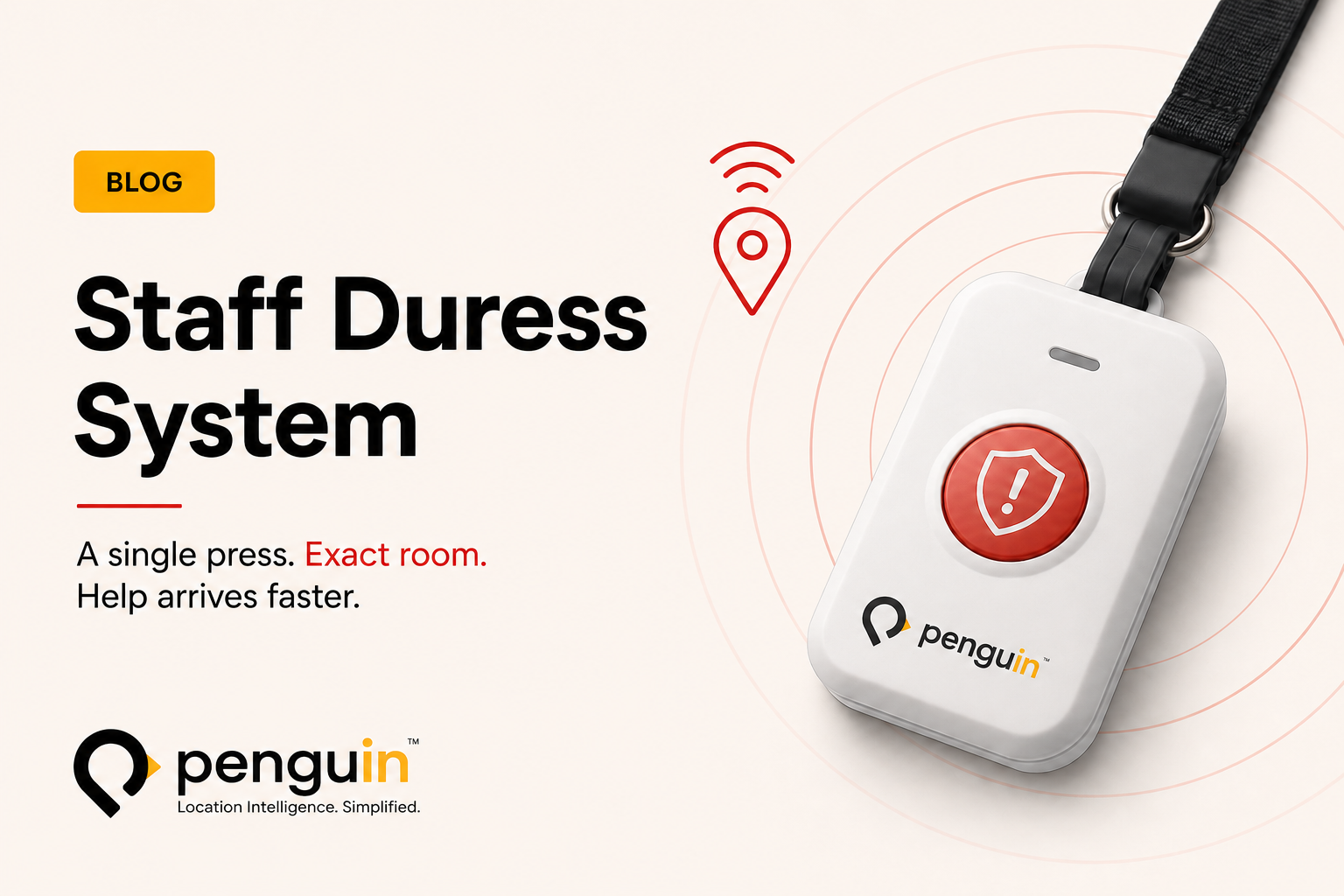
A staff duress system that tells you exactly where — affordable to deploy or replace.
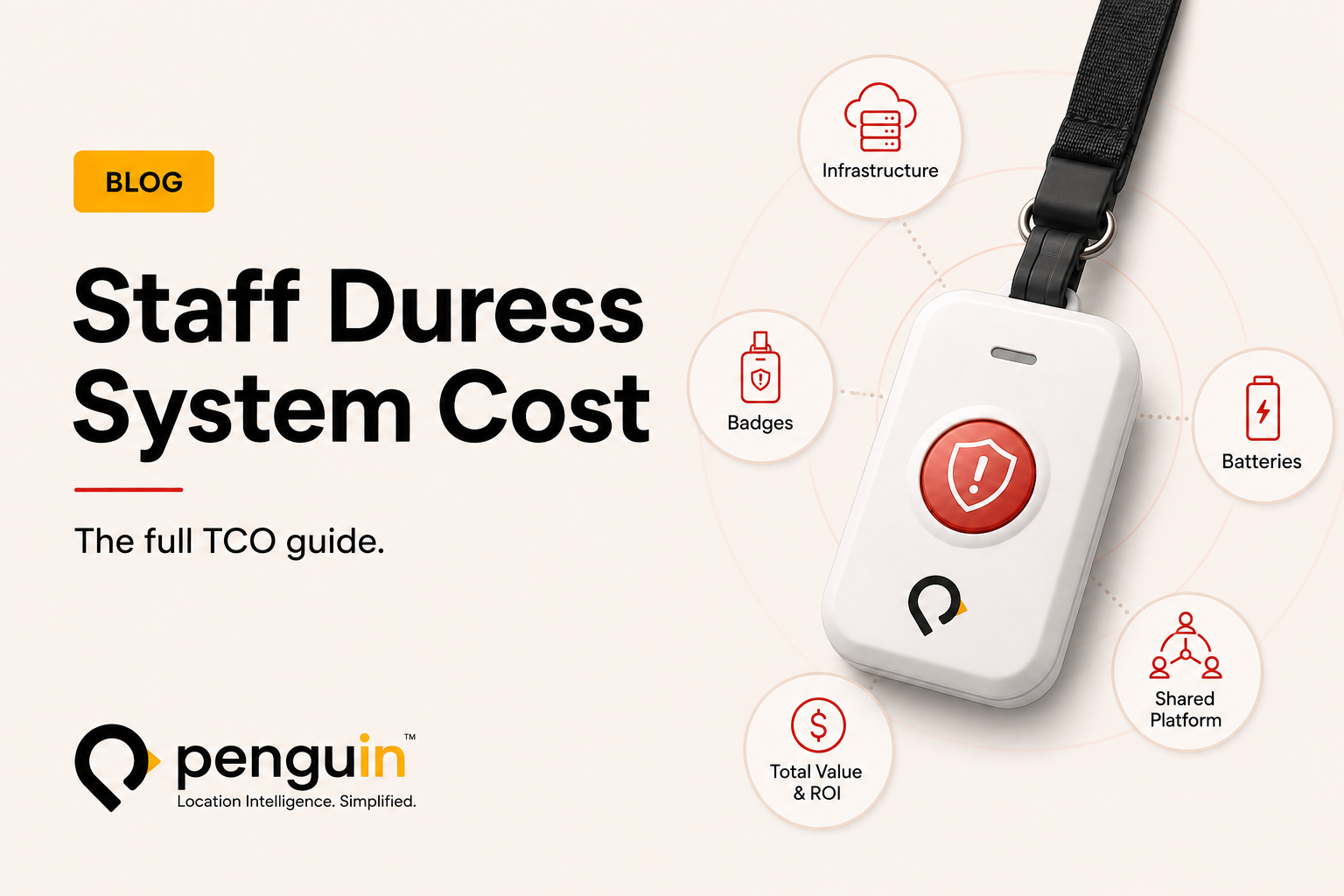
A staff duress badge is a wearable panic button for your team — and when a nurse or staff member calls for help, an alert alone isn’t enough — responders need to know which room, instantly. Penguin Location Services delivers room- and sub-meter accuracy with AI and BLE 5.1, so a single press turns into a precise location and a fast, coordinated response. And because it runs on AI and standard hardware instead of infrared in every room, it does this at a fraction of the cost of legacy duress systems. Here’s what a modern staff duress system does, what to look for, and when it’s time to replace an older one.
A duress button that only sends an alert tells responders something is wrong. A location-aware system tells them exactly where — turning “somewhere on the floor” into “room 412,” when seconds count.
How a modern staff duress system works
Three steps, with no thinking required from the person who needs help.
Press
A staff member presses their wearable badge — a discreet panic button that’s always on them, with no phone or app required.
Locate
The system fixes the exact room in real time and raises the alert on every responder’s device and dashboard.
Respond
Responders move straight to the location, and the event is logged automatically for review and reporting.
What to look for in a hospital staff duress system
If you’re evaluating options, these are the capabilities that separate a real safety system from a basic panic button.
- Room-level location — responders get the exact room, not just a floor or wing.
- One-press wearable badge — discreet, hands-free, always on the person.
- Real-time response routing — the alert and location reach every responder instantly.
- Integration — works with your nurse call, access control and security systems.
- Automatic reporting — timestamped incident logs, response-time trends and location heat maps for review and compliance.
- Rechargeable, non-proprietary badges — bought once and reused, with no locked-in tags or specialized batteries to keep buying.
- One platform — the same system can add wander prevention, infant protection, asset tracking and wayfinding when you’re ready.
Signs it’s time to replace your current duress system
The biggest reason hospitals keep an aging duress system is the assumed cost of replacing it. Penguin changes that math: because it runs on AI and standard hardware instead of infrared in every room, replacing a legacy system typically costs a fraction of what you’d expect — and far less to run year over year. That makes acting on these common gaps easy to justify.
Replacing costs less than you think
A modern Penguin system typically runs a fraction of a legacy platform — up to ~60% lower total cost of ownership — with off-the-shelf rechargeable badges and no per-room infrared to buy or maintain. Often the reason to switch, not the reason to wait.
It only sends an alert
Responders know something happened, but not the exact room — costing the seconds that matter most.
No response-time data
You can’t show how fast your team responds or whether the program is improving — which reviewers increasingly expect.
Dead zones & costly upkeep
Coverage gaps erode staff trust, while proprietary tags and specialized batteries mean ongoing purchases and fleet-wide replacement work.
Meet PenSafe, by Penguin Location Services
PenSafe is Penguin’s staff safety and duress platform, built on BLE 5.1 and AI-powered location. It resolves the exact room a staff member is in — achieving sub-meter accuracy roughly 95% of the time and about 99% room-level accuracy where room-level certainty is required — without infrared or ultrasound hardware in every room. Badges are off-the-shelf and rechargeable, so you can source them from any supplier and reuse them. And because it’s one platform, the same infrastructure can grow into wander prevention, infant protection, asset tracking and wayfinding.
PenSafe’s analytics portal captures every event automatically — timestamped incident logs, location heat maps, and response-time trends — the kind of documentation safety and accreditation teams need, produced as a byproduct of the system doing its job.
Room-level staff duress, made affordable. Penguin delivers it for a fraction of the cost of legacy duress systems — up to ~60% lower total cost — because AI replaces the per-room infrared hardware and badges are off-the-shelf and rechargeable.
Based on customer-reported evaluations and Penguin deployment pricing. Total cost of ownership varies by facility, scope and integrations.
Why Penguin staff duress is more affordable
Affordability isn’t a discount — it’s the architecture. Three design choices put hospital-grade duress within reach of more facilities.
AI instead of infrared
Room-level accuracy comes from AI and BLE 5.1 — no infrared emitter to buy, mount and maintain in every room, and a faster, less disruptive install.
Off-the-shelf badges
Badges are standard and rechargeable — buy them from any supplier and reuse them. No proprietary tags or specialized batteries to keep purchasing.
One platform, shared cost
The same infrastructure also powers wander prevention, infant protection, asset tracking and wayfinding — so the cost is spread across many uses, not one.
Have questions about staff duress?
Whether you’re just exploring or comparing options, we’re happy to walk you through how it works and answer anything — no sales pitch.
Ask a question, request a walkthrough, or just see if it’s a fit.
Staff duress systems: common questions
What is a staff duress system?
A staff duress system lets a healthcare worker call for help quickly and discreetly — usually with a button on a wearable badge. A modern, location-aware system goes further: it identifies the exact room where the alert came from and routes responders there in real time, rather than just signaling that something happened somewhere.
How does a hospital staff duress system work?
A staff member presses the button on their badge; the system determines their exact location in real time and raises the alert on responders’ devices and dashboards; responders go straight to the room; and the event is logged automatically. With Penguin, location is resolved using AI and BLE 5.1 — no infrared or ultrasound emitters in every room.
What should a hospital staff duress system include?
Look for room-level location accuracy, a discreet one-press wearable badge, real-time response routing, integration with your nurse call and security systems, automatic reporting (incident logs, response-time trends and heat maps), and rechargeable, non-proprietary badges so you’re not locked into one vendor’s tags and batteries.
Why does room-level accuracy matter for staff duress?
In an emergency, responders need to know exactly where to go. A system that reports only a floor or wing forces them to search, wasting the seconds that matter most. Room-level accuracy sends help directly to the right room — which is why it’s a safety requirement, not an optional upgrade.
How do I know it’s time to replace our current duress system?
Common signs include: it only sends an alert without a precise location; it can’t produce response-time data or reports; it has coverage dead zones or frequent false alerts that erode staff trust; or it’s costly to maintain because of proprietary tags and specialized batteries. Any of these is a reason to re-evaluate.
Can a staff duress system integrate with our existing systems?
Yes. A modern platform like PenSafe integrates with nurse call systems, access control and security operations, so the alert-to-response workflow is captured in one place — and the same infrastructure can later support wander prevention, infant protection, asset tracking and wayfinding.
Is a staff duress badge the same as a panic button?
Essentially, yes — a staff duress badge is a wearable panic button designed for healthcare staff. The difference with a modern system is what happens after the press: instead of just sounding an alert, it pinpoints the exact room and routes responders there in real time, and logs the event automatically.
How much does a staff duress system cost?
It varies by facility size, the number of badges and the integrations you need. Penguin Location Services is designed to be a fraction of the cost of legacy duress systems — up to roughly 60% lower total cost of ownership — because it uses AI and standard hardware instead of infrared in every room, plus off-the-shelf rechargeable badges. The best way to get a real number is a quick estimate for your facility.
© 2026 Penguin Location Services. Provided for informational purposes. Accuracy figures reflect Penguin Location Services’ stated performance and vary by facility and environment.