
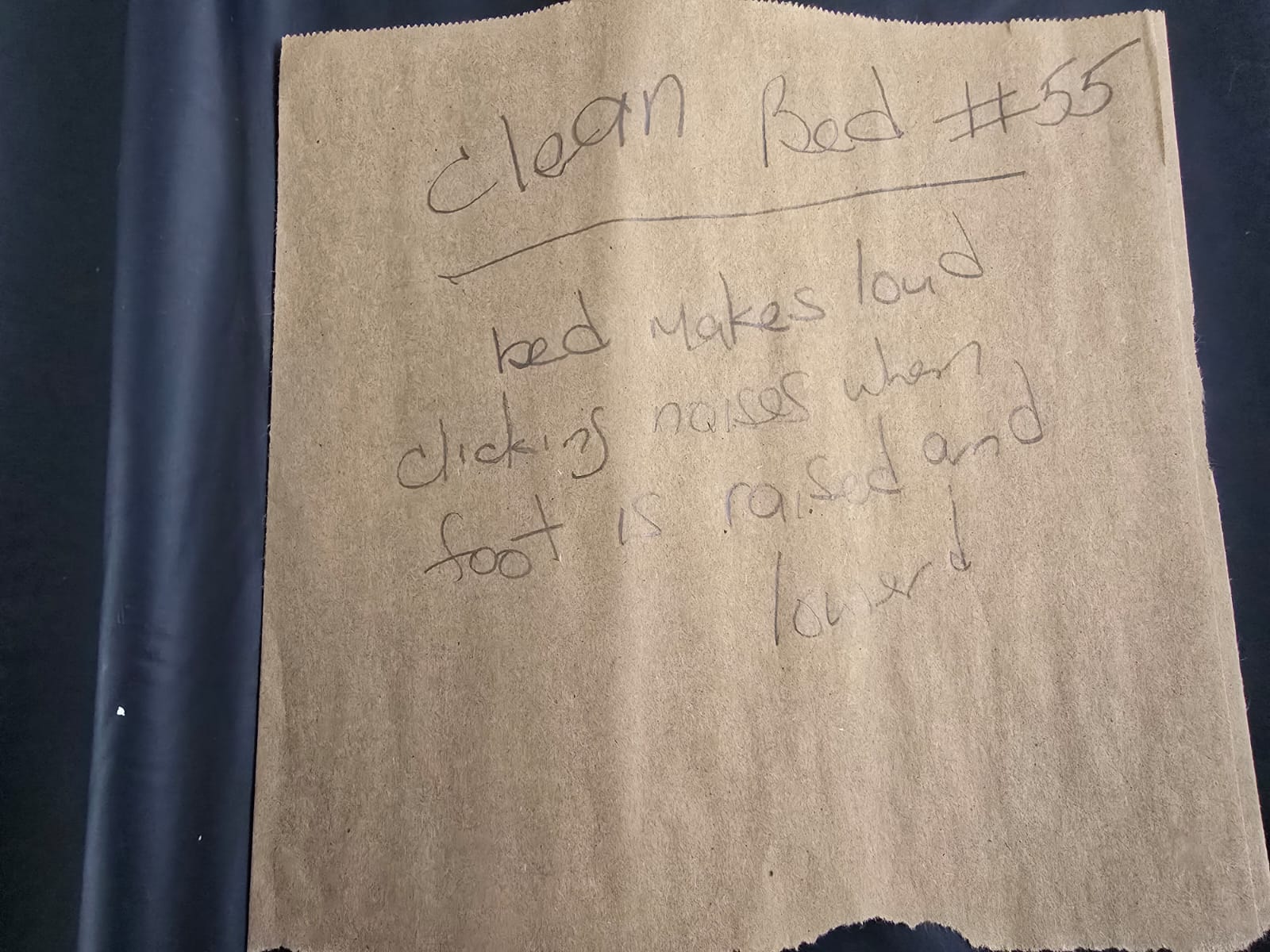
During a recent hospital visit, we noticed a handwritten note taped to a patient bed:
“Clean Bed #55 – Bed makes loud clicking noises when foot is raised and lowered.”
It was written on a paper towel.
At first glance, it seemed harmless, a nurse noticed an issue and flagged it. But that small paper towel note illustrates a widespread challenge in healthcare operations: manual maintenance workflows that operate outside real-time systems.
This gap is exactly what RTLS in healthcare (Real-Time Location Systems) is designed to eliminate.
Key Takeaways
- Manual maintenance workflows, sticky notes, verbal handovers, unstructured emails, create invisible data gaps that cost hospitals time, money, and compliance exposure.
- RTLS in healthcare connects asset location, condition, and performance data into a centralized platform that replaces guesswork with real-time intelligence.
- Every tagged device can be instantly located, automatically linked to a maintenance ticket, and monitored across its full lifecycle, no more missing equipment or location uncertainty.
- Hospitals implementing RTLS asset tracking report 30–50% reductions in equipment downtime and measurable improvements in repair response times.
- RTLS maintenance intelligence is the operational foundation that clinical digitization programs depend on, but too often overlook.
The Hidden Cost of Manual Maintenance Workflows
Hospitals are dynamic, high-pressure environments. Clinical teams focus on patient care, while biomedical and facilities teams handle thousands of assets. Yet equipment issues are still reported through methods like:
- Sticky notes or written memos
- Verbal handovers
- Manual logs
- Unstructured emails
Without digital tracking or RTLS asset management, crucial maintenance data disappears, leading to:
- Lack of standardized ticketing
- No automated escalation or response tracking
- Missed SLA targets
- No asset lifecycle visibility
- Lost opportunities for predictive maintenance
Each handwritten note is more than an outdated process, it is a missing data point in your hospital intelligence network.
RTLS in Hospitals: Closing the Visibility Gap
Imagine trying to manage 500+ hospital beds, 2,000+ portable clinical devices, and 24/7 continuous operations. If just 10% of assets are not properly tracked, the facility loses visibility into:
- Which assets fail most frequently
- Where failures occur and under what conditions
- Mean Time to Repair (MTTR)
- Preventive maintenance effectiveness
- Total cost of ownership
RTLS in hospitals fills this information gap by connecting medical device location, condition, and performance data into a centralized platform for decision-making. For a broader look at how RTLS transforms hospital operations across clinical and operational use cases, see our complete guide to RTLS in healthcare.
How Real-Time Location Systems (RTLS) Improve Hospital Maintenance
At Penguin Location Services, we integrate real-time location system technologies directly into hospital operations through our AIMS (Asset & Inventory Management System) platform.
This combination transforms maintenance workflows by connecting:
- Asset location data
- Maintenance and facilities operations
- Real-time staff notifications
- Historical service and performance analytics
With RTLS asset tracking, every tagged device can be instantly located within the hospital, automatically linked to a maintenance ticket, associated with a department, floor, or room, and monitored across its full lifecycle. No more searching for missing equipment. No more location uncertainty. For a detailed look at how this applies specifically to high-value assets, see our guide on hospital asset tracking with BLE RTLS.
AIMS + RTLS: Turning Paper Towels Into Data
Our AIMS platform integrates seamlessly with real-time location systems to digitize every maintenance event. With RTLS healthcare integration, hospitals gain:
- Real-time asset visibility
- Digital issue logging at the equipment level
- Instant alerts to biomedical and maintenance teams
- SLA tracking and performance reporting
- Trend identification for recurring issues
- Predictive maintenance scheduling
That simple paper towel note now becomes a structured RTLS data event, traceable, measurable, and actionable. When RTLS connects directly to your Computerized Maintenance Management System, this data loop closes completely. For more on how that integration works in practice, see our guide on RTLS and CMMS integration for healthcare.
Strategic Benefits of RTLS Asset Tracking in Healthcare
Implementing RTLS for healthcare asset tracking produces measurable outcomes:
- 30–50% reduction in equipment downtime
- Faster repair response times
- Reduced device loss and shrinkage
- Optimized capital utilization
- Improved vendor performance tracking
- Enhanced patient safety and staff efficiency
Hospitals already dedicate significant budgets to EMRs and clinical digitization. Yet operational digitization, powered by RTLS, is what ensures reliability behind the scenes.
The Future: Predictive Hospitals Powered by RTLS
The next generation of hospital efficiency will not come from more disconnected tools. It will come from connected systems built on real-time data, where every asset and workflow feeds into intelligent analytics.
The difference between a handwritten paper towel note and a connected RTLS workflow is transformative:
- Visibility into every asset
- Accountability across departments
- Predictive insight that drives smarter capital planning
This is more than an operational upgrade, it is the foundation for data-driven, predictive healthcare facilities.
If your organization is exploring ways to modernize asset tracking, facilities management, or preventive maintenance, Penguin Location Services can help implement an enterprise-grade RTLS strategy. Let us move beyond paper-based maintenance, and build RTLS-enabled hospitals that are operationally as intelligent as they are clinically advanced.
Frequently Asked Questions
How does RTLS in healthcare improve maintenance workflows?
RTLS connects asset location data with maintenance operations in real time. When a device has an issue, the system knows exactly where it is, automatically generates a maintenance ticket, and notifies the biomedical or facilities team instantly. This replaces handwritten notes, verbal handovers, and manual logs with a structured, traceable digital workflow that captures every event.
What is the difference between RTLS asset tracking and a traditional CMMS?
A traditional CMMS manages scheduled maintenance and work orders but relies on manual input to know where equipment is. RTLS adds real-time location intelligence on top of that, so maintenance teams know not just that an asset is due for service, but exactly which room it is currently in. When RTLS integrates with a CMMS, usage-based maintenance triggers replace calendar-based schedules and repair teams walk directly to the equipment rather than searching for it first.
What is the AIMS platform and how does it relate to RTLS?
AIMS is Penguin’s Asset and Inventory Management System, a platform that integrates RTLS location data with maintenance operations, facilities workflows, and performance analytics. Together, they digitize every maintenance event from issue detection through resolution, giving hospitals real-time visibility, SLA tracking, and trend analysis across their full asset fleet.
What ROI can hospitals expect from RTLS asset tracking?
Hospitals implementing RTLS for asset tracking consistently report 30–50% reductions in equipment downtime, significant reductions in device loss and shrinkage, faster repair response times, and lower capital expenditure as utilization data allows right-sizing of equipment inventories. For infusion pumps specifically, documented deployments show fleet reductions of 20–35% after tracking reveals the true utilization picture.
Can RTLS support predictive maintenance in hospitals?
Yes. When RTLS tracks device location, usage patterns, and maintenance history continuously, the system accumulates the data needed to predict failure before it occurs. Usage-based maintenance triggers replace fixed calendar intervals, meaning heavily used equipment gets serviced more frequently while lightly used devices are not pulled unnecessarily. Over time, this reduces unexpected failures and extends overall equipment lifespan.
Penguin Location Services delivers RTLS-based asset tracking and maintenance intelligence through PenTrack, part of an integrated platform covering asset management, patient safety, and indoor navigation on a single sensor infrastructure. Learn more at penguinin.com/asset-tracking.
Ready to Modernize Your Hospital Maintenance Operations?
Whether you are evaluating RTLS for asset tracking, planning a CMMS integration, or ready to replace manual maintenance workflows with real-time intelligence, our team is ready to help.
Reach out today
Contact Penguin Location Services to design an RTLS strategy that fits your hospital’s operations, budget, and growth plans.