
A nurse working a night shift in an emergency department cannot call for help the same way someone in an office can. She cannot shout without alarming a volatile patient. She cannot reach a wall phone if she is cornered. She cannot press a fixed panic button if the incident happens in a corridor, a patient room, or a stairwell.
This is the nurse duress problem, and it is not a minor gap. According to the Canadian Federation of Nurses Unions, over 61% of nurses in Canada report experiencing physical violence on the job. The Bureau of Labor Statistics documents that healthcare workers in the US face workplace violence at rates higher than any other sector. Government authorities have responded with legislation, Bill 168 in Ontario, OSHA healthcare guidelines in the US, but legislation alone does not protect a nurse in room 412 at 2 AM.
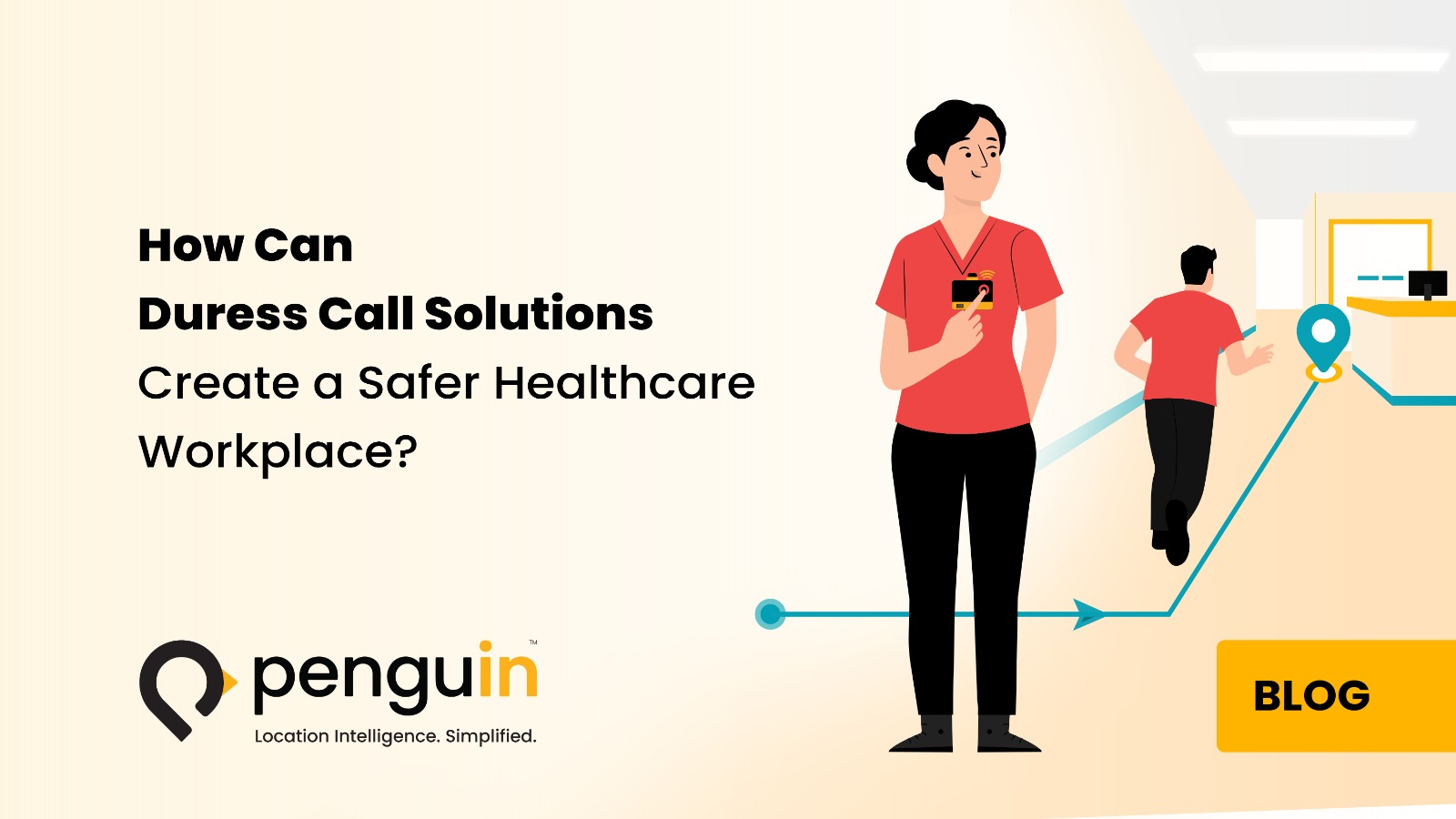
The technology that closes this gap is a wearable nurse duress system powered by real-time location, a badge the nurse wears at all times, everywhere she goes, that sends security her exact room location the moment she presses a button.
Key Takeaways
- Over 61% of nurses report experiencing physical violence at work, making nurse duress alerting one of the most urgent patient safety investments a hospital can make.
- A wearable RTLS nurse duress badge moves with the nurse everywhere in the facility. Fixed panic buttons only protect nurses who are standing next to them when an incident occurs.
- When a nurse activates her badge, security receives her name, photo, and exact room-level location within seconds, not just a zone or a floor, but the specific room.
- Automatic escalation ensures that if the first responder does not acknowledge the alert, it routes to the next person in the chain, so no alert is ever ignored.
- RTLS nurse duress systems run on the same sensor infrastructure as asset tracking, patient monitoring, and hand hygiene compliance, one deployment supporting multiple safety use cases.
Why Nurses Need a Dedicated Duress Solution
Workplace violence against nurses is not random, it clusters in predictable settings, at predictable times, with predictable patient profiles. Emergency departments, psychiatric units, and long-term care floors carry the highest risk. Night shifts and shift changes create supervision gaps. Patients in acute crisis, under involuntary holds, or experiencing cognitive impairment create elevated incident risk that clinical staff recognize but cannot always anticipate in time.
Traditional protection methods have well-documented limitations. Overhead Code White announcements broadcast that help is coming, which can escalate a volatile situation before responders arrive. Fixed wall-mounted panic stations only protect nurses who are close enough to reach them, which in a physical confrontation is rarely the case. Radio or phone calls require the nurse to speak, which is not always possible and reveals the call for help to the person causing the threat.
What nurses need is a silent, immediate, location-specific way to summon help from wherever they are, without making any visible signal that help is coming. This is what a wearable RTLS nurse duress system delivers. For a full comparison of duress system types and how they have evolved, see our guide on how hospital staff duress technology has evolved.
How a Nurse Duress System Works
A wearable nurse duress system uses BLE (Bluetooth Low Energy) technology to combine continuous location tracking with instant alert capability. Here is how the end-to-end process works in a live hospital environment:
Step 1, The nurse wears a BLE badge
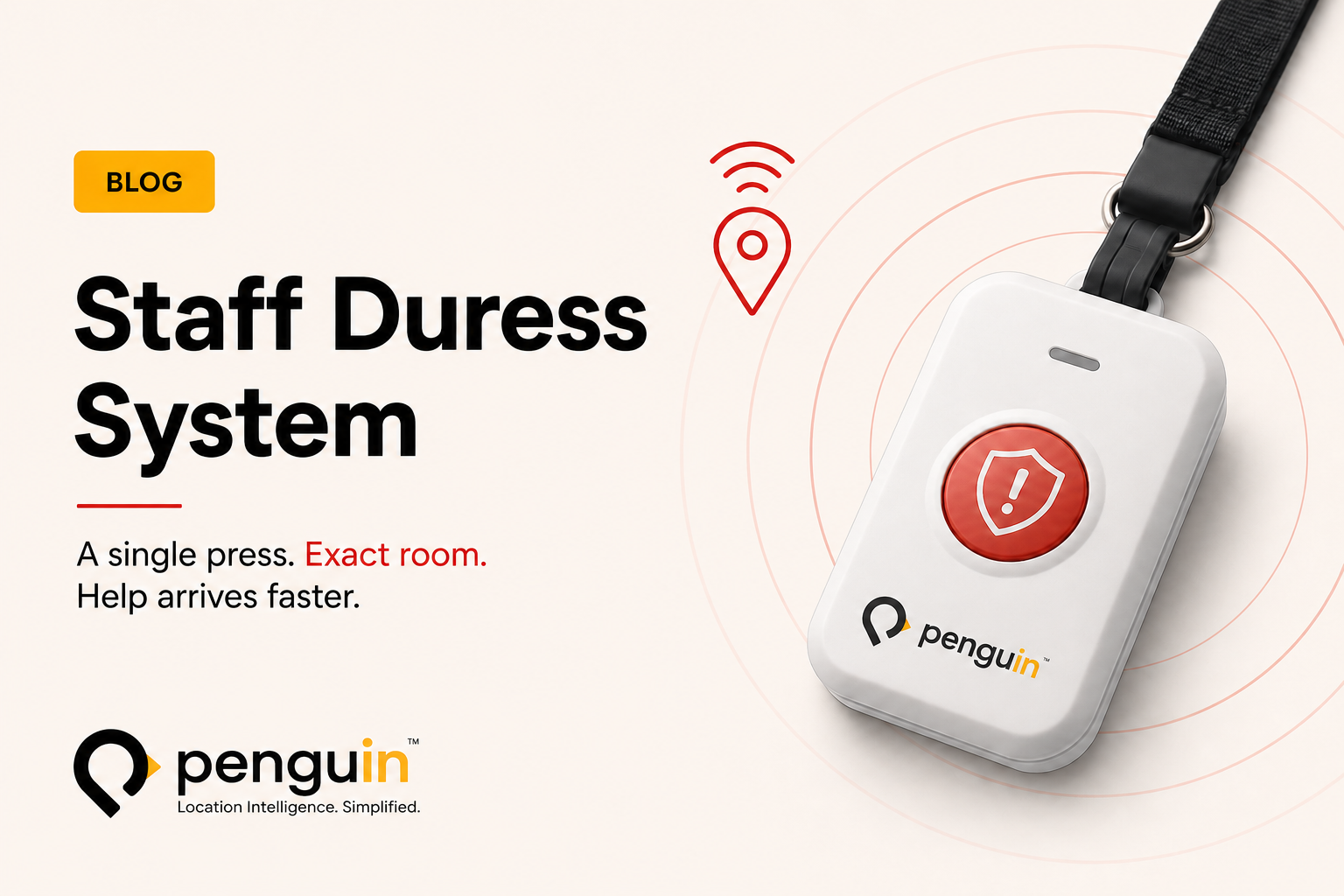
Each nurse receives a small, lightweight badge that clips to a lanyard or ID holder. The badge broadcasts a continuous location signal and has a single panic button, firm enough to prevent accidental activation, accessible enough to press quickly under stress without looking at it.
Step 2, The facility tracks location continuously
BLE readers installed throughout the hospital receive signals from every active badge and report location data to the RTLS platform in real time. The system maintains a live map showing every nurse’s current room-level location, updated continuously as they move through the facility.
Step 3, The nurse presses the badge button
When a nurse feels threatened, she presses the button. The alert fires silently through the software platform. No overhead announcement. No visible sign that help has been called. No escalation of the situation before responders arrive.
Step 4, Security receives the alert immediately
Within seconds, security personnel and supervisors receive a push notification on their mobile device or workstation showing the nurse’s name, department, and exact room-level location, updated in real time if she moves. Responders walk directly to the correct room rather than searching the unit.
Step 5, Escalation fires automatically if unacknowledged
If the initial alert is not acknowledged within a configurable window, the system automatically escalates to the next responder in the chain, charge nurse, security supervisor, emergency coordinator. This continues until someone takes ownership of the response.
Step 6, The system logs the event automatically
Every alert, acknowledgment, response time, and location event is timestamped and stored automatically. This creates the compliance documentation that Bill 168, OSHA, and accreditation bodies require, without any manual entry from nursing staff.
Wearable RTLS Badge vs. Fixed Panic Button
The most important distinction in nurse safety technology is between systems that move with the nurse and systems that do not.
Fixed Panic Buttons
Mounted at specific points on walls throughout the unit. When a nurse activates one, security receives an alert for that station’s location. The critical limitation is that nurses must be near the button to use it, and in most violent incidents, they are not. A nurse confronted in a patient room, a corridor, or a bathroom has no access to a fixed station. The system installed to protect her is out of reach at the exact moment she needs it.
Wearable RTLS Nurse Duress Badges
Move with the nurse everywhere she goes, every room, every corridor, every stairwell, every patient bathroom. When she presses the button, the system knows her exact location because it has been tracking her continuously. Security receives room-level location data within seconds, regardless of where in the facility the incident occurs. The nurse never needs to reach a wall, speak a word, or make any visible signal.
The difference between a fixed panic button and a wearable nurse duress badge is not a matter of degree, it is a matter of whether the system actually works during a real incident. In a physical confrontation, the nurse is almost never standing next to a wall station.
High-Risk Settings Where Nurse Duress Systems Matter Most
Emergency Departments
Emergency departments carry the highest documented rate of workplace violence in hospital settings. Long wait times, high patient acuity, substance intoxication, and the presence of patients under psychiatric holds create an environment where aggressive incidents are not rare exceptions, they are a regular operational reality. Research published in the American Journal of Emergency Medicine found that more than 80% of emergency nurses have experienced verbal or physical violence during their careers.
Inpatient Psychiatric and Behavioral Health Units
Psychiatric units present a different risk profile, patients may have full cognitive capacity but be in acute crisis, experiencing psychosis, or in withdrawal states that produce unpredictable behavior. The population of patients under involuntary holds is particularly high-risk. One-to-one supervision is often inadequate for covering all patients simultaneously, making wearable alerting essential for staff who are working with individual patients.
Long-Term Care and Memory Care Floors
Patients with dementia and Alzheimer’s disease can become agitated and physically aggressive in ways that are difficult to predict and impossible to reason with. Staff on these units work in environments where patients may not recognize them as caregivers, and where sundowning creates a predictable elevated-risk window in the late afternoon and evening.
Night Shifts and Reduced Staffing Periods
Incidents during night shifts are disproportionately severe because response times are longer when fewer staff are on the floor. A nurse working with reduced overnight staffing needs a duress system that compensates for the supervision gaps that night shift creates, not a system that depends on someone nearby hearing a call for help.
Compliance and Regulatory Requirements
Nurse duress systems sit at the intersection of workplace safety legislation and healthcare accreditation requirements, both of which are tightening their expectations around what constitutes an adequate protection program.
In Ontario, Bill 168 requires employers to provide workers with an immediate means of summoning assistance when violence occurs or is likely to occur. Ministry of Labour inspectors have increasingly questioned whether fixed wall-mounted stations meet this requirement for nurses working in high-risk clinical environments. Wearable RTLS duress systems are now widely regarded as the appropriate standard.
BC WorkSafe regulations and Alberta OHS legislation carry equivalent requirements. In the US, OSHA’s healthcare workplace violence guidelines establish parallel expectations for hospital employers.
The Joint Commission requires hospitals to implement proactive workplace violence prevention programs and demonstrate measurable response capability. RTLS nurse duress systems generate the timestamped incident logs and response time data that satisfy these documentation requirements automatically, without additional administrative burden on clinical staff.
What to Look for in a Nurse Duress Solution
When evaluating nurse duress systems, the specification sheet is the starting point, not the ending point. These are the questions that separate systems that work in a real hospital from systems that work in a vendor demonstration:
Does the badge move with the nurse everywhere? Confirm that the system provides continuous location tracking throughout the facility, not just in areas with specific hardware installed.
What is the room-level accuracy rate in a live hospital environment? Ask for accuracy data from a deployed facility, not from a controlled test environment. The RF conditions in a real hospital are meaningfully different from an empty room.
How does the system handle wall proximity? A nurse standing near a shared wall between two patient rooms should be placed in the correct room. Ask specifically how the system resolves this edge case.
Is the badge rechargeable? Disposable battery systems create an ongoing maintenance program and a predictable failure mode, a dead battery that gives no warning. Rechargeable badges eliminate both.
Does the alert route to the right person with actionable information? An alert that goes to a generic nursing station inbox is not the same as a push notification to the security officer’s mobile device showing the nurse’s name, photo, and room number.
What does the post-deployment support model look like? The first 90 days of operation are when alert threshold configuration, escalation logic, and workflow integration need the most adjustment. Ask specifically who is responsible for your account during this period.
For a detailed buyer’s guide covering all staff duress system types, see our complete guide on staff duress systems for Canadian hospitals.
Frequently Asked Questions About Nurse Duress Solutions
What is a nurse duress system?
A nurse duress system is a wearable safety device that allows nurses and other healthcare workers to silently trigger an emergency alert from anywhere in the facility. When the badge button is pressed, the system immediately notifies security and supervisors with the nurse’s name and exact room-level location, giving responders the information they need to reach the correct location within seconds. Unlike overhead Code White announcements, the alert is silent and does not escalate the situation before help arrives.
How is a nurse duress badge different from a fixed panic button?
A fixed panic button requires the nurse to be physically near a wall-mounted station to activate it. In most violent incidents, the nurse is not near a wall, she is in a patient room, a corridor, or a confined space. A wearable RTLS nurse duress badge moves with the nurse at all times. When she presses the button, the system knows her exact current location because it has been tracking her continuously. The response is faster, more targeted, and location-specific regardless of where in the facility the incident occurs.
Can a nurse activate the duress alert without the patient noticing?
Yes, and discreet activation is a core design requirement. The button activates silently with a single press. There is no audible alarm, no visible light, and no overhead announcement. The alert fires directly to security devices without any outward sign that help has been called. This is essential in volatile situations where alerting the patient that security is coming could escalate the incident before responders arrive.
What information does security receive when a nurse duress alert fires?
Security personnel receive a push notification on their mobile device or workstation showing the nurse’s name, department, current room-level location, and in some implementations her photo. The location updates in real time if she moves while the event is active. This gives responders everything they need to walk directly to the correct room rather than searching the unit.
Does a nurse duress system help with regulatory compliance?
Yes. RTLS nurse duress systems automatically log every alert, acknowledgment, response time, and location event with a timestamp. This creates the incident documentation that Bill 168, OSHA healthcare violence guidelines, and Joint Commission standards require, without any manual data entry from nursing staff. When a regulator or accreditor requests evidence of an active workplace violence prevention program, the system produces a complete, accurate audit trail immediately.
Can the same RTLS infrastructure support nurse duress and other hospital applications?
Yes. The BLE sensor network deployed for nurse duress alerting is the same infrastructure that supports asset tracking, patient elopement prevention, hand hygiene compliance monitoring, and indoor navigation. Penguin’s platform is designed around this consolidated model, one sensor network serving multiple safety and efficiency applications. A hospital that deploys RTLS for nurse duress has already built the foundation for all of these additional use cases without requiring separate hardware.
Penguin Location Services delivers nurse duress alerting through PenSafe, wearable BLE 5.1 badges, real-time room-level location, silent activation, and automatic escalation on a single integrated platform. To discuss how PenSafe works in your specific facility, visit penguinin.com/contact.
Ready to Protect Your Nursing Staff?
Whether you are evaluating nurse duress systems for the first time, replacing fixed panic buttons, or need guidance on Bill 168 or OSHA compliance, our team is ready to help.