
For any hospital operating in Saudi Arabia, CBAHI accreditation is not optional. Since the Cabinet of Ministers Decree Number 371 in 2013, the Saudi Central Board for Accreditation of Healthcare Institutions has made accreditation mandatory for all healthcare facilities across the Kingdom. It is also a prerequisite for renewal of the operating license.
That reality gives the CBAHI standards a different weight than advisory guidelines. When a standard is tied to your right to operate, compliance is not a quality initiative. It is a business continuity requirement.
Among the most consequential standards in the CBAHI framework are those governing patient safety sentinel events. Standard QM.12 defines the events hospitals must treat with the highest level of incident management, root cause analysis, and documented corrective action. Standard QM.12.3 specifically classifies infant abduction or discharge to a wrong family as a sentinel event — placing it in the same category as unexpected patient deaths, wrong-site surgeries, and hemolytic transfusion reactions.
This article explains what that classification means for Saudi hospital maternity wards. It also explains why traditional infant security methods cannot reliably prevent a QM.12.3 event, and how RTLS technology gives hospitals the preventive capability and audit documentation that CBAHI surveyors look for.
Table of Contents
- › What CBAHI Is and Why It Matters for Saudi Hospitals
- › CBAHI Sentinel Events and Infant Safety: Standard QM.12.3 Explained
- › Why Traditional Infant Security Cannot Prevent a Sentinel Event
- › How RTLS Technology Supports CBAHI Compliance
- › How Penguin’s PenSafe Platform Addresses Specific CBAHI Standards
- › CBAHI, Vision 2030, and the Push Toward Smart Hospital Technology
- › What Saudi Hospitals Should Evaluate When Choosing an Infant Protection System
- › Closing Thought
- › Frequently Asked Questions
What CBAHI Is and Why It Matters for Saudi Hospitals
CBAHI is the official non-profit body the Saudi Health Council established to set healthcare quality and patient safety standards. It was founded in October 2005 under Ministerial Order Number 144187. In 2013, the Cabinet of Ministers strengthened its mandate by making national accreditation mandatory for all healthcare institutions — public, private, and military.
CBAHI currently operates three accreditation programs: the National Hospital Standards program, the Primary Healthcare Center Accreditation Program, and the Central Blood Banks and Reference Laboratories program. As of 2023, more than 300 hospitals in Saudi Arabia have obtained CBAHI accreditation. An additional 89 hold unaccredited status, 20 have Conditional Accreditation, and four have faced revocation.
Those revocation statistics matter. CBAHI accreditation is not a one-time certification — it requires ongoing demonstrated compliance. Surveyors assess not just whether policies exist, but whether systems can prevent the sentinel events those policies address.
The CBAHI standards framework covers three categories of requirements:
Structural Standards
Structural standards cover essential hospital infrastructure — medical equipment, facility design, staffing levels, and the physical environment of care. Maternity unit design, access control, and monitoring equipment fall within this category.
Process Standards
Process standards focus on clinical workflows — patient assessment, treatment protocols, handover communication, and the procedures governing how staff deliver care. Patient identification protocols and infant security procedures are process standards.
Outcome Standards
Outcome standards measure healthcare performance — patient safety indicators, infection rates, and adverse event reporting. Sentinel event classification, root cause analysis, and corrective action documentation are outcome standards.
The standards that most directly govern newborn safety sit across all three categories. Because each category carries different compliance requirements, understanding where each standard sits helps hospitals make better technology decisions.
CBAHI Sentinel Events and Infant Safety: Standard QM.12.3 Explained
Standard QM.12 defines the sentinel events Saudi hospitals must treat with mandatory incident reporting, root cause analysis, and documented corrective action. The list includes unexpected patient deaths, patient suicide, wrong-site surgery, hemolytic transfusion reactions, and serious injury with loss of limb or function. Under QM.12.3 specifically:
Infant abduction or discharge to a wrong family.
— CBAHI National Hospital Standards, QM.12.3
This classification has significant operational implications. When a QM.12.3 event occurs, Standard QM.13 requires hospitals to take three specific actions:
QM.13.1 — Form a Root Cause Analysis Team
A dedicated team must assemble immediately following a sentinel event. Their job is to investigate not just the immediate trigger, but the systemic conditions that allowed the event to occur.
QM.13.2 — Complete Root Cause Analysis Within 10 Working Days
The root cause analysis must be complete and documented within ten working days. This is a tight window. It presupposes the hospital has already assembled the incident documentation needed to support a meaningful analysis.
QM.13.3 — Develop and Review an Action Plan
The hospital must develop a corrective action plan and establish a review system to evaluate whether implemented changes actually prevent recurrence.
Beyond QM.12 and QM.13, two additional standards directly support infant protection:
Standard QM.17 — Correct Patient Identification requires hospitals to prevent wrong-patient events. For newborns, this means mother-baby matching — verifying that the correct infant pairs with the correct family at all times.
Standard QM.20 — Safety of Alarm Systems requires that hospitals maintain functioning, reliable alert systems for patient safety. An infant protection system that generates automated alerts when a newborn approaches an unauthorized area directly supports QM.20 compliance.
Together, these standards create a clear expectation: Saudi hospitals must have active, documented, technology-supported systems for preventing infant abduction and misidentification — not just policies on paper.
Why Traditional Infant Security Cannot Prevent a Sentinel Event
The CBAHI requirement for active prevention systems is the key phrase that distinguishes what surveyors expect from what most maternity wards currently operate. To understand this gap, hospitals need to look honestly at the limitations of traditional security methods.
Manual Wristband Identification
Manual wristbands are the universal baseline for infant identification. They provide a physical identifier but no active verification. A staff member must read the band, compare it to another, and confirm the match manually. This process works well under ideal conditions. However, it becomes consistently vulnerable during high-volume periods, night shifts, and handovers — which is exactly when most misidentification events occur. A mismatch generates no alert. The error surfaces only after it has happened.
CCTV Monitoring
Closed-circuit camera systems document events. They do not prevent them. A camera at a corridor exit records an incident after the infant has already passed that point. CBAHI sentinel event root cause analyses routinely find that CCTV footage was valuable for investigation but had no role in prevention. The footage answers what happened. The question CBAHI surveyors ask is what systems were in place to stop it.
Access-Controlled Doors
Controlled access points restrict entry and exit at designated locations. They cannot secure a full hospital. Saudi hospitals — particularly large medical cities and government hospitals — have extensive footprints with multiple entry and exit points, stairwells, and service corridors. Emergency egress requirements prevent comprehensive lockdown. While controlled doors are a necessary layer of protection, they are not a sufficient one on their own.
Visual Nursing Supervision
Nursing supervision is the most direct form of protection — and the one most affected by staffing realities. A nurse responsible for multiple patients cannot provide continuous, unbroken observation of a single infant. Shift changes, medication rounds, and family interactions all create monitoring gaps. Because these gaps are structural and not the result of negligence, no policy change eliminates them.
The root cause of most QM.12.3 sentinel events is not negligence. It is an information gap: the right clinical staff did not have real-time awareness of where the infant was at the moment the risk materialized. Traditional security methods cannot close that gap because they are inherently reactive. RTLS technology closes it by making the information available before the event occurs.
How RTLS Technology Supports CBAHI Compliance
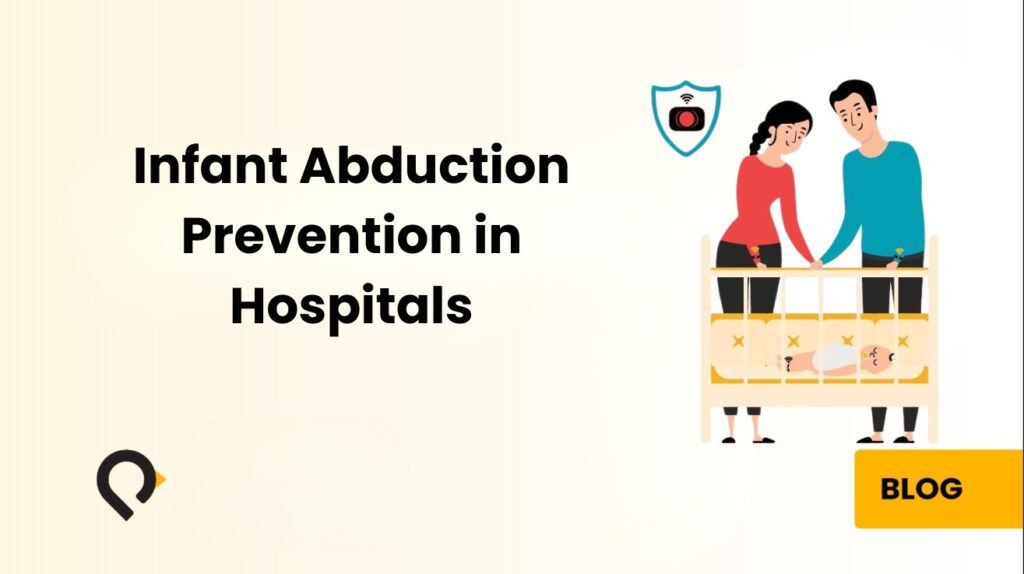
A real-time location system for infant protection in hospitals tags each newborn with a lightweight wearable. A network of sensors throughout the maternity unit tracks their position continuously. When a tagged infant approaches a monitored boundary or exit, the system generates an automated alert — giving staff time to intervene before a QM.12.3 event occurs rather than after. For a deeper look at how these systems work in practice, see our guide on infant abduction prevention in hospitals.
The CBAHI compliance value of RTLS operates at three distinct levels:
Prevention — Directly Addressing QM.12.3
Continuous real-time monitoring means the system always knows where each tagged infant is within the facility. Tamper-detecting anklet tags generate an immediate alert if someone removes them from skin contact. Automated exit lockdown — through integration with door access control — physically prevents an infant’s removal from the protected area when an alert triggers. This combination of real-time awareness, instant alerting, and automated physical response gives hospitals a preventive capability no manual system can replicate.
Mother-baby matching automatically verifies that the correct infant pairs with the correct family at the point of care. When staff bring a newborn into a room where the paired mother is not present — or when the wrong infant moves toward a family — the system generates an alert before anyone needs to check manually. This directly supports Standard QM.17 on correct patient identification.
Documentation — Supporting QM.13 Root Cause Analysis
Automated incident logging captures every location event, zone breach, alert, and staff acknowledgment with a timestamp. When a QM.12.3 event occurs — or when a near-miss happens — the system provides the complete incident timeline that QM.13.2 requires within ten working days. Instead of reconstructing events from staff recollections, the investigation team has a complete, accurate, timestamped record. It shows exactly where the infant was at every moment, when alerts triggered, who acknowledged them, and what the response time was.
This documentation quality does more than support root cause analysis. It demonstrates to CBAHI surveyors that the hospital has systems in place to understand and learn from adverse events.
Continuous Quality Improvement — Supporting QM.13.3
Analytics and reporting dashboards give quality management teams the data to evaluate whether safety systems perform as designed. Alert response times, false alert rates, zone breach frequency, and shift trends all become visible. This is exactly the performance measurement Standard QM.13.3 expects — not just a corrective action plan, but a demonstrable review system showing whether those actions work.
How Penguin’s PenSafe Platform Addresses Specific CBAHI Standards
Penguin Location Services has deployed RTLS-based safety solutions in healthcare facilities across Saudi Arabia and the Gulf region. The PenSafe platform runs on patented BLE 5.1 technology with algorithms that deliver sub-room level accuracy — the precision effective infant protection requires in a real hospital environment, not just a specification-sheet claim.
The platform maps directly to the CBAHI standards most relevant to maternity ward safety:
QM.12.3 — Infant abduction or discharge to wrong family. PenSafe’s continuous real-time monitoring, tamper-detecting anklet tags, automated boundary alerts, and access control integration collectively address the technical requirement behind this sentinel event classification. The system prevents the event rather than documenting it afterward.
QM.13 — Root cause analysis documentation. PenSafe’s automated incident logging produces the complete, timestamped event record root cause analysis requires. Every alert, acknowledgment, and location event is accessible through the reporting dashboard — ready for a CBAHI investigation review without manual reconstruction.
QM.17 — Correct patient identification. Mother-baby matching through paired BLE tags provides automated verification at the point of care. A mismatch triggers an immediate alert. The verification does not depend on a staff member being in the right place at the right moment.
QM.20 — Safety of alarm systems. PenSafe’s alert architecture escalates notifications to assigned nurses, charge nurses, and security teams. It routes actionable information to the right person with the patient’s name, location, and alert type — not a generic station notification.
Beyond infant protection, the same BLE 5.1 sensor infrastructure also powers staff duress alerting in hospitals, patient elopement and wander prevention, and asset tracking across the facility. For Saudi hospitals pursuing comprehensive CBAHI compliance across multiple patient safety domains, this consolidated infrastructure costs significantly less than deploying separate point solutions for each application.
CBAHI, Vision 2030, and the Push Toward Smart Hospital Technology
Saudi Arabia’s Vision 2030 healthcare transformation initiative has added momentum to CBAHI compliance beyond the mandatory accreditation requirement. The National Transformation Program established the Saudi Patient Safety Center in 2017 — the first of its kind in the entire region. Since then, healthcare technology investment has become a central pillar of the Kingdom’s ambition to build a world-class healthcare system.
Within this context, RTLS technology sits at an intersection Saudi hospital leadership increasingly recognizes: it satisfies regulatory compliance requirements while contributing to the operational intelligence goals Vision 2030 prioritizes. Understanding how RTLS in healthcare creates that broader value helps hospital leadership build the case for investment across multiple departments — not just patient safety.
Technology as a Compliance Strategy
For CBAHI surveyors, the question is not whether a hospital has written policies — all hospitals have written policies. The real question is whether systems ensure those policies work in real time, across all shifts. RTLS technology provides that assurance in a way manual processes and paper records cannot. The system operates independently of individual staff attention. It does not depend on whether the right person was in the right place at the right moment.
From Compliance to Operational Excellence
The data an RTLS platform generates goes beyond compliance documentation. Response time analytics, alarm frequency trends, and movement pattern data give hospital leadership insight into how safety systems perform — and where improvements are needed before a CBAHI survey visit, not after. Vision 2030’s emphasis on data-driven healthcare management makes this operational intelligence layer increasingly valuable.
Saudi Arabia established the Saudi Patient Safety Center in 2017 — the first of its kind in the region — as part of the National Transformation Vision 2030. CBAHI compliance is not separate from this initiative. It is part of the same national commitment to building a healthcare system that meets international quality and safety standards while serving the Kingdom’s growing population.
What Saudi Hospitals Should Evaluate When Choosing an Infant Protection System
When assessing technology for infant protection and CBAHI compliance, the evaluation should go beyond vendor claims. The focus should be on what CBAHI surveyors actually assess.
Does the system prevent QM.12.3 events, or only document them?
A camera and a wristband document incidents. An RTLS system with tamper detection, real-time boundary alerts, and access control integration prevents them. Because the CBAHI standard requires active prevention systems, passive recording tools do not satisfy the compliance requirement on their own.
Does the system generate the documentation QM.13 requires?
Root cause analysis within ten working days demands a complete, accurate incident timeline. If the system cannot produce a timestamped record of every infant movement, alert, and staff response, the hospital reconstructs events from memory. That is not the standard CBAHI expects.
Does the system support correct patient identification under QM.17?
Mother-baby matching capability closes the misidentification risk QM.17 targets. A system that handles abduction prevention but not misidentification is incomplete for CBAHI compliance purposes.
Does the alarm system meet QM.20 requirements?
Alerts must reach the right person with actionable information — not a generic station notification. The system should route alerts to assigned nursing staff with the patient’s name, current location, and alert type, with escalation if the first notification goes unacknowledged.
Does the infrastructure support multiple CBAHI safety domains?
A sensor network for infant monitoring can simultaneously support staff duress alerting, patient elopement prevention, and asset tracking. Facilities that deploy a single platform for multiple CBAHI requirements get significantly better return on infrastructure investment than those purchasing separate point solutions for each standard.
Does the vendor have experience with Saudi healthcare environments?
CBAHI accreditation surveys assess real-world compliance, not specification sheets. A technology partner with experience in Saudi hospitals — and familiarity with how CBAHI surveyors evaluate patient safety systems — brings value a standard product presentation cannot match.
Closing Thought
CBAHI Standard QM.12.3 is direct: infant abduction or discharge to a wrong family is a sentinel event. The standard does not distinguish between a near-miss and a completed event in terms of documentation and corrective action. What it does distinguish is between hospitals with active prevention systems in place — and those that rely on policies and manual procedures with known structural limitations.
RTLS-based infant protection is not a premium addition to a standard safety program. For hospitals pursuing CBAHI accreditation in Saudi Arabia, it is increasingly the difference between demonstrating active prevention capability and demonstrating good intentions on paper.
The technology exists. The CBAHI framework expects it. Saudi Arabia’s Vision 2030 healthcare transformation is moving toward it. The question for hospital leadership is not whether to invest in real-time infant protection — it is how to do it in a way that serves multiple CBAHI compliance domains on a single, cost-effective infrastructure.
Frequently Asked Questions
The following questions represent the most common queries from Saudi hospital administrators, quality managers, maternity ward directors, and procurement teams evaluating RTLS solutions for CBAHI compliance. Each answer gives a complete, accurate, and actionable response.
Q: What does CBAHI classify as a sentinel event related to infant safety?
Under CBAHI Standard QM.12.3, infant abduction or discharge to a wrong family is a sentinel event. This places it in the same category as unexpected patient deaths, wrong-site surgery, and hemolytic transfusion reactions. When a QM.12.3 event occurs, Standard QM.13 requires hospitals to form a root cause analysis team, complete the analysis within ten working days, and develop a documented corrective action plan with a review mechanism to evaluate its effectiveness.
Q: Is CBAHI accreditation mandatory for hospitals in Saudi Arabia?
Yes. Since the Cabinet of Ministers Decree Number 371 in 2013, CBAHI accreditation has been mandatory for all healthcare facilities in the Kingdom — public, private, and military. Accreditation is a prerequisite for renewal of the operating license. Facilities that fail to meet CBAHI standards face Conditional Accreditation status or revocation. As of 2023, more than 300 hospitals have obtained CBAHI accreditation, while others remain unaccredited or hold conditional status.
Q: Which specific CBAHI standards does an infant protection system help hospitals comply with?
The most directly relevant standards are: QM.12.3 (sentinel event classification for infant abduction or discharge to wrong family), QM.13 (root cause analysis process and documentation requirements), QM.17 (correct patient identification, including mother-baby matching), and QM.20 (safety of alarm systems). An RTLS-based infant protection system supports compliance across all four standards — through active prevention, automated documentation, mother-baby verification, and reliable alert routing to clinical and security staff.
Q: How does RTLS help with the CBAHI root cause analysis requirement under QM.13?
Standard QM.13.2 requires root cause analysis documentation within ten working days of a sentinel event. An RTLS system automatically logs every infant location event, zone breach, alert, acknowledgment, and staff response with timestamps. When an incident occurs, the investigation team has a complete, accurate timeline immediately available — rather than reconstructing events from staff recollections and partial records. This documentation quality directly supports the CBAHI requirement and demonstrates to surveyors that the hospital can understand and prevent adverse events.
Q: How does infant protection RTLS connect to Saudi Arabia’s Vision 2030 healthcare goals?
Saudi Arabia’s Vision 2030 prioritizes building a world-class healthcare system through technology investment and operational excellence. The Saudi Patient Safety Center was established in 2017 as part of this initiative — the first of its kind in the region. RTLS-based patient safety technology sits directly at the intersection of CBAHI compliance and Vision 2030 goals: it satisfies mandatory accreditation requirements while generating the operational data and performance analytics that modern, data-driven hospital management demands. Hospitals that deploy RTLS for infant protection simultaneously address regulatory compliance, improve clinical outcomes, and build the technology infrastructure Vision 2030 expects.
Q: Can one RTLS infrastructure support multiple CBAHI compliance requirements?
Yes — and this is one of the most important considerations for Saudi hospitals evaluating RTLS technology. Penguin’s PenSafe platform deploys a single BLE 5.1 sensor infrastructure that simultaneously supports infant protection (QM.12.3, QM.17, QM.20), staff duress alerting, patient wander and elopement prevention, and asset tracking. Hospitals that deploy a single platform for multiple CBAHI requirements benefit from lower total infrastructure cost, simplified IT management, and a unified reporting dashboard — rather than managing separate systems and vendor relationships for each compliance domain.
Penguin Location Services works with hospitals across Saudi Arabia and the Gulf region to deploy RTLS-based safety solutions aligned with CBAHI accreditation requirements. Our PenSafe platform covers infant protection, staff duress, patient elopement prevention, and asset tracking on a single BLE 5.1 infrastructure. To discuss how PenSafe supports your CBAHI compliance program, visit penguinin.com/pensafe.