
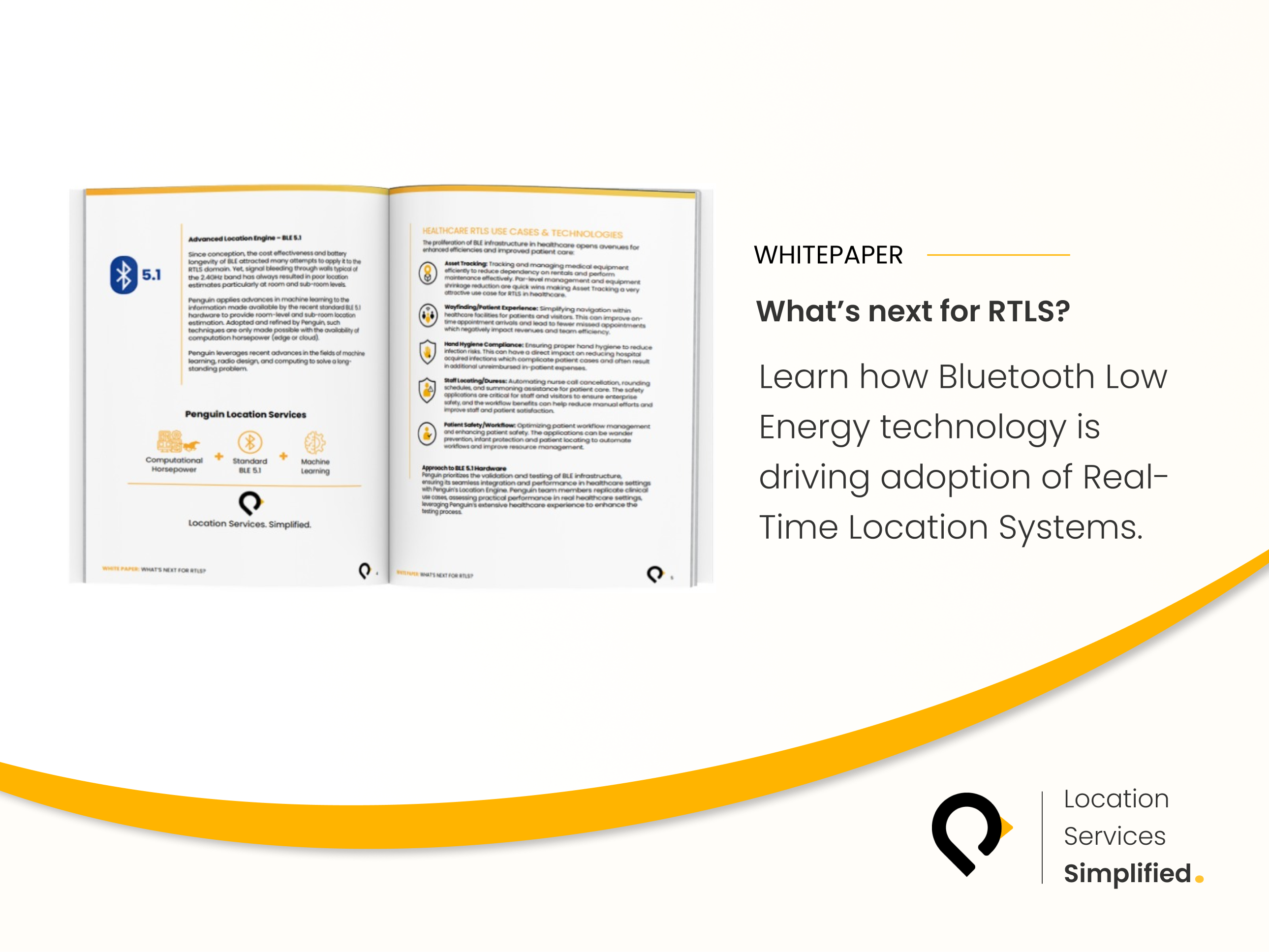
Bluetooth Low Energy has become the standard wireless technology for Real-Time Location Systems in healthcare, because it delivers the accuracy clinical environments require at a cost that enterprise-wide deployment actually makes sense. This shift from proprietary infrared and ultrasound systems to standardized BLE infrastructure is one of the most significant technology transitions in hospital operations over the past decade.
This guide explains how BLE technology works in healthcare RTLS, why BLE 5.1 specifically represents a major advancement over earlier versions, what clinical and operational use cases it enables, and how hospitals can evaluate BLE-based systems before committing to a deployment. A full technical whitepaper is available for download below.
Key Takeaways
- BLE has replaced proprietary infrared and ultrasound RTLS technologies in most new healthcare deployments because it uses off-the-shelf hardware, integrates with existing Wi-Fi infrastructure, and delivers consistent accuracy at a fraction of the legacy cost.
- BLE 5.1 introduced advanced machine learning advanced location technology, the capability that enables sub-meter precision in hospital environments where traditional signal-based positioning degrades due to RF interference.
- A single BLE 5.1 sensor network deployed for asset tracking can simultaneously support staff duress alerting, patient monitoring, hand hygiene compliance, and indoor navigation, making it one of the highest-ROI infrastructure investments a hospital can make.
- BLE tags require no wiring, run on batteries for 2-5 years, and are small enough to attach to any mobile device without disrupting clinical workflows.
- The most important evaluation question for BLE RTLS is not “what accuracy does the spec sheet claim?” but “what accuracy does the system deliver in a live hospital environment with real RF interference?”
Why BLE Technology Became the Healthcare RTLS Standard
The previous generation of healthcare RTLS relied on proprietary technologies, infrared badges, ultrasound emitters, and specialized RFID readers that required dedicated parallel infrastructure entirely separate from the hospital’s existing network. These systems were expensive to install, difficult to maintain, and locked hospitals into single-vendor relationships with limited options when performance fell short.
Bluetooth Low Energy disrupted this model by doing three things simultaneously. First, it operates on standardized, widely available hardware that any supplier can produce, which means competitive pricing and no vendor lock-in. Second, it integrates with existing enterprise Wi-Fi infrastructure, which means hospitals can overlay BLE RTLS on their existing Cisco Meraki, Aruba, or Juniper Mist networks without a separate installation project. Third, it achieves accuracy levels that are clinically useful, room-level positioning that enables the specific workflows hospitals need to improve.
According to the Bluetooth Special Interest Group, BLE devices consume minimal power while maintaining strong connectivity, which is why BLE tags can run for 2-5 years on a small battery while broadcasting their location signal continuously. This combination of low power consumption, standardized hardware, and sufficient accuracy made BLE the natural successor to proprietary RTLS technologies across the healthcare market.
For a full overview of how BLE RTLS applies across different hospital use cases, see our complete guide to RTLS in healthcare.
BLE 5.1: What Changed and Why It Matters for Hospitals
BLE 5.1 introduced a capability that fundamentally changed what was possible with Bluetooth-based positioning: advanced machine learning.
Earlier BLE versions estimated location using signal strength estimation, measuring how strong the signal from a tag was at each reader and triangulating from multiple measurements. signal strength estimation works adequately in open spaces but degrades significantly in hospital environments due to multipath interference, signals bouncing off walls, floors, ceilings, medical equipment, and human bodies in ways that distort the apparent signal strength. The result was location errors that put a device in the wrong room or gave inconsistent results that eroded clinical staff confidence in the system.
Penguin’s BLE 5.1 machine learning approach calculates the precise angle at which a signal arrives at a receiver rather than just its strength. Because it measures angle rather than intensity, multipath interference affects it far less. The result is sub-meter precision that remains consistent in the complex RF environments of real hospitals, not just in clean laboratory test conditions.
What This Means Clinically
Room-level accuracy means the system can reliably distinguish between two adjacent patient rooms. This matters for asset tracking (knowing which room a device is in, not just which corridor), for staff duress alerting (routing security to the correct room rather than the general unit), and for patient monitoring (knowing whether a patient is in their room, in the bathroom, or in the hallway).
Sub-room accuracy means the system can distinguish between beds within a room, relevant for ICUs with multiple patients, large open bays, and decontamination areas where bay-level identification matters.
Penguin’s BLE 5.1 platform uses patented location algorithms that further reduce false room assignments when a badge is positioned near a shared wall, the most common edge case in dense hospital floor plans.
Healthcare RTLS Use Cases Powered by BLE
A single BLE 5.1 sensor network supports multiple hospital applications simultaneously. This is the most important economic argument for BLE infrastructure, the per-use-case cost drops significantly when the underlying network serves multiple purposes.
Medical Equipment Tracking
BLE tags on infusion pumps, ventilators, wheelchairs, and other mobile devices give clinical staff real-time location access through a mobile app or dashboard. Search time drops from 20-30 minutes per shift to under 60 seconds. Fleet utilization data enables right-sizing that consistently reduces equipment inventories by 20-35%.
Staff Duress Alerting
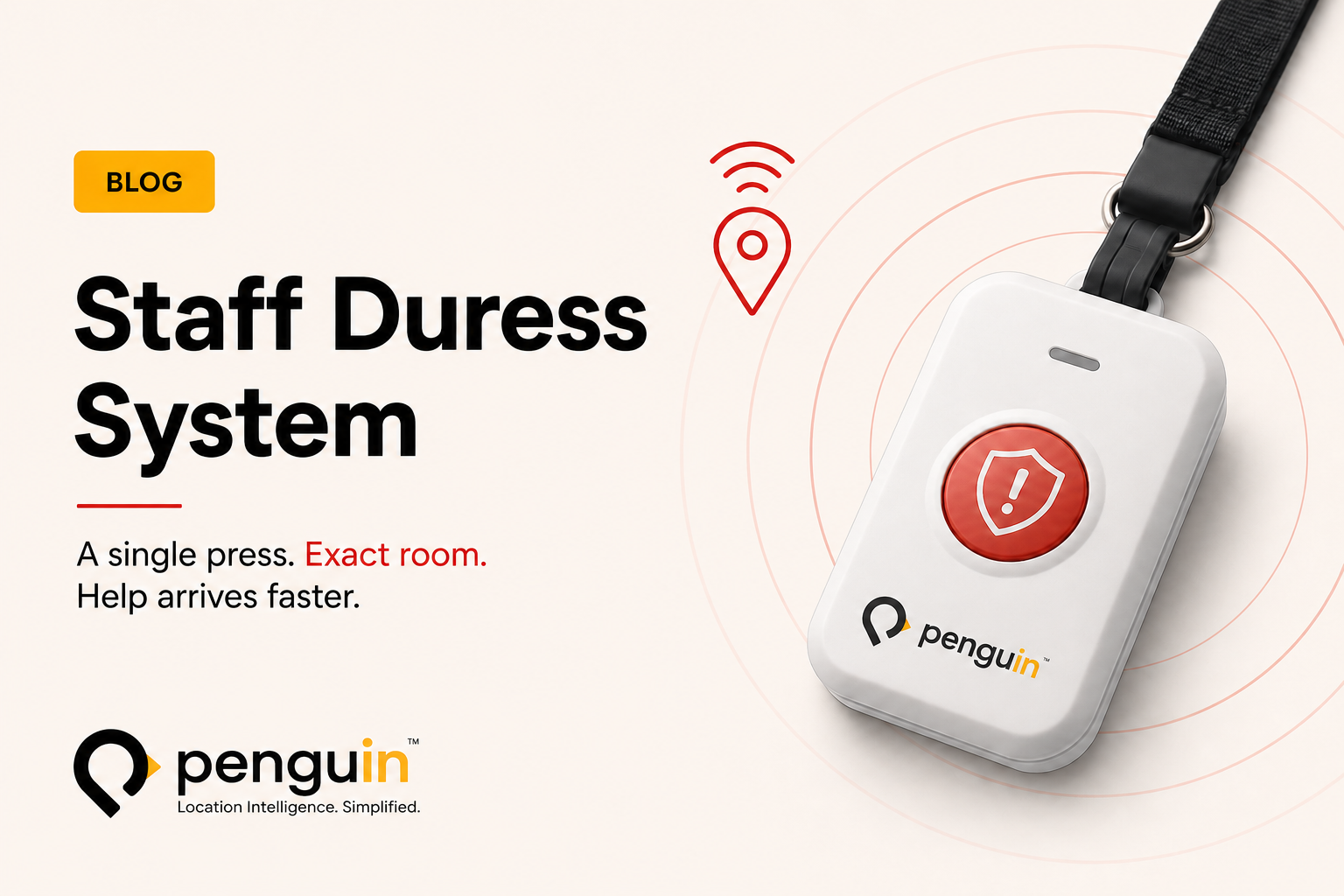
Nurses and clinical staff wear BLE badges with a panic button. When pressed, security receives the staff member’s exact room-level location within seconds, silently, without overhead announcement. This is the core application of workforce safety technology in high-risk clinical environments.
Patient Monitoring and Safety
BLE wristbands on patients enable elopement prevention, infant protection, and patient flow tracking simultaneously. When a patient crosses a restricted boundary, an alert fires to the assigned nurse with the patient’s name and current location. The same infrastructure supports automated cycle-time measurement throughout the patient journey.
Hand Hygiene Compliance
BLE-enabled dispensers combined with staff location tracking detect whether a staff member cleaned their hands before entering a patient room. Unlike observation-based monitoring, this captures every event rather than a sample, providing accurate, continuous compliance data for infection prevention programs.
Indoor Navigation
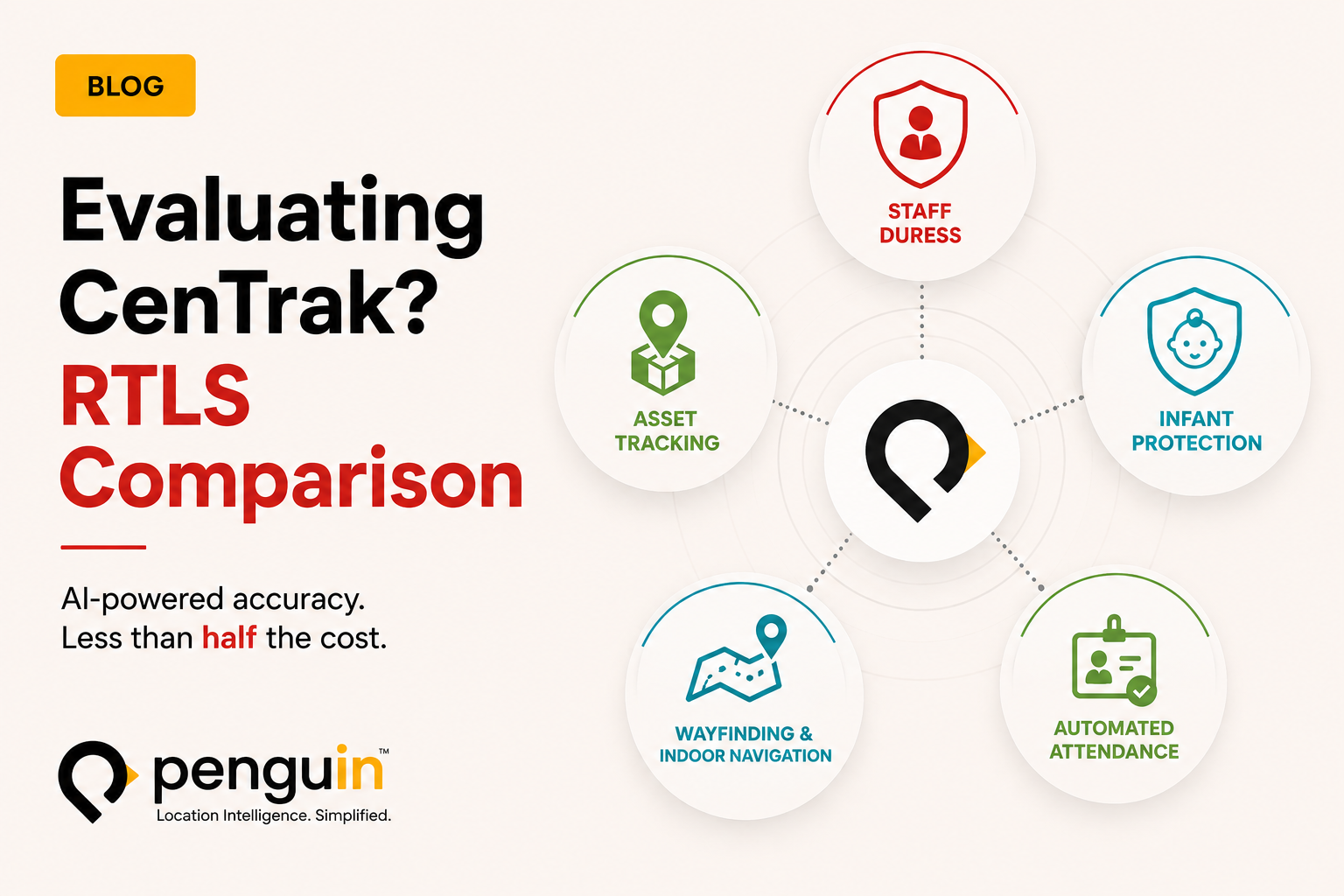
BLE infrastructure also powers patient and visitor wayfinding, the same positioning technology that tracks assets provides the blue-dot navigation experience that helps patients find their appointment location without asking for directions. One sensor network, five use cases.
Infrastructure: What BLE RTLS Requires to Deploy
One of the most common misconceptions about BLE RTLS is that it requires extensive new hardware infrastructure. In many hospitals, this is not the case.
Leveraging Existing Wi-Fi Infrastructure
Enterprise Wi-Fi access points from Cisco Meraki, Aruba, and Juniper Mist can serve as BLE readers when configured appropriately. Hospitals that have already invested in these networks can overlay BLE RTLS without a separate infrastructure project, the sensor network is already there. Penguin’s platform is specifically built to leverage existing Meraki and Aruba infrastructure, which significantly reduces implementation cost and timeline. For a detailed look at how this works, see our Cisco Meraki RTLS integration guide.
Where Dedicated BLE Readers Are Needed
In areas without adequate Wi-Fi coverage, storage rooms, stairwells, elevator lobbies, decontamination areas, dedicated BLE readers fill the gaps. Modern battery-powered BLE readers mount using standard adhesive, require no wiring, and can be deployed by facilities staff without IT involvement. This dramatically reduces the installation complexity compared to previous generations of RTLS infrastructure.
BLE Tags
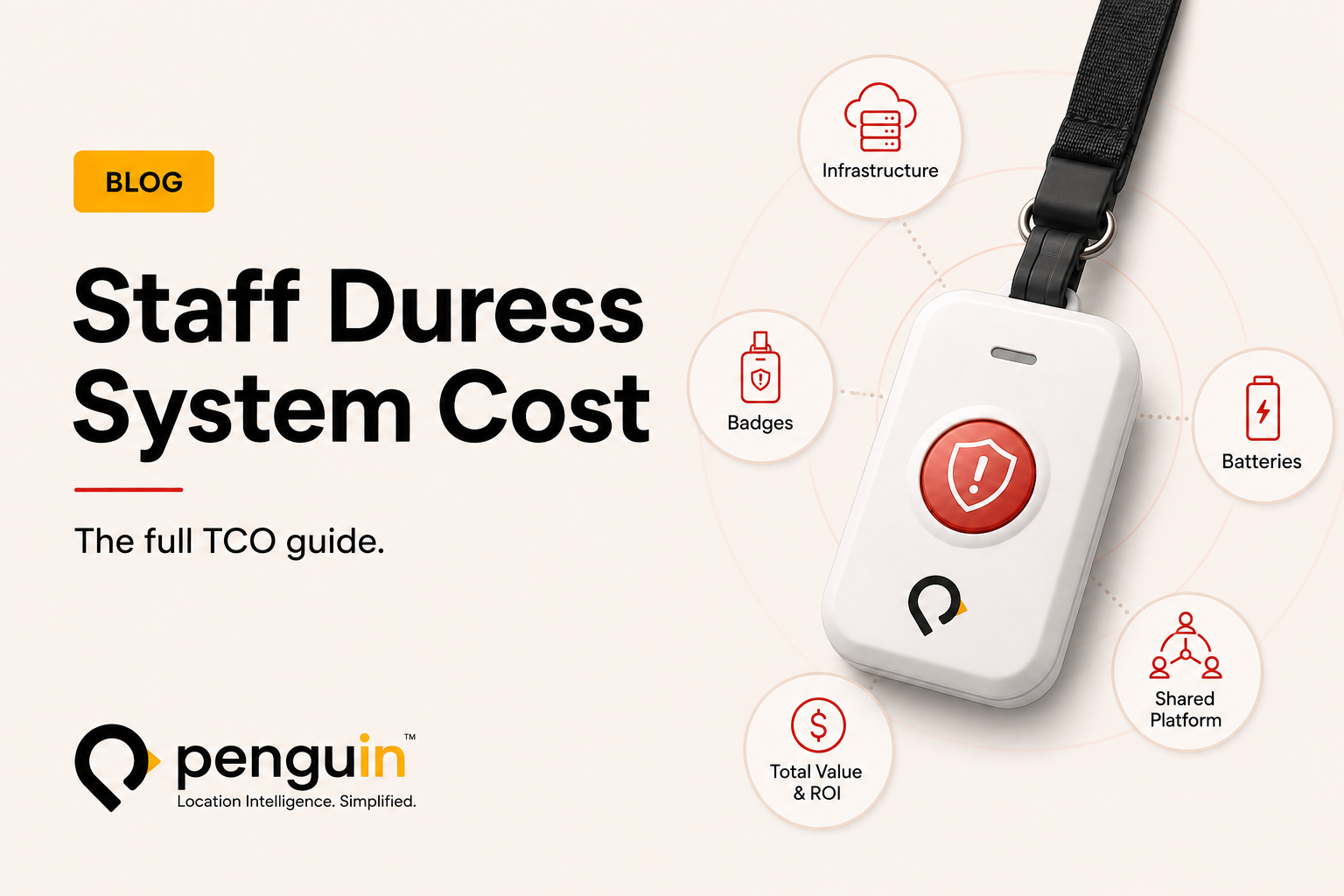
BLE tags attach to medical equipment, patient wristbands, and staff badges. They are small, lightweight, and require no wiring or power connection to the host device. Battery life runs between 2 and 5 years depending on broadcast frequency. Rechargeable badge technology eliminates battery replacement programs entirely for staff duress applications, removing one of the largest ongoing cost drivers in legacy RTLS deployments.
BLE vs. Alternative Technologies
BLE vs. Active RFID
Active RFID systems use proprietary frequencies that require dedicated reader infrastructure, they cannot leverage existing Wi-Fi networks. Hardware costs are higher, vendor ecosystems are more closed, and the accuracy levels achieved by modern BLE 5.1 now equal or exceed what active RFID delivers in clinical environments. BLE’s standardized ecosystem means competitive hardware pricing and no single-vendor dependency.
BLE vs. Ultra-Wideband (UWB)
UWB provides centimeter-level accuracy, higher than BLE 5.1 in controlled conditions. The tradeoff is cost: UWB infrastructure is significantly more expensive per square foot, and the tags are larger and more power-hungry. For most healthcare RTLS use cases, asset tracking, staff duress, patient monitoring, room-level or sub-meter accuracy is sufficient. UWB’s additional precision does not justify its additional cost for the majority of hospital applications. Penguin’s BLE 5.1 platform delivers the accuracy hospitals actually need at a cost that makes enterprise-wide deployment feasible.
BLE vs. Passive RFID
Passive RFID requires a tag to pass within range of a reader to register its location, there is no continuous tracking. It is cost-effective for checkpoint-based inventory management but cannot support real-time applications like duress alerting, patient monitoring, or live asset location. For any use case that requires knowing where something is right now rather than when it last passed a reader, active BLE is the appropriate technology.
Evaluating BLE RTLS Systems: What to Ask
When evaluating BLE RTLS vendors for a healthcare deployment, these questions separate systems that perform in real hospitals from systems that perform in vendor demonstrations:
What accuracy does the system achieve in a live hospital environment? Ask for data from a deployed facility with comparable size and construction, not from a controlled test. The RF environment in a real hospital with dense equipment, metal infrastructure, and high Wi-Fi traffic is fundamentally different from an empty room.
How does the system handle wall proximity? A badge positioned near a shared wall between two patient rooms should be placed in the correct room. Ask specifically what the false room assignment rate is in edge cases like this.
Does the system run on existing Wi-Fi infrastructure or require proprietary readers? The answer affects installation cost, timeline, and long-term vendor dependency significantly.
What is the tag battery life and replacement model? Rechargeable badges eliminate the ongoing battery replacement program that adds tens of thousands of dollars annually to mid-size hospital deployments.
Can one infrastructure deployment support multiple use cases? A system that requires separate hardware for asset tracking, staff safety, and patient monitoring is three times as expensive to deploy as one that handles all three on a shared sensor network.
For a detailed look at how all of these factors apply to hospital asset tracking specifically, see our guide on hospital asset tracking with BLE RTLS.
Download the Full BLE Technology in Healthcare Whitepaper
The whitepaper covers emerging BLE technologies in healthcare in full technical depth, including advanced location algorithms, deployment architecture, accuracy benchmarks, and a full comparison of BLE 5.1 against alternative RTLS technologies.
Frequently Asked Questions About BLE Technology in Healthcare
What is BLE technology and how is it used in healthcare?
BLE stands for Bluetooth Low Energy, a wireless communication protocol that transmits short-range signals using minimal power. In healthcare, BLE tags attached to medical equipment, patient wristbands, and staff badges broadcast continuous location signals to a network of readers installed throughout the facility. A software platform processes these signals to maintain a real-time map of every tagged asset’s location, enabling applications from equipment tracking and staff safety to patient monitoring and indoor navigation.
What is the difference between BLE 4.0, 5.0, and 5.1 in hospital RTLS?
BLE 4.0 and 5.0 estimate location using signal strength (signal strength estimation), which degrades in the RF-congested environment of a real hospital. BLE 5.1 introduced advanced machine learning advanced location technology, calculating the precise angle at which a signal arrives at a receiver rather than just its strength. This makes BLE 5.1 significantly more accurate in hospital environments, achieving consistent sub-meter precision where earlier versions would place a device in the wrong room due to multipath interference.
Can BLE RTLS run on a hospital’s existing Wi-Fi network?
Yes, in many cases. Enterprise Wi-Fi access points from Cisco Meraki, Aruba, and Juniper Mist can serve as BLE readers when configured appropriately. Hospitals that have already deployed these networks can overlay BLE RTLS without separate hardware installation. In areas without adequate Wi-Fi coverage, battery-powered BLE readers can be mounted using adhesive without any wiring or construction work.
How accurate is BLE technology for medical equipment tracking?
BLE 5.1 with advanced machine learning advanced location technology achieves consistent room-level accuracy in live hospital environments, meaning the system reliably identifies which room a device is in, not just which floor or wing. Sub-meter accuracy is achievable in areas with higher reader density. For most equipment tracking use cases, room-level accuracy is sufficient to eliminate search time entirely, because knowing a device is in Room 412 versus “somewhere on the fourth floor” is the difference between a 30-second retrieval and a 20-minute search.
What is the ROI of deploying BLE RTLS in a hospital?
The return on investment comes from multiple sources simultaneously. Equipment tracking reduces search time (20-30 minutes per nurse per shift returned to patient care), right-sizes equipment fleets (typically 20-35% reduction after utilization data reveals true inventory needs), and reduces emergency rental costs. Staff safety applications reduce incident severity and turnover driven by unsafe working conditions. Because one BLE infrastructure deployment supports all of these use cases, the per-application cost is significantly lower than deploying separate systems for each.
Penguin Location Services delivers BLE 5.1 RTLS across healthcare, enterprise, and campus environments through PenTrack, PenSafe, and PenNav, a single platform covering asset tracking, staff safety, patient monitoring, and indoor navigation. To discuss how BLE RTLS can work in your facility, visit penguinin.com/contact.
Ready to Explore BLE RTLS for Your Facility?
Whether you are evaluating BLE technology for the first time, replacing a legacy RTLS system, or want to understand how your existing Wi-Fi infrastructure can support RTLS, our team is ready to help.