
Today, hospitals face immense pressure from multiple directions. They must deliver high-quality care while optimizing staff performance and managing equipment costs effectively. Traditional reporting systems cannot keep up with these demands — because they show what happened yesterday, not what is happening now.
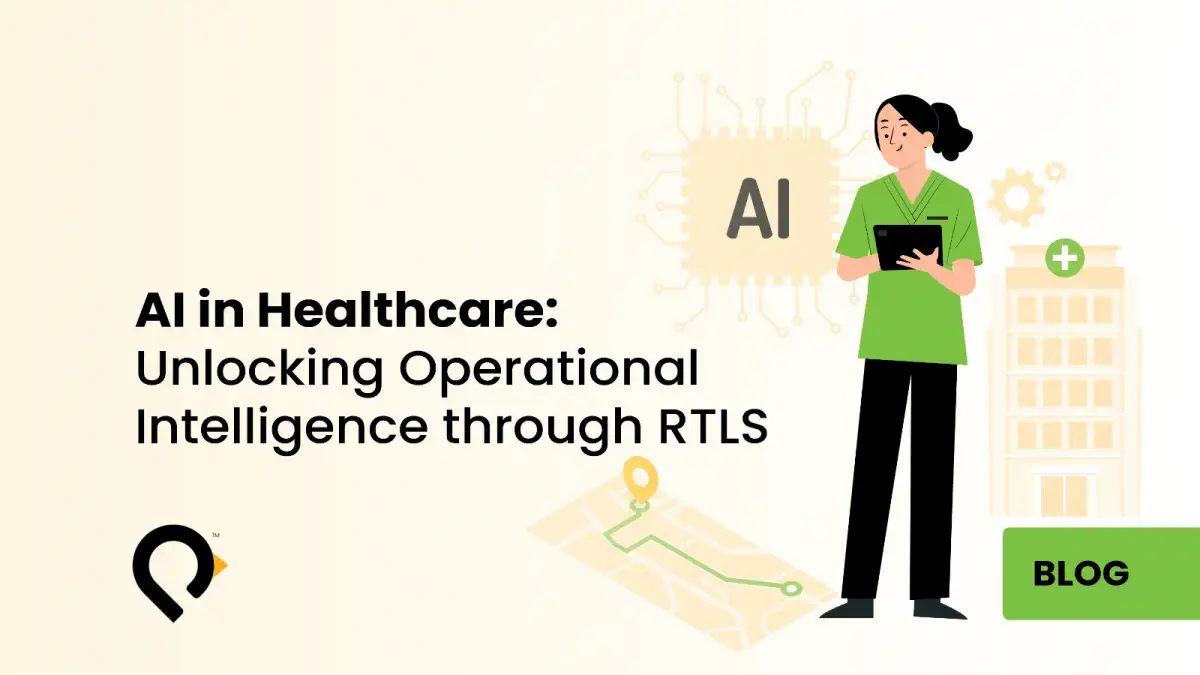
Healthcare providers need real-time capabilities powered by AI and location intelligence for better decision-making. This is where healthcare RTLS systems and AI analytics become essential. Together, they create operational intelligence that transforms how hospitals manage assets, staff, and patient flow.
Table of Contents
- › What Is Operational Intelligence in Healthcare?
- › Operational Intelligence in 2025
- › The Role of Location in Operational Intelligence
- › Healthcare RTLS as a Foundation for Operational Intelligence
- › Integrating RTLS with Other Healthcare Systems
- › Real-World Example: AI for Asset Optimization
- › Additional Use Cases: Burnout Detection and Beyond
- › Frequently Asked Questions
Key Takeaways
- Operational intelligence combines real-time location data with AI analytics to give hospital leaders a live picture of operations — not a report from yesterday.
- About 20% of hospitals now have RTLS infrastructure deployed, while over 60% are actively exploring AI integration with their location systems.
- Location data answers the questions that matter most: where are critical assets right now, how long do patients wait between care stages, and do staff workflows align with care protocols?
- RTLS becomes most powerful when integrated with EHR, nurse call, and bed management systems — transforming isolated location data into coordinated operational intelligence.
- AI-powered asset optimization can identify equipment hoarding, predict shortages before they affect care, and automatically trigger redistribution workflows.
What Is Operational Intelligence in Healthcare?
Operational intelligence (OI) represents a significant shift in hospital management. Rather than reviewing historical reports after the fact, it helps leaders understand and optimize daily operations as they unfold — using real-time data combined with AI analytics to surface actionable insights.
Unlike traditional reporting systems, OI allows leaders to respond as situations develop. It connects data from multiple hospital systems — location data, scheduling platforms, and electronic health records — and converts that raw data into decisions. Because this happens continuously, hospitals can improve care delivery, resource utilization, and workflow efficiency in ways that periodic reporting simply cannot support.
Operational Intelligence in 2025
In 2025, operational intelligence combines real-time data with machine learning in ways that were practically unavailable to mid-size hospitals five years ago. Hospitals now deploy Real-Time Location Systems and integrate them with hospital information systems, then apply AI models to optimize staff movement and equipment availability.
Research shows clear trends: about 20% of hospitals now have RTLS infrastructure, while over 60% are exploring AI integration. Health systems are evolving — moving from smart infrastructure to truly intelligent operations that can anticipate issues and manage resources proactively, rather than responding after the fact.
The Role of Location in Operational Intelligence
Location data provides the critical context that makes operational intelligence actionable. Consider a ventilator sitting idle in one ward while another department searches desperately for one. This is not just a logistics problem — it is a patient safety risk. When clinician movement is tracked, inefficiency patterns become visible. Those same patterns can indicate fatigue or burnout before a clinical error occurs.
Location-based data answers the questions that matter most:
- Where are critical assets right now?
- How long do patients wait between care stages?
- Do staff workflows align with care protocols?
This spatial awareness gives AI the context it needs to generate insights and recommend actions that are grounded in what is actually happening on the floor — not what the schedule says should be happening.
Healthcare RTLS as a Foundation for Operational Intelligence
RTLS provides essential spatial and temporal data. By itself, it helps staff locate assets and monitor patient movement. When paired with AI and hospital information systems, however, it becomes far more powerful — an engine for continuous improvement rather than a location lookup tool.
Hospitals can generate real-time alerts when equipment leaves designated areas. Predictive analytics can forecast equipment shortages based on historical use patterns. Staff workflow data can correlate with patient outcomes. The key point is that RTLS must integrate with other systems to deliver its full value — location data alone, without the clinical and operational context around it, answers only the simplest questions. For a full breakdown of how RTLS delivers value across hospital operations, see our complete guide to RTLS in healthcare.
Integrating RTLS with Other Healthcare Systems
Integration unlocks the full power of operational intelligence. When RTLS connects with clinical and administrative systems, the data becomes far richer than any single system can produce on its own.
Integrating with electronic health records ties location to patient episodes — so the system knows not just where a device is, but which patient it is serving. Nurse call systems can use staff proximity to route alerts efficiently, sending calls to the nearest available clinician rather than broadcasting to the entire unit. Bed management systems can track patient movement and speed up discharge workflows by flagging when a patient has been medically cleared but their room has not yet been turned over.
This data fusion creates a fundamental shift: hospitals move from siloed, reactive responses to coordinated, intelligent actions. For a detailed look at how RTLS and CMMS integration works in practice, see our guide on RTLS and CMMS integration for healthcare.
Real-World Example: AI for Asset Optimization
Healthcare RTLS and AI for IV Pump Utilization
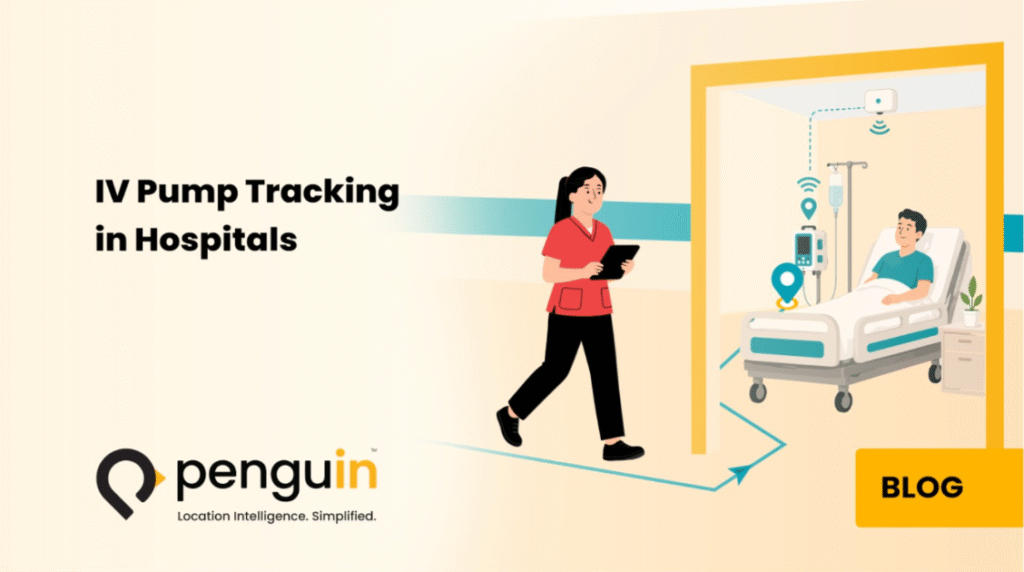
Consider how a hospital uses RTLS and AI analytics together to optimize IV pump utilization — one of the most documented asset management challenges in healthcare. For a full clinical breakdown of this use case, see our guide on IV pump tracking in hospitals.
- Data Collection — RTLS infrastructure captures the precise location of every IV pump throughout the hospital. The system stores movement patterns and dwell times in a central database for AI analysis.
- Data Preparation — Raw location data is preprocessed and enriched with metadata including pump type, department assignment, and patient correlation — giving the AI model the context it needs to interpret location events correctly.
- Feature Engineering — Analysts extract features such as idle time, relocation frequency, and average usage per shift. Time-series trends reveal patterns that are invisible in raw location logs — for example, which departments consistently have excess pumps on Monday mornings and which run short by Thursday afternoon.
- AI Modeling and Insight Generation — A machine learning model is trained to classify usage patterns, categorizing equipment as underutilized, optimally used, or over-utilized. Because the model learns from historical patterns, it can identify anomalies — units with unusually high idle time — and flag them automatically for review.
- Operational Dashboard — Insights are presented through an operational dashboard where decision-makers can see which departments are hoarding equipment and which units have persistent shortages. Automatic alerts fire when a pump exceeds a predefined idle threshold.
- Workflow Action — The logistics team receives automatic notifications to redistribute idle equipment. When patterns persist beyond a threshold, the system generates recommendations for purchasing decisions and staff training program adjustments.
Additional Use Cases: Burnout Detection and Beyond
Clinician burnout detection demonstrates how operational intelligence extends beyond equipment. RTLS data correlates with shift schedules, EMR interactions, and patient assignments. AI models can then estimate movement fatigue and detect cognitive overload — because the pattern of a nurse making 40 trips across a floor in a single shift looks measurably different from a sustainable workload.
This enables proactive interventions. Hospitals can adjust assignments before burnout occurs, provide mental health support early, and prevent the turnover and clinical errors that follow when burnout goes undetected. The cost of a single experienced nurse leaving — recruitment, training, and productivity loss — typically far exceeds the cost of the monitoring system that could have prevented it.
Other emerging use cases include:
- Predicting emergency department bottlenecks before they affect patient flow
- Optimizing cleaning and housekeeping schedules based on real-time room occupancy
- Automating contact tracing during infectious disease outbreaks
Frequently Asked Questions About AI in Healthcare and RTLS
What is operational intelligence in healthcare?
Operational intelligence is a management approach that uses real-time data and AI analytics to give hospital leaders a live picture of operations — not a historical report. When combined with RTLS, it enables hospitals to see where assets are, how staff are moving, and where patient flow is breaking down, and to act on that information while there is still time to intervene.
How does RTLS support AI in healthcare analytics?
RTLS provides the continuous stream of spatial and temporal data that AI models need to identify patterns and generate predictions. Without location data, AI in healthcare analytics is limited to clinical records and scheduling information. When RTLS data is added, models can correlate equipment movement with care outcomes, staff location with response times, and asset utilization with departmental efficiency — producing insights that neither system could generate alone.
What is the difference between RTLS data and operational intelligence?
RTLS data tells you where something is. Operational intelligence tells you what that location data means for your operations. RTLS answers “where is the IV pump?” Operational intelligence answers “why does Ward 4 consistently run short of IV pumps on Thursday evenings, and what should change?” The AI layer transforms raw location events into decisions.
How do hospitals use AI to reduce clinician burnout?
RTLS movement data correlates with shift schedules and patient assignments to identify patterns consistent with high-stress workloads — excessive floor traversal, prolonged absence from a base station, or unusually compressed interaction sequences. AI models trained on this data can estimate stress and fatigue levels, enabling managers to adjust assignments proactively before clinical errors or resignation notices follow.
What systems does RTLS need to integrate with for operational intelligence?
The highest-value integrations are with electronic health records (to tie location to patient episodes), nurse call systems (to route alerts by proximity), bed management platforms (to accelerate discharge and turnover workflows), and CMMS platforms (to trigger usage-based maintenance). Each integration adds a data layer that makes the AI model’s predictions more accurate and more actionable.
Penguin Location Services leads operational intelligence in healthcare. Our PenTrack RTLS platform integrates with hospital systems to deliver real-time visibility and AI-powered insights at scale — covering asset utilization, staff optimization, and patient safety on a single infrastructure. To discuss how operational intelligence can work in your facility, visit penguinin.com/healthcare.
Ready to Build an Intelligent Hospital?
Whether you are tackling asset utilization, staff optimization, or patient safety — our team can help you build a more intelligent, responsive healthcare facility powered by RTLS and AI.
Reach out today
Get in touch to learn how Penguin can bring operational intelligence to your hospital.