
RTLS staff duress systems are becoming essential for hospitals as Violence against nurses and frontline caregivers is rising in hospitals and emergency departments, yet feeling unsafe should never be part of the job. When staff can discreetly call for help and responders know exactly where to go, hospitals reduce risk, response time, and stress across the organization.
Why accurate RTLS matters for staff duress
During a duress event, every second between pushing the button and help arriving counts. Inaccurate or delayed location data can send security teams to the wrong unit, floor, or room, wasting time and allowing incidents to escalate. An RTLS-powered staff duress system combines real-time indoor positioning with clear alerting so responders see who needs help, where they are, and how the situation is evolving as they move.
Hospitals that pair duress alerts with precise indoor location tend to report faster responses, fewer injuries, and better compliance with workplace violence standards from organizations like The Joint Commission. Accurate location also supports post-incident reviews, helping leaders identify patterns, high-risk areas, and gaps in existing safety protocols.
How RTLS staff duress systems work
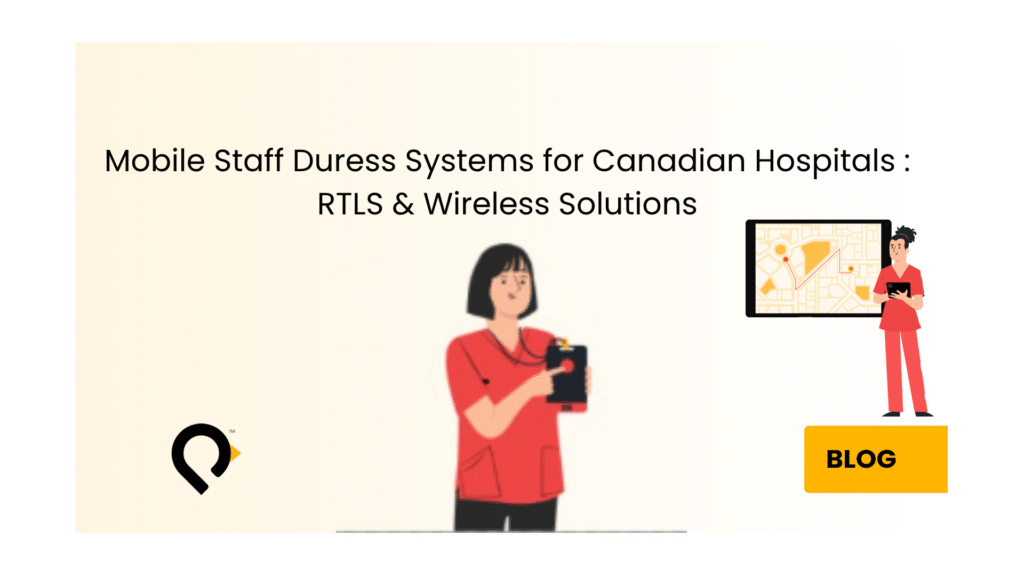
Most RTLS duress systems use discreet staff badges with a built‑in panic button or similar trigger. When a caregiver feels unsafe, they activate the badge and the system immediately sends an alert with three critical pieces of information: the person’s identity, their precise location, and the time of the event.
A modern healthcare RTLS platform then:
-
Captures the signal from BLE or other wireless infrastructure throughout the facility.
-
Calculates the staff member’s location down to room or sub‑room level, depending on the risk profile of each area.
-
Delivers alerts to security teams, charge nurses, or rapid response leaders through dashboards, mobile apps, or integrated communication tools.
-
Updates the location in real time if the staff member moves while the event is active, enabling a truly targeted response.
Many hospitals already use RTLS in healthcare to improve safety and operational efficiency.
Because RTLS is already used for asset tracking, patient flow monitoring, and infant protection in many health systems, staff duress protection can often be added as another workflow on the same platform — especially with rechargeable badges that are 1/10th the cost of typical vendor alternatives, eliminating battery replacement expenses entirely.
The role of affordability in hospital staff safety
Many hospitals know they need staff duress technology but hesitate due to cost, complexity, or past experiences with proprietary RTLS hardware. Traditional systems have often required specialized infrastructure, complex wiring, and long deployment timelines, driving up total cost of ownership — particularly with disposable, high-cost badges. As budgets tighten and workforce challenges intensify, health systems are looking for practical ways to increase staff safety without creating new financial or operational burdens.
RTLS 3.0: Staff duress as part of intelligent hospital operations
Penguin Location Services is focused on what industry observers describe as “RTLS 3.0” for healthcare — moving from basic dots on a map to intelligent, AI-driven orchestration of hospital operations. In this model, staff duress is not a standalone tool; it is one of several safety and workflow applications powered by the same location intelligence engine.
By combining BLE 5.1 infrastructure with high‑velocity, AI‑enhanced positioning algorithms, the platform is designed to deliver sub‑room‑level accuracy and rapid updates across complex facilities. This accuracy helps hospitals better protect staff, but it also supports complementary use cases such as asset tracking, indoor wayfinding, emergency department flow, and infant protection — all enabled by cost-effective, rechargeable badges at 1/10th the cost of legacy alternatives.
Use cases for RTLS staff duress in healthcare
Hospitals deploy RTLS-based duress systems across a variety of care settings and risk profiles. Common scenarios include:
-
Emergency departments, where high acuity, long wait times, and behavioral health presentations increase the likelihood of aggressive incidents.
-
Inpatient behavioral health units, where precise location visibility helps teams respond quickly while honoring patient dignity and privacy.
-
Intensive care and step‑down units, where caregivers may need rapid backup during high‑tension discussions or code situations.
-
Outpatient clinics and procedural areas, where staff may work in isolated rooms or off main corridors.
In each setting, the goal is the same: give staff a fast, reliable way to request help and give responders clear, actionable location data so they can intervene effectively.
Benefits beyond the moment of duress
-
Increased staff confidence and retention, as employees know help is always within reach.
-
Reduced incident severity and fewer lost work days, supporting workforce stability and cost control.
-
Better alignment with workplace violence prevention standards and regulatory expectations.
-
Detailed incident analytics that help leaders refine staffing models, security rounds, and training programs.
Building a staff duress strategy with RTLS
A successful hospital staff duress program combines technology, policy, and training. RTLS provides the real-time visibility and data foundation, while leaders use these insights to shape protocols, drills, and continuous improvement efforts.
-
Matching the level of location accuracy (unit, room, sub-room) to the risk level of each clinical area.
-
Ensuring badge design is comfortable, discreet, easy to activate under stress, and rechargeable to minimize ongoing costs.
-
Integrating duress alerts with security, nurse call, communication platforms, and electronic health records where appropriate.
-
Measuring performance through response-time metrics, incident heatmaps, and staff feedback.
Q&A: RTLS Staff Duress for Hospitals
What is RTLS staff duress?
RTLS staff duress uses real-time location systems to pinpoint a caregiver’s exact indoor position when they trigger a panic alert from a wearable badge. This sends responders precise coordinates (room-level or better) alongside the alert, cutting response times compared to manual location reporting.
How accurate does RTLS need to be for staff duress?
Sub-room accuracy (3–10 feet) is ideal for high-risk areas like EDs or behavioral health units, ensuring teams go directly to the right bed, alcove, or corridor. Zone-level (room or unit) works for lower-risk zones but may delay responses in sprawling facilities.
Is affordable RTLS staff duress possible for hospitals?
Yes — BLE 5.1-based systems leverage existing WiFi or low-cost anchors, avoiding proprietary hardware markups. Rechargeable badges at 1/10th the cost of other vendors, plus cloud-hosted platforms, make staff duress an add-on to asset tracking at a fraction of what legacy systems charge.
What are common RTLS staff duress use cases?
How does RTLS staff duress integrate with nurse call?
Can RTLS staff duress improve hospital compliance?
Why choose rechargeable RTLS duress badges?
Rechargeable badges are 1/10th the cost of disposable competitor alternatives, with no battery replacement logistics or hidden maintenance overhead. They maintain full duress functionality after daily charging, supporting 24/7 staff safety readiness at a fraction of traditional total cost of ownership.