
A nurse in a busy hospital ward needs an infusion pump. The last record shows it was checked in at the fourth floor supply room two hours ago. She walks to the supply room. It is not there. She checks the adjacent corridor, the medication room, the neighboring ward. Nine minutes later, she finds it on a different floor entirely. Nine minutes of a clinical professional’s time — lost to a search that healthcare RTLS technology solved years ago.
This scenario plays out thousands of times every day in American hospitals. It is one of dozens of operational inefficiencies and patient safety failures that Real-Time Location Systems are designed to eliminate. Despite RTLS in healthcare being a mature, proven, and affordable technology, many US facilities still operate without it. Decision-makers often lack a clear, jargon-free picture of what RTLS does, how it works, and what it costs to deploy.
This guide provides that picture. It covers the fundamentals of RTLS technology and the specific use cases where it delivers the most measurable value. You will also find guidance on how BLE-based RTLS works, how to evaluate accuracy levels, what implementation success looks like, and the questions to ask any RTLS vendor before committing.
Table of Contents
-
-
-
-
- › What Is RTLS in Healthcare?
- › How BLE-Based Healthcare RTLS Works in a Hospitals
- › Understanding Healthcare RTLS Accuracy Levels: Matching Technology to Clinical Need
- › The Core Use Cases: Where Healthcare RTLS Delivers the Most Value
- › Healthcare RTLS Integration: Connecting to Your Hospital’s Existing Systems
- › Implementation Best Practices: What Successful Healthcare RTLS Deployments Have in Common
- › How to Evaluate Healthcare RTLS Vendors: The Questions That Matter
- › The ROI Calculation: What Healthcare RTLS Saves and What That Means for Your Budget
- › Frequently Asked Questions About RTLS in Healthcare
- › Conclusion
-
-
-
Key Takeaways
- RTLS uses wireless signals to continuously track the real-time location of assets, staff, and patients inside hospital buildings — providing visibility that GPS cannot deliver indoors.
- Bluetooth Low Energy (BLE) is the most accessible and widely deployed RTLS technology in healthcare today, working with existing Wi-Fi infrastructure or affordable, easy-to-install beacons that require no wiring.
- The primary healthcare use cases for RTLS are medical asset tracking, staff safety and duress alerting, infant protection, wander prevention, hand hygiene compliance, contact tracing, patient flow management, and environmental monitoring.
- RTLS delivers measurable ROI through reduced equipment search time, lower asset rental costs, improved staff response times, reduced clinical risk, and better patient satisfaction scores tied to HCAHPS reimbursement.
- Modern BLE beacons install with 3M adhesive mounting — no wiring, no power cables, no construction — making healthcare RTLS accessible in older hospital buildings.
- Accuracy levels range from entry/exit point detection through presence-based and room-level to sub-room precision — each serving different clinical use cases at different cost points.
- RTLS integrates with EHR, CMMS, nurse call, and access control systems to amplify value across the hospital’s existing technology ecosystem.
- Hospitals that deploy RTLS consistently find the cost of the problems it solves is higher than the cost of the solution itself.
What Is RTLS in Healthcare?
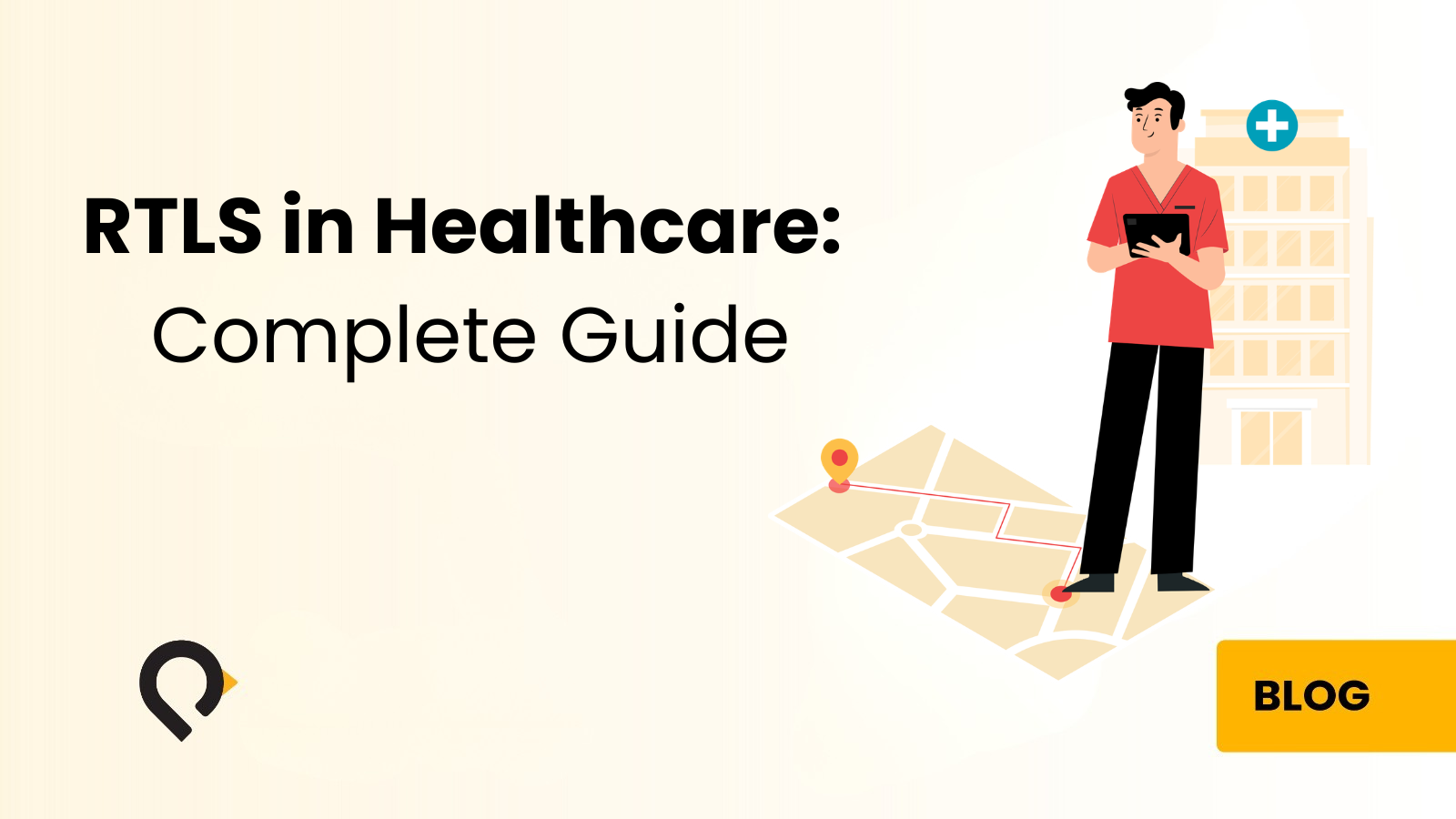
Real-Time Location Systems in healthcare automatically and continuously identify the location of tagged objects, assets, and people inside a hospital. Unlike inventory systems that tell you where something was last recorded, healthcare RTLS tells you where it is right now. Tags move through the building and location updates continuously.
The practical significance of this distinction is enormous. A hospital that knows a wheelchair was last checked in at physiotherapy three hours ago has a historical record. One that knows that same wheelchair is currently in the second-floor corridor near the elevator bank has operational intelligence it can act on immediately. RTLS creates the second type of visibility.
Think of it as indoor GPS for hospitals. GPS uses satellite signals to locate you on a road. RTLS in healthcare uses wireless signals inside a building to tell clinicians, security teams, and facility managers where every tagged asset, staff member, and patient is at every moment. Satellite signals cannot penetrate walls and floors reliably, so RTLS relies on different technology. The value proposition is the same: know where things are, in real time, so you can act.
This real-time visibility transforms how hospitals manage their most critical resources. Proactive responses replace reactive searches. Data reveals patterns, inefficiencies, and risks that would otherwise be invisible. When connected to the EHR, the nurse call system, and the CMMS, RTLS becomes the connective tissue that turns independent platforms into a coherent operational picture.
How BLE-Based Healthcare RTLS Works in a Hospital
Bluetooth Low Energy is the dominant RTLS technology in US healthcare environments today. Understanding how it works removes much of the complexity that surrounds RTLS conversations.
The Basic Principle
Every BLE-enabled tag continuously broadcasts a small wireless signal at regular intervals. This is true whether the tag is attached to equipment, worn by a staff member, or integrated into a patient wristband. BLE readers positioned throughout the facility receive this signal. The RTLS software then calculates the tag’s position based on signal strength and reader geometry. It updates the tag’s location on a real-time digital map of the facility.
The result is a continuously updated picture accessible in real time. Security teams, clinical managers, charge nurses, and facility operations staff can view it from any terminal, mobile device, or dashboard in the building.
BLE 5.1 and What It Adds to Healthcare RTLS
BLE 5.1 introduced a capability called Direction Finding. This allows compatible readers to determine the precise direction from which a tag signal arrives — not just its strength. That directional information significantly improves positioning accuracy. It enables consistent room-level precision without requiring the dense reader infrastructure that older BLE systems needed.
For healthcare facilities upgrading to BLE 5.1 infrastructure, this means higher accuracy with lower hardware density. Where BLE 5.1 capable access points are available, the system leverages them fully. Where existing infrastructure predates BLE 5.1, standard BLE positioning works effectively using signal strength-based triangulation.
The Beacon Deployment Model: Why Infrastructure Is No Longer a Barrier
The most persistent misconception about RTLS in healthcare is that deploying it requires a major infrastructure project. New cabling runs, dedicated network equipment, and construction work — these concerns have delayed RTLS adoption more than any other single factor.
Modern BLE beacon technology has fundamentally changed this picture. Current BLE beacons are battery-powered devices roughly the size of a matchbox. They mount directly to walls or ceilings using standard 3M adhesive — no wiring, no power cables, and no electrician required. A facilities team member installs a beacon in under two minutes. An entire floor is instrumented in a single morning.
Battery life typically runs between two and five years. Replacement is a simple swap — no downtime, no disruption, no specialist required.
For hospitals with existing enterprise Wi-Fi infrastructure — Cisco Meraki, Aruba, or comparable systems — existing access points can often serve as the receiving infrastructure for BLE signals. This reduces or eliminates the need for dedicated BLE readers. Facilities with modern access point deployments may find their positioning infrastructure is largely already in place.
For older buildings or constrained capital budgets, a fully beacon-based deployment provides comprehensive RTLS capability at accessible cost. This removes the infrastructure barrier that previously made RTLS a large-system-only technology.
Understanding Healthcare RTLS Accuracy Levels: Matching Technology to Clinical Need
Accuracy is one of the most important dimensions of RTLS selection — and one of the most frequently misunderstood. Not all use cases require the same level of precision. Choosing the right accuracy tier is essential for both clinical effectiveness and cost management.
Entry and Exit Point Detection
The most basic level of location awareness is knowing when a tagged asset or person passes through a specific threshold. This could be a doorway, an exit, or a connection between buildings. Low-frequency RF technology creates these choke points, generating alerts when equipment approaches unauthorized exits. This accuracy level suits equipment loss prevention, building egress monitoring, and basic perimeter security.
Presence-Based Locating
Presence-based locating determines whether a tag is within a defined zone — a unit, a floor, a wing — without specifying the precise room. Wi-Fi or standard BLE infrastructure typically achieves this. It suits unit-level asset visibility, broad staff location awareness, and general patient census management. Knowing the ultrasound machine is somewhere on the third floor narrows the search considerably, even without an exact room.
Room-Level Locating
Room-level accuracy is the threshold at which healthcare RTLS becomes genuinely transformative for most clinical workflows. The system identifies which specific room a tagged asset, staff member, or patient is in — not just which unit or floor. For a nurse searching for an infusion pump, this means the system tells her it is in Room 412B. For a security team responding to a duress alert, it means dispatching to a specific room rather than searching an entire corridor.
BLE-based RTLS reliably achieves room-level accuracy across standard hospital floor plans. Most healthcare RTLS use cases — asset tracking, staff safety, infant protection, wander prevention — deliver their full value at this accuracy tier.
Sub-Room and Clinical-Grade Locating
Sub-room accuracy distinguishes between positions within a single room — identifying which bed, bay, or station a tag is associated with. This precision matters in dual-occupancy patient rooms, multi-bay procedure areas, and operating rooms. ICU environments also need it, where the link between a specific patient and a specific piece of equipment must be unambiguous.
BLE 5.1 direction-finding supports sub-room accuracy where appropriate infrastructure exists. Facilities can invest in BLE 5.1 capable readers in specific high-acuity areas. This delivers clinical-grade accuracy where it matters most, without requiring full-facility upgrades.
The practical guidance for most US hospitals: start with room-level accuracy as your baseline. Deploy sub-room capability in the environments where bed-level or bay-level precision is required. Do not let the pursuit of maximum accuracy everywhere slow down a healthcare RTLS deployment that will deliver substantial value at room-level precision throughout.
The Core Use Cases: Where Healthcare RTLS Delivers the Most Value
Medical Asset and Equipment Tracking
Equipment tracking is the most common first RTLS deployment in US hospitals. The return on investment is immediately quantifiable. The International Journal of Health Geographics has documented that hospitals purchase 10 to 20 percent more portable equipment than they operationally need. Without visibility, the practical response to not finding something is to buy more of it.
The cumulative cost across infusion pumps, wheelchairs, portable monitors, and mobile workstations is significant. A 400-bed hospital carrying 15 percent more equipment than necessary is absorbing a procurement and maintenance burden that a healthcare RTLS system eliminates.
Beyond inventory cost, the clinical time cost is equally meaningful. Studies consistently document that nursing staff spend between 30 minutes and an hour per shift searching for equipment. Across a large nursing workforce, the hours diverted from patient care every day are difficult to ignore — especially when every clinical hour is both precious and expensive.
How asset tracking works in practice
RTLS asset tracking makes every tagged asset findable in seconds. A nurse opens the interface, searches for the nearest infusion pump, sees its exact room location, and retrieves it. Total time: under 60 seconds. The cumulative recovery of clinical time across a hospital’s nursing workforce is typically the single largest ROI driver in the first year of a healthcare RTLS deployment.
Usage-based maintenance scheduling is another benefit. The system triggers maintenance reminders based on actual usage cycles rather than calendar intervals. Equipment life extends, unexpected failures decrease, and the automated audit trail supports Joint Commission medical device management requirements.
PenTrack— RTLS Asset Tracking & Operational Intelligence
Asset Tracking
Complete real-time visibility over mobile equipment and assets. Long-life wireless tags transmit continuous location data to a centralized dashboard, supporting par-level management, chokepoint alerts, utilization reporting, and CMMS integration.
Workflow & Operational Intelligence
AI-powered analytics on staff, patient, and visitor movement across the facility. Identifies bottlenecks, automates alerts, measures space utilization, and delivers the operational intelligence layer that transforms location data into management decisions.
Staff Safety and Duress Alerting
Healthcare workers face workplace violence at rates among the highest of any occupation in the United States. The Bureau of Labor Statistics has documented that healthcare and social service workers account for a disproportionate share of all workplace violence incidents. Nurses and emergency department staff face the highest individual risk. Research published in the American Journal of Emergency Medicine found that more than 80 percent of emergency nurses reported experiencing verbal or physical violence during their careers.
Unsafe working conditions drive nurse turnover — a particularly damaging problem when the American Association of Colleges of Nursing projects a nursing shortage reaching hundreds of thousands of positions over the next decade. A healthcare system unable to retain clinical staff because of safety concerns faces a compounding operational and financial crisis.
How RTLS duress alerting works
Staff carry or wear a small BLE-enabled badge with an integrated panic button. When pressed — or when the badge detects a sudden fall or no-motion event — the system immediately transmits an alert to security and management. The alert includes the staff member’s real-time room-level location.
Knowing someone pressed a panic button is very different from knowing exactly which room they are in right now. Response time and response accuracy both improve dramatically when location accompanies the alert. The nearest available security resource gets dispatched precisely.
In behavioral health units, psychiatric facilities, and emergency departments, healthcare RTLS staff duress provides protection that directly supports compliance with Joint Commission workplace violence prevention standards.
PenSafe— Workforce Safety & Staff Duress
Badge-based panic alerting with precise real-time location. Instant notification to designated responders with the staff member’s exact position. Critical for healthcare, education, and high-risk industrial environments.
Infant Protection and Newborn Security
Infant abduction and newborn identity errors are among the most serious patient safety incidents in US healthcare. The National Center for Missing and Exploited Children has documented that a significant proportion of infant abductions occur within healthcare facilities. The reputational, legal, and human consequences of a single incident are catastrophic.
RTLS-based infant protection addresses both abduction risk and mother-infant matching errors simultaneously. Continuous monitoring runs from tag application through to discharge.
How infant protection RTLS works
A lightweight RTLS tag attaches to each newborn’s ankle band. The system monitors every tagged infant’s location in real time. When an infant moves toward an unauthorized exit — a stairwell, service corridor, or emergency exit — the system detects this and triggers an immediate response. Automated door locking, alerts to the nursing station, notification to security, and alarms at the nearest exit point all activate. Critically, this response occurs before the infant crosses the threshold, not after.
Mother-infant matching extends protection to every clinical interaction — feeding, transport between units, discharge. Every handover is verified against the correct patient identity record. In high-volume maternity units processing dozens of births per day, automated identity verification provides a consistency that manual checking alone cannot guarantee.
PenSafe— Infant Protection
Wander Prevention and Patient Elopement
Patient elopement — the unauthorized departure of a patient from a clinical setting — is a recognized patient safety event across US hospitals. For patients with dementia, Alzheimer’s disease, behavioral health conditions, or acute delirium, the consequences of elopement range from injury to death. The Joint Commission has cited elopement as a category of sentinel event. CMS Conditions of Participation place clear requirements on facilities to implement monitoring for patients identified as elopement risks.
Healthcare RTLS wander prevention provides continuous, automated monitoring using lightweight wrist-worn or ankle-worn tags. The RTLS platform defines virtual zones around exits, stairwells, and boundary areas. When a tagged patient approaches a restricted zone — before crossing it — the system triggers an alert to nursing staff with the patient’s precise current location.
Why automation matters here
A charge nurse on a busy unit cannot provide continuous observation for multiple high-risk patients simultaneously. RTLS does exactly this — monitoring continuously and generating alerts only when a specific condition is met. Staff attention goes precisely where and when it is needed.
Modern wander prevention systems minimize false alerts — a significant problem with earlier generation systems that caused alert fatigue. Zone sensitivity, approach speed thresholds, and configurable alert routing all contribute to actionable alerts rather than background noise.
PenSafe— Wander Prevention
Hand Hygiene Compliance and Infection Control
Healthcare-associated infections are one of the most costly and most preventable categories of patient harm in US hospitals. The CDC estimates that approximately one in 31 hospital patients has at least one HAI on any given day. HAIs contribute to tens of thousands of patient deaths annually. Hand hygiene is the single most impactful HAI prevention measure — yet manual compliance monitoring has well-documented limitations.
Traditional monitoring relies on secret shoppers — infection control observers who periodically audit clinical areas. This method overstates actual compliance rates, is resource-intensive, and creates the Hawthorne effect. Observed staff behave differently than unobserved staff.
Continuous automated monitoring
RTLS-based hand hygiene compliance replaces spot-check observation with continuous automated monitoring. Sensors on dispensers throughout the facility detect every dispensing event. RTLS staff location data identifies which staff member is in which room at each moment. The combined data stream determines whether hand hygiene protocols were followed at every point of care interaction. Compliance reports generate at the individual, unit, department, and facility level.
This transforms hand hygiene from a compliance checkbox into a continuously measured clinical safety metric. Coaching targets staff with documented low compliance. Unit trends are visible before they become outbreak risks. The audit trail provides objective documentation for regulatory review and accreditation purposes.
PenSafe— Hand Hygiene Compliance
Contact Tracing with Healthcare RTLS
The COVID-19 pandemic demonstrated the operational cost of not having automated contact tracing in healthcare facilities. Manual contact tracing — interviewing staff and reviewing schedules to reconstruct who was near whom — is labor-intensive, slow, and inevitably incomplete.
Healthcare RTLS-based contact tracing generates this information automatically. When a patient or staff member has been exposed to an infectious agent, the system produces a complete log within minutes. This log includes every tagged individual who was in the same room, bay, or zone as the index case during a defined time window. Decisions on notification, testing, or quarantine can then be based on actual documented proximity — not broad precautionary assumptions.
Beyond pandemic response, automated contact tracing has ongoing value for routine infectious disease incidents — TB exposure events, MRSA outbreaks, C. difficile clusters. Rapid, accurate identification of contacts reduces both clinical risk and the operational disruption of overly broad quarantine measures.
Patient Flow and Throughput Management
Patient flow — the movement of patients through a care pathway from ED arrival through admission, treatment, and discharge — is one of the most financially consequential management challenges in US hospital operations. Inefficiencies manifest as ED boarding, extended length of stay, surgical schedule delays, and bed management crises. Revenue, capacity, and patient satisfaction scores all suffer.
Healthcare RTLS provides the data layer that makes patient flow visible and manageable. Tagging patients through admission wristbands allows the system to track location and movement continuously. Staff see a real-time map of where every patient is in their care pathway.
From reactive to proactive flow management
Consider three common scenarios healthcare RTLS addresses: A patient lingers in the pre-op holding area beyond protocol — the system flags the delay before it cascades into a surgical schedule disruption. A patient medically cleared for discharge still occupies a bed two hours later — the system identifies the specific bottleneck. ED occupancy trends toward a diversion threshold — bed management receives early warning rather than a crisis.
HCAHPS scores reflect patient experience dimensions that flow directly affects: wait times, staff responsiveness, and care transition communication. Hospitals that improve flow management improve their scores. In the post-ACA environment, where Medicare reimbursement ties to satisfaction performance, that has direct revenue implications.
Environmental and Temperature Monitoring
Hospitals store temperature-sensitive materials — medications, blood products, vaccines, tissue samples, biologics — that require continuous monitoring within safe storage parameters. Manual temperature logging is labor-intensive, provides point-in-time rather than continuous coverage, and is difficult to make reliable across dozens of controlled storage locations.
Healthcare RTLS infrastructure extends to include environmental sensors that monitor temperature, humidity, and air quality continuously. These sensors integrate with the same platform as asset and staff tracking, providing a unified operational view rather than a separate system for environmental data.
Automated alerts and compliance documentation
When a refrigerator temperature deviates from its defined range, an alert triggers automatically. Corrective action happens before stored materials are compromised. For pharmacy operations, blood banks, and laboratory specimen storage, continuous environmental monitoring provides both risk management and the regulatory compliance documentation that accreditation standards require.
Healthcare RTLS Integration: Connecting to Your Hospital’s Existing Systems
The value of RTLS multiplies when it connects to the other systems your hospital operations depend on. A standalone RTLS system showing where assets and staff are located is useful. One that shares its data with the EHR, CMMS, nurse call platform, and access control creates operational intelligence greater than the sum of its parts.
EHR Integration
Connecting RTLS patient location data to the electronic health record lets care workflows trigger automatically from location events. A patient arriving in pre-op initiates automated surgical checklist preparation. A patient leaving recovery generates a bed turnover request. Discharge documentation captures the actual departure timestamp. For facilities running Epic, Oracle Health, or Cerner, healthcare RTLS integration adds a real-time location context layer that these platforms do not natively provide.
CMMS Integration
Connecting RTLS asset utilization data to the Computerized Maintenance Management System enables usage-based maintenance scheduling. Equipment completing a defined usage cycle receives a service flag. Idle equipment receives extended intervals. Equipment life extends, unnecessary service costs decrease, and the system generates the maintenance documentation trail that Joint Commission standards require.
Nurse Call Integration
Connecting RTLS staff location data to nurse call systems enables intelligent call routing. When a patient activates a call, the alert routes to the nearest available nurse rather than broadcasting to the entire unit. Response times improve. Unnecessary interruptions for distant staff decrease. Nurse managers gain workflow data to optimize staffing patterns at the unit level.
Access Control Integration
Connecting RTLS to door access systems enables location-triggered security responses. Exits lock automatically when an infant protection tag approaches a perimeter. Real-time alerts generate when staff access patterns deviate from expected location data. Audit logs capture movement through sensitive clinical areas for compliance and investigation purposes.
Implementation Best Practices: What Successful Healthcare RTLS Deployments Have in Common
Across healthcare RTLS deployments covering millions of square feet of clinical infrastructure, the factors that consistently distinguish successful implementations are not primarily technical. They are organizational.
Secure executive sponsorship before starting
RTLS changes workflows, affects staff behavior, and requires sustained organizational attention. Implementations with active C-suite sponsorship achieve substantially faster and more complete adoption than those driven solely from IT or facilities management. A CNO committed to staff duress adoption or a CFO who has approved asset tracking ROI targets makes a significant difference.
Define success metrics before go-live
Organizations that define specific, measurable outcomes gain a framework for evaluating the deployment and demonstrating ROI. Examples: reduce average equipment search time from eight minutes to under two; achieve 90 percent hand hygiene compliance monitoring coverage within six months. Without defined metrics, justifying expansion investment to the board consistently proves harder.
Align accuracy expectations across stakeholders
Before deployment, ensure that clinical, operational, and IT stakeholders share a common understanding of what room-level accuracy means in practice — and what it does not mean. Misaligned expectations, particularly the assumption that healthcare RTLS performs like GPS with instantaneous sub-meter precision, are the most common source of early stakeholder dissatisfaction.
Start with one or two use cases, prove value, then expand
The temptation to deploy every available RTLS use case simultaneously consistently produces slower adoption and less clear ROI attribution than a phased approach. Lead with the use case that has the clearest pre-existing pain point — typically asset tracking or staff safety. Demonstrate results, then expand.
Plan for ongoing staff engagement, not just initial training
Staff adoption of RTLS is not a one-time training event. Ongoing reinforcement, visible management support, and regular feedback on system performance outcomes are all required. Departments receiving regular updates on reduced search times, improved response times, or better compliance rates achieve higher sustained adoption than those that receive only initial training.
Treat map maintenance as an operational responsibility
Digital floor maps degrade in accuracy as buildings change. Renovations, departmental moves, new equipment rooms, and layout changes all affect positioning accuracy. Clear ownership of map maintenance must be assigned before go-live. Without it, accuracy drift undermines staff confidence in the system over time.
Choose a managed service model if your internal team cannot absorb ongoing maintenance
For most community hospitals and mid-sized health systems, internal IT and clinical engineering teams already carry full workloads. A managed service model that includes deployment, calibration, map maintenance, tag management, and accuracy assurance delivers better long-term system performance and lower total cost of ownership than a capital purchase model that places ongoing maintenance responsibility internally.
How to Evaluate Healthcare RTLS Vendors: The Questions That Matter
The RTLS vendor landscape in US healthcare includes large established players, mid-sized specialists, and newer entrants. Selecting the right partner requires asking questions that go beyond product specifications.
What is their track record specifically in healthcare?
General IoT or asset tracking vendors who have added a healthcare module are different from organizations whose entire history is in clinical RTLS deployment. Ask for specific case studies from hospitals of comparable size and type to yours, with documented outcomes.
Do they support hardware independence?
Proprietary hardware requirements create long-term cost and flexibility constraints. An RTLS platform that works with off-the-shelf BLE tags and leverages your existing network infrastructure gives you flexibility and protects your investment.
How do they handle accuracy maintenance over time?
Positioning accuracy degrades as buildings change. Ask specifically how accuracy is maintained after go-live — who is responsible, how physical environment changes are reflected in the system, and what the process is when accuracy degrades.
What is their integration experience with your specific systems?
Ask for reference customers who have completed the specific integrations you require — your EHR, your nurse call system, your CMMS — not just a list of systems they theoretically support.
What does their implementation process look like?
A vendor who can describe a structured clinical excellence consulting process — needs assessment, use case prioritization, stakeholder engagement planning, phased rollout design, go-live support, and post-deployment success management — is more likely to deliver a successful healthcare RTLS implementation than one whose process ends at hardware installation.
What is the total cost of ownership over five years?
List price comparisons between vendors are often misleading. Ask for a five-year total cost of ownership model that includes hardware, software licensing, tags and consumables, integration costs, maintenance, and accuracy management. The vendor with the lowest initial quote is frequently not the vendor with the lowest five-year cost.
The ROI Calculation: What Healthcare RTLS Saves and What That Means for Your Budget
Healthcare executives evaluating RTLS investment need a framework for quantifying both the cost and the return. The most reliable ROI calculation for a US hospital RTLS deployment typically draws from five sources.
Equipment inventory reduction
If your facility carries 15 to 20 percent more mobile medical equipment than necessary due to visibility limitations, RTLS asset tracking enables gradual inventory right-sizing. For a hospital with $5 million in tracked mobile equipment, a 15 percent reduction represents $750,000 in avoided future capital expenditure.
Equipment rental cost reduction
Hospitals that rent supplemental equipment because they cannot locate owned equipment find that RTLS deployment eliminates most rental requirements within the first year. Rental costs for infusion pumps, portable monitors, and other frequently rented equipment typically recover fastest.
Clinical staff time recovery
If nursing staff across your facility spend 30 minutes per shift searching for equipment, and your facility employs 300 nurses working three shifts, that represents 450 hours of clinical time per day. Calculate that figure using your own fully loaded nursing labor cost before presenting a healthcare RTLS investment case to your CFO.
Reduced agency and travel nurse dependency
Staff turnover driven by unsafe working conditions is a major cost driver in US hospitals. Agency and travel nurse rates run at multiples of employed staff cost. Even a modest retention improvement in your most at-risk units produces a significant labor cost impact.
HCAHPS performance improvement
Patient satisfaction survey performance affects Medicare reimbursement under the Hospital Value-Based Purchasing program. Facilities that improve their HCAHPS scores — driven in part by better responsiveness, shorter wait times, and smoother care transitions that healthcare RTLS enables — recover real reimbursement dollars. This is frequently the ROI dimension that resonates most with hospital CFOs who understand the VBP program mechanics.
Frequently Asked Questions About RTLS in Healthcare
What is RTLS in healthcare?
Answer:
RTLS stands for Real-Time Location System. In healthcare, it is a technology platform that automatically tracks the location of tagged assets, staff, and patients inside a hospital in real time. Tags attached to people or objects transmit wireless signals — most commonly Bluetooth Low Energy. Readers positioned throughout the building receive this data. The system continuously updates location on a digital map of the facility. Hospitals can then locate equipment instantly, respond to safety incidents with precision, and monitor patient movement through care pathways.
How is RTLS different from GPS?
Answer:
GPS relies on satellite signals that cannot reliably penetrate building walls and floors. Healthcare RTLS uses short-range wireless signals from infrastructure installed inside the building — BLE beacons or readers positioned in corridors, rooms, and key clinical areas. This calculates positions indoors with room-level or better accuracy. RTLS is purpose-built for the indoor environment that GPS cannot serve.
What technology does healthcare RTLS use?
Answer:
Bluetooth Low Energy is the most widely used healthcare RTLS technology in US hospitals today. BLE offers the right combination of positioning accuracy, battery efficiency, installation flexibility, and infrastructure cost for most clinical use cases. BLE 5.1 adds direction-finding capability that enables higher accuracy where compatible infrastructure is available. In facilities with existing enterprise Wi-Fi networks, existing access points can often receive BLE signals, reducing additional hardware requirements.
What RTLS accuracy level do different healthcare use cases require?
Answer:
Asset tracking and patient flow management work well at presence-based or room-level accuracy. Staff duress alerting requires room-level accuracy for effective response dispatch. Infant protection and wander prevention require room-level accuracy as a minimum. They benefit from sub-room precision in high-risk perimeter areas. Hand hygiene compliance monitoring requires room-level accuracy to associate staff location with specific dispensing events. Operating room instrument tracking and ICU patient-equipment association may require sub-room or clinical-grade accuracy.
Does healthcare RTLS require significant infrastructure investment in existing hospital buildings?
Answer:
Not necessarily. Hospitals with existing enterprise Wi-Fi can often leverage their access points as BLE receivers with minimal additional hardware. For areas with limited wireless coverage — older wings, basement levels, recently renovated spaces — battery-powered BLE beacons mount with 3M adhesive. They require no wiring, no power infrastructure, and no IT work. This makes RTLS deployment accessible in older hospital buildings that previously faced significant infrastructure barriers.
How long does it take to deploy RTLS in a US hospital?
Answer:
Timeline depends on facility size, use case scope, existing infrastructure, and integration requirements. Single-use-case deployments — such as asset tracking in a single building — can go live in weeks. Multi-use-case deployments across a multi-building campus with EHR, CMMS, and nurse call integrations typically take several months from site assessment to full go-live. A phased approach, starting with the highest-priority use case and expanding as ROI is demonstrated, usually delivers value faster than a full-scope simultaneous deployment.
Can RTLS integrate with Epic, Cerner, or Oracle Health?
Answer:
Yes. Modern healthcare RTLS platforms provide integration APIs that connect with major EHR systems including Epic, Oracle Health, and Cerner, as well as CMMS platforms, nurse call systems, and access control systems. Integration enables location-triggered workflow automation — patient arrival triggering checklist preparation, discharge triggering bed turnover, and staff location optimizing call routing. Integration depth varies by vendor — always ask specifically about documented integrations with the systems your facility uses.
What is the ROI of RTLS in healthcare?
Answer:
ROI from healthcare RTLS comes through equipment inventory reduction, elimination of supplemental equipment rental, recovery of clinical staff time from equipment searches, reduction in staff turnover costs through improved safety, and improvement in HCAHPS scores that affects Medicare VBP reimbursement. Most US hospitals recover their initial RTLS investment within one to three years through equipment utilization improvement and staff time recovery alone. The specific ROI for your facility depends on current pain point severity, facility size, and use case scope.
How does RTLS support Joint Commission accreditation?
Answer:
Joint Commission standards touch multiple areas where RTLS delivers relevant documentation and capability. RTLS-generated asset utilization and maintenance records support medical device management standards. Perimeter monitoring and elopement prevention documentation address environment of care and life safety standards. Dedicated RTLS safety applications address patient safety standards for infant protection and high-risk patient monitoring. RTLS staff duress systems with documented response time data support workplace violence prevention standards — which Joint Commission has significantly strengthened in recent years.
Is healthcare RTLS suitable for community hospitals, not just large health systems?
Answer:
Yes. Modern BLE-based RTLS with beacon deployment is accessible to community hospitals and mid-sized facilities that would previously have found the technology cost-prohibitive. No-wiring beacon installation, cloud-hosted software, and managed service delivery models have significantly reduced both the capital cost and the internal resource requirement for RTLS deployment. A 200-bed community hospital deploying healthcare RTLS for asset tracking and staff safety achieves proportionally the same operational improvements as a large academic medical center.
How is staff and patient location data protected?ب
Answer:
Well-designed RTLS platforms apply role-based access controls that limit who can see which location data, for what purpose, and for what duration. Patient location data is classified as protected health information under HIPAA. Staff location monitoring requires clear organizational policies and appropriate staff communication. In unionized environments, collective bargaining requirements also apply. Location history retention periods, access logging, and data anonymization for analytics reporting are all standard features of mature RTLS platforms.
What is the difference between RTLS and RFID in healthcare?
Answer:
Passive RFID detects tags when they pass near a reader, providing a checkpoint record of asset movement. This is useful for inventory management, medication dispensing verification, and access control. Active RTLS uses tags that continuously broadcast their location, providing real-time visibility throughout the facility. RFID tells you that an asset passed through a doorway at a specific time. Healthcare RTLS tells you where that asset is right now. Both have roles in hospitals — the distinction is between historical record-keeping and real-time operational visibility.
Conclusion
RTLS in healthcare has moved firmly from emerging technology to proven operational infrastructure. Mature BLE technology, affordable beacon-based deployment, managed service models, and a use case portfolio addressing the most pressing clinical and operational challenges in US hospitals — staff safety, asset management, patient safety, infection control, throughput efficiency — have made healthcare RTLS accessible to facilities of every size.
US hospitals building real-time visibility infrastructure today are defining the next generation of clinical operational excellence. RTLS is not a peripheral enhancement to hospital operations. It is the data layer that connects people, assets, and workflows into an intelligent, responsive clinical environment. Staffing pressures, reimbursement challenges, patient safety expectations, and accreditation requirements all point in the same direction: toward real-time operational intelligence, and away from the reactive, manual, visibility-limited management model that most facilities still rely on.
For most healthcare executives, the question is no longer whether healthcare RTLS is worth deploying. That evidence is settled. The real question is which use case delivers the clearest value for your specific organization — and who the right partner is to get you there.
Penguin Location Services is an American provider of Real-Time Location Systems and indoor location intelligence, headquartered in Irvine, California. Our healthcare RTLS platform — including PenTrack for asset and workflow tracking and PenSafe for staff safety, infant protection, wander prevention, and hand hygiene compliance — is deployed across healthcare facilities in the United States and internationally, covering more than 4 million square feet of clinical infrastructure. To speak with our team about your facility’s needs, visit penguinin.com.
Reach out today
Contact Penguin Location Services to improve nurse efficiency, reduce operational delays, and optimize patient care with real-time location systems.