
Fixed vs. Wireless vs. Mobile Staff Duress Systems for Canadian Hospitals: Complete Buyer’s Guide (2026)
A mobile staff duress system is a wearable device. It allows hospital workers to trigger a silent emergency alert from anywhere in a facility. Unlike fixed panic buttons, it does not require the worker to be near a wall station. The alert delivers the worker’s exact room location to security within seconds.
Canadian hospitals today face three converging pressures: rising workplace violence, tightening OHS rules, and tight capital budgets. According to the Canadian Centre for Occupational Health and Safety, healthcare workers face higher rates of workplace violence than workers in any other sector in Canada. Recent research from the Canadian Federation of Nurses Unions underscores the urgency of this issue, highlighting the widespread and escalating nature of violence against nurses. Understanding the difference between fixed, wireless, and mobile duress solutions is therefore critical to making the right investment decision for your facility.
This guide covers how the three generations of staff duress technology compare, what features matter most when choosing wearable badges, how costs have changed, and what Canadian hospitals most commonly ask before buying.
Key Takeaways
Staff duress systems have evolved through three generations — from fixed wall stations to wireless pagers to RTLS wearable badges that deliver room-level location accuracy. The critical limitation of fixed and wireless systems is that workers must be near a station or carry a separate device; wearable RTLS badges move with the worker at all times. Over 61% of nurses in Canada report experiencing physical violence on the job, according to the Canadian Federation of Nurses Unions (2023). Legacy RTLS badges cost $200–$800 per unit with annual battery programs; modern rechargeable badges cost far less with no ongoing battery expense. For a 300-bed hospital with 600 staff badges, the difference between legacy and modern badge pricing represents $120,000–$400,000 in upfront savings before battery costs are factored in.
How Hospital Staff Duress Technology Has Evolved: Three Generations?
Hospital staff duress systems have evolved through three distinct generations. Each one addressed the location accuracy and mobility limits of the one before it. Understanding where each generation falls short is therefore the foundation of a sound buying decision.
Generation 1 — Fixed Panic Buttons
Wall-mounted buttons or pull-cord stations sit at fixed points throughout a unit. When a worker activates the system, it sends an alarm to the nursing station or security desk. The alarm typically carries only zone-level location data.
The critical limitation is simple. Workers must be near the button to use it. In most violent incidents, however, the worker is not near a wall. A nurse confronted in a patient room, a corridor, or a stairwell has no access to a fixed station. As a result, the system that was installed to protect them is out of reach at the moment they need it most.
Generation 2 — Wireless Pager and Radio Duress
Personal wireless devices, often linked with two-way radios or pager systems, allow a worker to send a distress signal from anywhere in the facility. This improves on fixed buttons by removing the location limit.
However, location accuracy remains at floor or unit level — not room-level. Security knows a worker is in distress somewhere on the fourth floor, but not which room. Additionally, staff must carry and maintain a separate device. Battery management also becomes a burden across a large staff fleet.
Generation 3 — RTLS-Based Wearable Badges
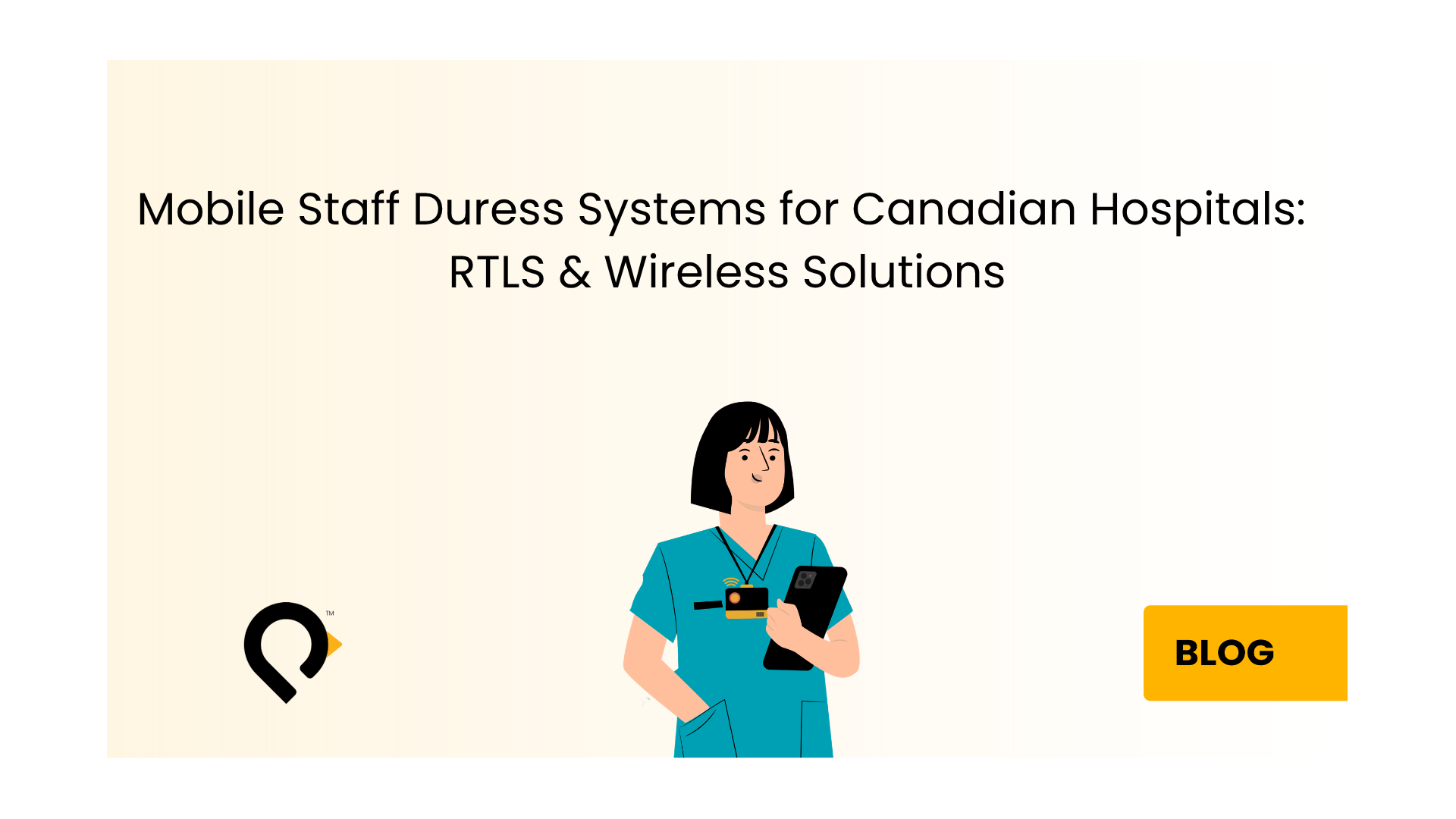
Small BLE badge tags clip to an ID lanyard or are worn as a wristband. The badge connects continuously with gateway readers installed throughout the hospital. When a worker presses the badge button, the system instantly sends an alert. It shows the worker’s name, department, and room-level location to security devices and mobile phones at the same time.
Healthcare groups in Canada and the United States now consider RTLS wearable badge systems the current standard of care for hospital staff safety programs. Specifically, they address every limit of the previous two generations — the worker always has the device, it always knows their location, and the alert is silent and discreet.
Modern workforce safety platforms, such as those offered by Penguin, enable hospitals to deploy scalable, real-time staff duress systems that integrate seamlessly with existing infrastructure.
What Makes Mobile Staff Duress Systems Effective: Badge Features to Evaluate?
When choosing wearable staff duress badges for a Canadian hospital, buying teams should assess six core features.
Essential Features: Button, Battery, and Durability
Button design must allow fast, discreet use under stress. The button must be easy to press without looking. It should be firm enough to prevent accidental activation. However, it must not be so recessed that it cannot be pressed quickly during a physical confrontation.
Battery model is the single most impactful feature for long-term cost. Rechargeable badges remove the most common failure mode — a dead battery that gives no warning and no protection. In contrast, disposable battery systems require ongoing replacement programs. These programs add significant yearly costs to a mid-size hospital badge fleet.
Durability is a basic requirement in clinical settings. Hospital badges face cleaning chemicals, patient contact, and physical stress on every shift. Therefore, IP-rated water resistance is the minimum standard. Ask vendors for the specific IP rating and cleaning protocol before buying.
Additional Features: Comfort, Detection, and Charging
Weight and comfort directly affect whether staff wear their badges. Heavy or bulky badges lead to lower use rates — staff leave them at the nursing station, in lockers, or on their desk. A badge that staff do not wear gives no protection. Consequently, comfort is a safety feature, not a preference.
Tamper and fall detection adds protection for worst-case events. Some systems detect when a badge has been removed from a person — a possible sign of assault — and trigger an automatic alert without needing a button press. This feature matters most in psychiatric units and emergency departments where physical incidents escalate quickly.
Charging station setup is essential for managing a badge fleet safely. Smart charging docks track charge levels across all badges. They allow facilities teams to spot any badge that has not been docked within a set time — before it becomes a non-working safety device on a worker’s lanyard.
The Affordability Shift: How Mobile Staff Duress Systems Became Accessible for Canadian Hospitals?
The most important change in mobile staff duress technology over the past three years is the sharp drop in badge cost. Rechargeable technology and competitive hardware pricing have driven this shift.
Historically, legacy RTLS badges cost $200–$800 per unit. They used disposable batteries that required annual replacement programs. These programs added tens of thousands of dollars per year in running costs for a mid-size hospital badge fleet. Furthermore, legacy vendors added significant hardware margin to their pricing. This inflated capital costs well beyond the actual value of the components.
Modern rechargeable RTLS badges are available at a fraction of legacy badge costs. There is no ongoing battery expense. For a 300-bed hospital deploying 600 badges, the difference between legacy and modern badge pricing can represent $120,000–$400,000 in upfront savings. This comes before counting the removal of battery replacement programs entirely.
Over a seven-year system lifecycle, this cost advantage grows significantly. In many cases, the total cost of owning a modern rechargeable badge system is lower than the cost of maintaining a legacy platform for the same period. Consequently, hospitals that previously thought RTLS-based staff duress was out of their budget are now finding that a modern system costs less over time than staying with legacy technology.
Frequently Asked Questions About Mobile Staff Duress Systems for Canadian Hospitals
Q: Can a nurse activate a staff duress alert without anyone noticing?
A: Yes — and discreet use is a critical design requirement, not a secondary feature. RTLS wearable badge buttons are designed for single-press silent activation. The alert fires through the software platform to security devices. There is no audible alarm, visible light, or physical sign that the worker has called for help. This is essential in volatile situations. Alerting an aggressive patient that help is coming could, in fact, escalate the situation before responders arrive.
Q: What is the difference between a wearable RTLS badge and a fixed panic button for hospital staff duress?
A: A fixed panic button requires the worker to be near a wall station to use it. In most violent incidents, the worker is not near a wall — they are in a patient room, a corridor, or a small space. In contrast, a wearable RTLS badge moves with the worker at all times. Activation requires only a single button press on the device on their lanyard. Additionally, the RTLS system delivers room-level location accuracy to security — not just a zone or floor-level alert — enabling a faster and more targeted response.
Q: How does rechargeable badge technology change the total cost of owning a staff duress system?
A: Rechargeable badges remove the largest ongoing cost in a legacy staff duress setup — battery replacement. A 300-bed hospital with 600 active badges on a disposable battery system typically spends $15,000–$40,000 per year on battery replacement alone. This does not include the staff time needed to manage the program. Rechargeable badge systems with smart dock-charging stations remove this cost entirely. As a result, over a seven-year lifecycle, the savings frequently exceed the total hardware cost difference between a legacy and modern system.
Q: Do staff actually wear their duress badges consistently, and how do hospitals improve compliance?
A: Badge wearing is one of the most overlooked aspects of staff duress program management. Hospital safety programs consistently show that use rates drop when badges are heavy, bulky, or uncomfortable to wear for a full shift. The most effective strategies combine lightweight badge design, visible leadership support for wearing badges, orientation training that makes activation a habit before an incident occurs, and regular drills. Additionally, smart charging docks help by making it easy to identify which staff members have not collected their badge at the start of a shift.
Compliance and Vendor Selection Questions
Q: Are mobile RTLS staff duress systems compliant with Bill 168 in Ontario and equivalent OHS laws across Canada?
A: Yes. Bill 168 in Ontario requires employers — including hospitals — to provide workers with an immediate means of calling for help when violence occurs or is likely to occur. RTLS wearable badge systems meet this requirement directly. They provide immediate, worker-initiated, room-specific alert capability that fixed call stations cannot match in high-risk clinical settings. Additionally, RTLS systems automatically generate timestamped incident logs. These satisfy the reporting requirements of Bill 168 and equivalent OHS laws in BC, Alberta, and Manitoba.
Q: What should a Canadian hospital ask a staff duress vendor before purchasing?
A: Seven questions every buying team should ask before committing. First, what is the room-level accuracy rate and how does the system handle badges near shared walls? Second, are badges rechargeable and what is the charging setup required? Third, how many gateways are needed per square metre and what does installation cost? Fourth, does the system connect with existing nurse call and security dispatch systems? Fifth, what compliance reports does the system produce for Bill 168 and OHS audits? Sixth, what is the five-year total cost of ownership including hardware, software, and maintenance? Seventh, what is the vendor’s track record in Canadian healthcare settings?
Conclusion
Hospital staff duress technology has progressed from fixed wall stations to wireless pagers to RTLS wearable badge systems that deliver room-level location accuracy from anywhere in a facility. Each generation addressed the mobility and accuracy limits of the one before it. The third generation — RTLS wearable badges — now represents the standard that Canadian OHS regulators, accreditors, and healthcare unions expect.
The cost barrier that historically limited RTLS adoption to large academic health centres has been greatly reduced. Moreover, rechargeable badge technology, AI-optimized gateway design, and clear hardware pricing have brought mobile staff duress systems within reach of Canadian community hospitals in the 50–400 bed range.
For Canadian hospital safety officers and buying teams reviewing options in 2026, the generation comparison is largely settled. Instead, the buying decision now turns on badge features, total cost of ownership, system compatibility, and vendor experience in Canadian healthcare settings.