
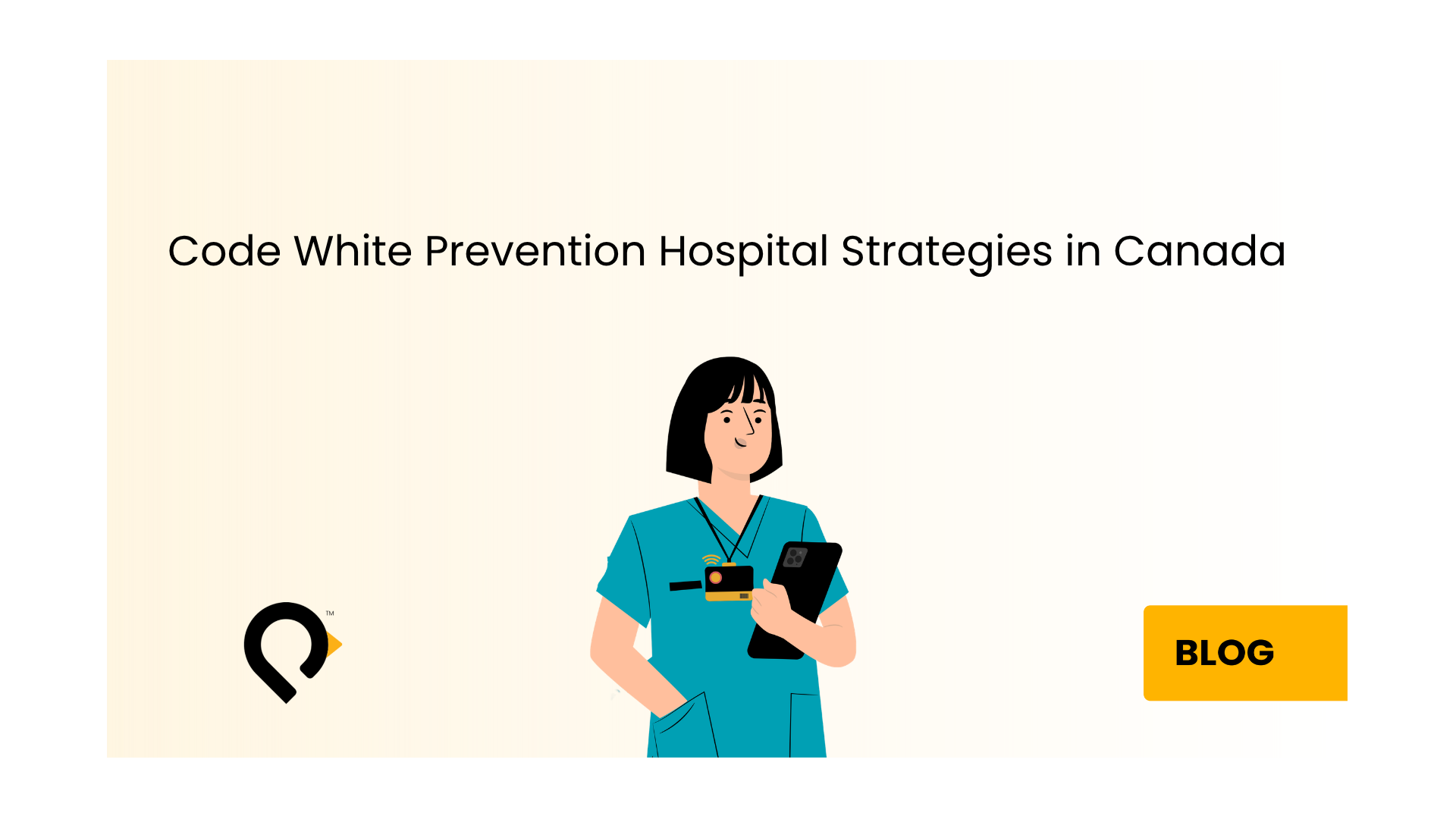
Today, code white prevention hospital strategies in Canada are becoming a critical priority as workplace violence continues to rise.
What Is a Code White Prevention Hospital Strategy in Canada?
Code White Prevention Hospital Challenges in Canada: The Scale of the Problem
- The Canadian Institute for Health Information (CIHI) has identified workplace violence as a major occupational health risk for healthcare workers, and according to OSHA, workplace violence in healthcare settings includes threats, harassment, and physical assaults. As a result, many hospitals are adopting evidence-based strategies to improve healthcare staff safety. This helps reduce incidents and improve response times.
- In addition, emergency departments, psychiatric units, and ICUs report the highest frequency of Code White events
- Furthermore, response time to a Code White without location technology averages 4–8 minutes in most hospitals — a critical window where serious injury can occur
- Moreover, nurses are the most frequent target of patient-initiated violence in Canadian hospitals
This shift highlights the importance of a modern code white prevention hospital approach that focuses on early intervention and staff safety.
How RTLS Supports Code White Prevention Hospital Systems in Canada?
1. Earlier Activation
Because a staff member can silently press a badge button without leaving their patient or making a verbal call, they activate help earlier — before a situation escalates to the level requiring a full Code White broadcast.
2. Precise Location Routing
Instead of broadcasting “Code White, 4 North” and sending a team to the whole floor, RTLS delivers the exact room number and the staff member’s name to responders’ mobile devices within seconds — reducing response time from minutes to under 60 seconds in well-designed deployments.
3. Data for Prevention
RTLS systems log every duress event with time, location, staff member, and department. Over time, this data reveals high-risk rooms, high-risk hours, and patterns that strengthen Code White prevention in Canadian hospitals — allowing hospital safety officers to intervene proactively.
What Makes a Code White Prevention Hospital System Effective in Canada?
- Wearable badges that are always on — not a wall-mounted button that requires a worker to reach it
- Room-level accuracy confirmed by AI-assisted doorway detection, not just signal triangulation
- Low gateway density infrastructure — hospitals should not need a gateway in every room; efficient systems use AI and signal modeling to cover large areas with fewer access points
- Integration with nurse call and security dispatch — so alerts reach the right people simultaneously, not sequentially
- Rechargeable, maintenance-free badges — battery failure is a real risk in legacy systems; rechargeable badge technology eliminates this safety gap
Ultimately, every code white prevention hospital system must combine technology, training, and fast response to reduce risk.
Q&A — Code White Prevention Hospital Systems and Staff Safety Technology
Q: What is the difference between a Code White system and a staff duress system?
A: They are related but distinct. A Code White system is the hospital’s response protocol — teams, communication, and procedures. A staff duress system is the technology that activates and guides that response. Think of staff duress technology as the trigger and tracking layer that makes Code White prevention in Canadian hospitals faster, more precise, and data-driven.
Q: Can RTLS technology actually prevent Code White incidents, or just respond faster?
A: Both. Faster response is the immediate benefit — but the data layer is the prevention layer. RTLS plays a key role in Code White prevention in Canadian hospitals by turning reactive incident management into proactive risk reduction.
Q: How many gateways does a hospital need to cover Code White detection?
A: It depends heavily on the RTLS vendor’s technology. Legacy systems often require one gateway per room — for a 300-bed hospital, that’s 300+ gateways, each requiring power, data cabling, and installation. Newer BLE-based RTLS platforms use AI signal modeling and wider-range antennas to support Code White prevention in Canadian hospitals with far fewer access points.
Q: Is a staff duress system required for Code White compliance in Ontario?
A: Bill 168 in Ontario requires hospitals to have a means of summoning immediate assistance in violent situations. While the legislation does not mandate a specific technology, RTLS-based systems are increasingly associated with Code White prevention in Canadian hospitals as a best practice.
Q: What is the ROI of a Code White prevention system for a Canadian hospital?
A: The financial case includes reduced workers’ compensation claims, reduced sick leave and staff turnover, and faster response times. Hospitals implementing solutions focused on Code White prevention in Canadian hospitals report reductions in both incident frequency and severity within 12–18 months of deployment.