
Patient elopement is one of the most preventable serious adverse events in hospital settings — and one of the most misunderstood. Clinical staff often confuse it with patient wandering. Administrators sometimes treat it as a security problem rather than a care quality issue. And the technology used to address it is frequently chosen based on a single metric — accuracy — without understanding what accuracy actually means in a real hospital environment.
This article explains what patient elopement is at both clinical and operational levels.
It also explores why it continues to happen despite known risks.
Additionally, it shows how hospitals use location technology to close prevention gaps.
It also addresses one of the most common points of confusion when evaluating location-based safety systems: the difference between room-level and zone-level accuracy, and why neither is inherently superior — only differently suited to the situation.
What Patient Elopement Actually Means
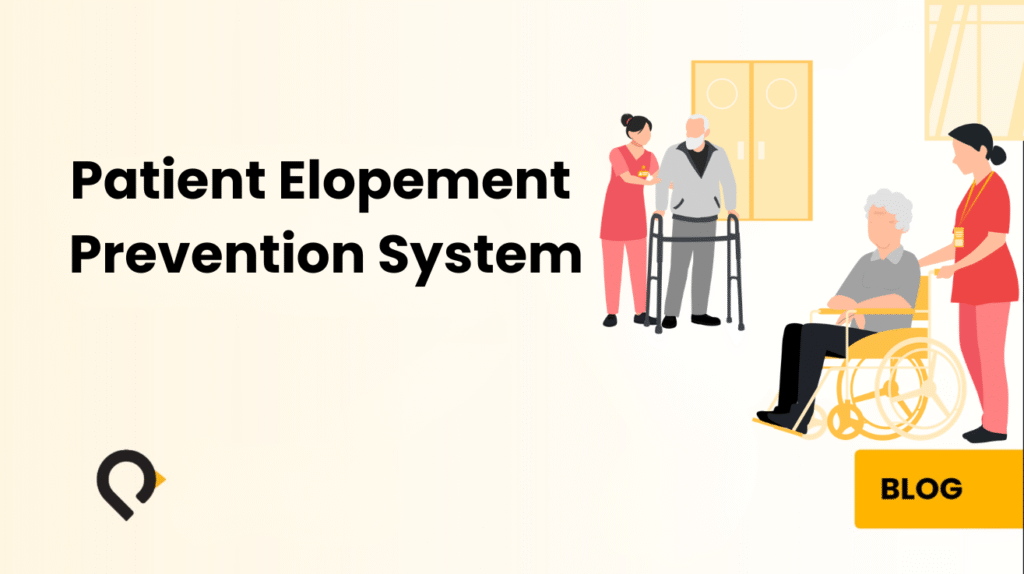
Patient elopement occurs when a patient leaves a healthcare facility or a designated safe area without authorization, in circumstances where that departure places them at direct risk of harm, as highlighted in patient safety case studies on elopement incidents.
The clinical definition turns on two conditions: the patient lacked the decision-making capacity to leave safely, and the departure was unsupervised.
This is not the same as a patient discharging against medical advice. In an against-medical-advice scenario, the patient understands the risks and makes an informed — if inadvisable — decision. In an elopement, the capacity to make that decision is absent. The patient may not understand where they are, where they are going, or what danger they are walking into.
The National Quality Forum classifies death or serious harm resulting from patient elopement as a “never event” — a serious reportable event that should not occur in a well-managed healthcare facility. The Joint Commission treats any unauthorized departure from a 24-hour care setting that results in death or permanent harm as a sentinel event. It requires root cause analysis and documented corrective action.
Despite this classification, elopement remains common. Emergency departments, general medical-surgical units, and behavioral health facilities all report incidents. The patient populations involved are predictable, the time windows are known, and the environmental vulnerabilities are well documented. Yet many hospitals continue to rely on prevention methods that have fundamental limitations built into their design.
Why Patient Elopement Keeps Happening
Understanding why elopement persists requires looking honestly at the methods hospitals use to prevent it — and where each one breaks down.
Visual Supervision Has Limits
Visual supervision is the most direct form of prevention. But it does not scale. A nurse responsible for five or six patients cannot watch a high-risk individual continuously while caring for others. The moment attention shifts — to a medication draw, a call bell, a family conversation — a disoriented patient can begin moving toward an exit.
Locked Exits Cannot Cover Every Door
Locked exits and controlled access restrict movement at specific points. They cannot secure an entire facility. Most hospitals have dozens of entry and exit points. Emergency egress requirements prevent full lockdown. A patient determined to leave can often find an unsecured path.
Scheduled Checks Create Gaps
Scheduled visual checks every 15 or 30 minutes are standard in many units. But they create predictable gaps. A confused patient can travel far in five minutes. By the time the next check reveals an empty bed, the patient may already be outside.
Verbal Redirection Cannot Stop a Patient Elopement
Verbal redirection and environmental cues — signage, camouflaged exits, activity programs — can reduce wandering. They are not reliable when a patient is in acute confusion. A patient experiencing sundowning or a paranoid episode is unlikely to respond to a sign on a door.
The Joint Commission’s analysis of sentinel events involving elopement consistently points to two root causes:
- Inadequate risk assessment at intake.
- Breakdowns in communication between members of the care team.
Both problems share a common thread — they are information problems. The right people did not have the right information at the right moment.This is precisely what location technology addresses.
Who Is Most Vulnerable to Patient Elopement
Patient elopement is not randomly distributed across a hospital population. It clusters in predictable patient groups and predictable time windows.
Dementia and Alzheimer’s Patients
Patients with dementia and Alzheimer’s disease represent the largest share of elopement incidents across most healthcare settings. Often driven by wandering behavior associated with cognitive decline.
For these patients, the hospital environment is genuinely disorienting. They may not recognize it as a place of care. They often have strong, persistent drives to return to familiar locations — their home, a workplace from decades ago, a person they are looking for. These drives do not respond to logical explanation. They respond only to consistent monitoring and timely intervention.
The risk is not constant throughout the day. Sundowning — the pattern of increased confusion and agitation that many dementia patients experience in the late afternoon and evening — creates a distinct elevated risk window.
Shift changes create supervision gaps. The first 48 hours of a new admission represent another peak period, as the environment is at its most unfamiliar.
Behavioral Health and Psychiatric Patients
Behavioral health and psychiatric patients present a different risk profile. These patients may have full cognitive capacity but be in acute crisis, under involuntary holds, or in withdrawal states that produce strong and unpredictable drives to leave the facility. Emergency departments are particularly vulnerable here, especially in facilities without dedicated psychiatric units or consistent one-to-one supervision staffing.
Altered Mental Status Raises Patient Elopement Risk
Patients with altered mental status are frequently underestimated as elopement risks. Causes include post-surgical confusion, medication effects, infectious encephalopathy, and traumatic brain injury. Mental status can shift rapidly within a single shift, and a patient who appears oriented in the morning may be acutely confused by evening. Risk assessment at admission is necessary but not sufficient. Ongoing reassessment throughout the stay is equally important.
Pediatric and Adolescent Patients
Pediatric patients, particularly adolescents in behavioral health settings, also carry meaningful elopement risk that is sometimes underappreciated relative to the geriatric population.
Location Accuracy in Elopement Prevention: Room-Level vs. Zone-Level
One of the most frequent questions hospitals ask when evaluating patient elopement technology is about accuracy. Specifically: Is room-level accuracy better than zone-level accuracy?
The question contains a false premise. Neither is inherently better. They serve different use cases, and understanding the difference helps hospitals make smarter decisions about what they actually need.
Zone-level accuracy
places a patient within a defined area — a wing, a floor, a unit, or a corridor section. It tells staff that a patient is somewhere within that area, but not precisely where. For large open environments, outdoor spaces, or perimeter monitoring, zone-level accuracy is often entirely appropriate. If the goal is to know whether a patient has crossed from a secure unit into an unsecured corridor, zone-level detection is sufficient to trigger the alert. The response is the same regardless of exactly where the patient is within the corridor.
Room-level accuracy
places a patient within a specific room or space — a patient room, a bathroom, a nursing station, an elevator lobby. It tells staff not just that a patient has moved but where they are at this moment.
For elopement prevention specifically, room-level accuracy becomes critical at certain decision points:
- When a patient is approaching a high-risk exit and the responding staff member needs to know exactly which door to go to.
- When a patient has disappeared from a room and the system needs to tell staff whether they are in the adjoining bathroom or already in the hallway heading toward an exit.
The practical implication is that a well-designed elopement prevention system uses both.
Zone-level monitoring covers large areas efficiently and keeps infrastructure costs manageable across a sprawling campus.
Room-level accuracy activates where the stakes are highest — around exits, in high-risk units, and for patients whose risk profile demands tighter monitoring.
Choosing a system based on accuracy specification alone — “this system does sub-meter accuracy” or “this system uses zone detection” — without mapping those capabilities to the specific environments and scenarios in your facility is how hospitals end up with technology that works on paper and fails in practice.
The right question is not “which accuracy is better?” It is “Which accuracy is right for each space and each patient population in my facility?”
What Effective Patient Elopement Monitoring Looks Like in Practice
A location-based elopement monitoring system works by tagging at-risk patients with a lightweight wearable — typically a wristband — and using a network of sensors throughout the facility to track their location continuously.
Hospitals implementing patient elopement prevention systems in hospital environments are using this approach to improve response times and reduce risk. When a patient moves toward a monitored boundary or exit, the system generates an alert and routes it to the appropriate responder before the patient crosses that boundary.
The operational details matter as much as the technology:
Alert Routing and Patient Elopement Response Time
determines whether the right person receives the notification. An alert that goes to a generic nursing station inbox is not the same as an alert pushed directly to the assigned nurse’s mobile device, including the patient’s name, photo, last confirmed location, and current direction of movement. The difference between those two scenarios can be several minutes of response time — and in elopement events, those minutes are the entire margin between intervention and incident.
Escalation logic
determines what happens when the first alert is not acknowledged. A system that alerts once and waits is inadequate. Effective systems escalate automatically — to a charge nurse, to security, to a supervisor — if the initial notification does not generate a timely response.
Per-patient configuration
allows the monitoring perimeter to reflect individual clinical risk. A patient with moderate dementia who is ambulatory and tends to wander at night needs tighter monitoring than a post-surgical patient with mild delirium who is largely bedbound. Systems that apply a single monitoring configuration to all tagged patients generate excessive false alerts, which causes staff to treat the alert system as background noise — exactly the opposite of the intended effect.
Integration with existing infrastructure
determines whether the system creates additional workload or reduces it. Systems that route alerts through the nurse call platform and communication tools the team already uses require no new monitoring stations and no new habits. Systems that require staff to watch a dedicated console introduce alert fatigue and compete for attention.
Automated documentation
captures every location event, zone breach, alert, and acknowledgment with a timestamp. For hospitals subject to Accreditation Canada requirements, Joint Commission standards, or provincial mental health legislation, this documentation is mandatory and typically burdensome when done manually. An RTLS-based system generates it automatically, removing the documentation burden from nursing staff while improving the quality and completeness of the compliance record.
The Clinical Case for Treating Elopement as a System Problem
Elopement events are almost always attributed, at least informally, to individual failures — a nurse who was distracted, a door that was left unlocked, an assessment that was incomplete. This attribution is understandable but operationally counterproductive.
Elopement is a system problem. It happens because the systems hospitals rely on for supervision have structural gaps — gaps that exist not because of individual negligence but because the methods themselves are limited. Manual supervision cannot scale to continuous coverage. Scheduled checks cannot close a 22-minute window. Locked exits cannot secure a 400-bed hospital.
Location technology does not eliminate human judgment from elopement prevention. It gives human judgment the information it needs to operate effectively. A nurse who receives an alert with a patient’s name, photo, and current location — before that patient has left the unit — can intervene. A nurse who discovers an empty bed during a scheduled check and has no information about where the patient went cannot do the same thing.
The shift from reactive to proactive is not a technology question. It is a design question. What information does the clinical team need, and when do they need it, in order to intervene before an elopement becomes an adverse event?
What Hospitals Should Evaluate When Choosing a Patient Elopement Solution
When assessing technology for patient elopement prevention, the evaluation should go beyond specification sheets and focus on operational fit:
Does the alert reach the right person with actionable information? Name, location, and risk level — not just a generic alarm.
Does the system integrate with what your team already uses? Nurse call systems, access control, and mobile communication tools should all connect without requiring a new monitoring workflow.
Can monitoring be configured per patient, not just per unit? High-risk patients need tighter perimeters. Lower-risk patients need lighter touch monitoring that does not generate unnecessary alerts.
Does the system produce audit-ready documentation automatically? Compliance documentation should be a byproduct of the system running, not additional work for clinical staff.
Does the infrastructure support more than one use case? A sensor network deployed for elopement monitoring can support staff duress alerting and asset tracking on the same infrastructure. Facilities that evaluate these use cases together get significantly better return on the infrastructure investment than those that deploy point solutions for each problem separately.
Closing Thought
Patient elopement is not an unsolvable problem. The patient populations at risk are known. The time windows are predictable. The environmental vulnerabilities are well understood. What has been missing in many facilities is the information infrastructure to act on that knowledge in real time — before a patient crosses an exit, not after.
Location technology closes that gap. Not by replacing clinical judgment, but by ensuring that clinical judgment has what it needs: the right information, routed to the right person, at the moment it is still possible to intervene.
Frequently Asked Questions:
The following questions represent the most common queries from healthcare administrators, facility managers, procurement leaders, and technology teams evaluating real-time location systems. Each answer is written to give you a complete, honest, and actionable response.
Q: What is the difference between patient elopement and patient wandering?
Answer:
Patient wandering refers to aimless or restless movement within a safe, supervised area of the facility. It is often harmless and can even be managed with redirection, activity programs, or environmental cues.
Patient elopement, on the other hand, is a serious adverse event. It occurs when a patient leaves the facility or a designated safe area without authorization and without the mental capacity to do so safely. The key distinction is that elopement places the patient at direct risk of harm because they lack decision-making capacity and the departure is unsupervised.
While wandering can sometimes lead to elopement, they are not the same. Elopement is classified as a “never event” by the National Quality Forum and often triggers a sentinel event review by The Joint Commission when it results in serious harm.
Q: Is room-level accuracy always better than zone-level accuracy for elopement prevention?
Answer:
No — neither is inherently superior. Room-level accuracy is critical near high-risk exits, elevators, or in high-acuity units where staff need to know the exact room or doorway. Zone-level accuracy is often more practical and cost-effective for monitoring large areas like wings, floors, or perimeters. The best systems combine both, using zone-level detection for broad coverage and room-level precision where the risk is highest.
Q: Why do elopements still happen even when staff are aware of the risks?
Answer:
Most traditional prevention methods have built-in limitations: nurses cannot provide 24/7 visual supervision while caring for multiple patients, scheduled checks create predictable gaps, and locked exits cannot cover every possible egress point in a large hospital. Elopement is often the result of information gaps — the right staff not having timely, actionable information about a patient’s movement. Real-time location technology addresses this by delivering alerts before the patient reaches an exit.
Q: Which patients are at highest risk for elopement?
Answer:
The highest-risk groups include patients with dementia or Alzheimer’s (especially during sundowning), behavioral health patients in crisis, individuals with altered mental status (from medications, infection, or surgery), and certain pediatric/adolescent patients. Risk peaks during the first 48 hours of admission, during shift changes, and in the late afternoon/evening.
Q: How does a location-based elopement prevention system actually work in daily practice?
Answer:
At-risk patients wear a lightweight tag (usually a wristband). Sensors throughout the facility track their location in real time. When a patient approaches a monitored boundary or exit, the system immediately sends an alert to the assigned nurse’s mobile device with the patient’s name, photo, last location, and direction of movement — giving staff time to intervene before the patient leaves the safe area.
Penguin Location Services delivers real-time patient elopement monitoring through PenSafe, part of an integrated RTLS platform covering staff safety, patient monitoring, and asset tracking on a single sensor infrastructure. Learn more at penguinin.com/wander-prevention or request a demo.
Reach out today
Contact Penguin Location Services to enhance patient safety with a real-time patient elopement monitoring solution designed for modern healthcare environments.